
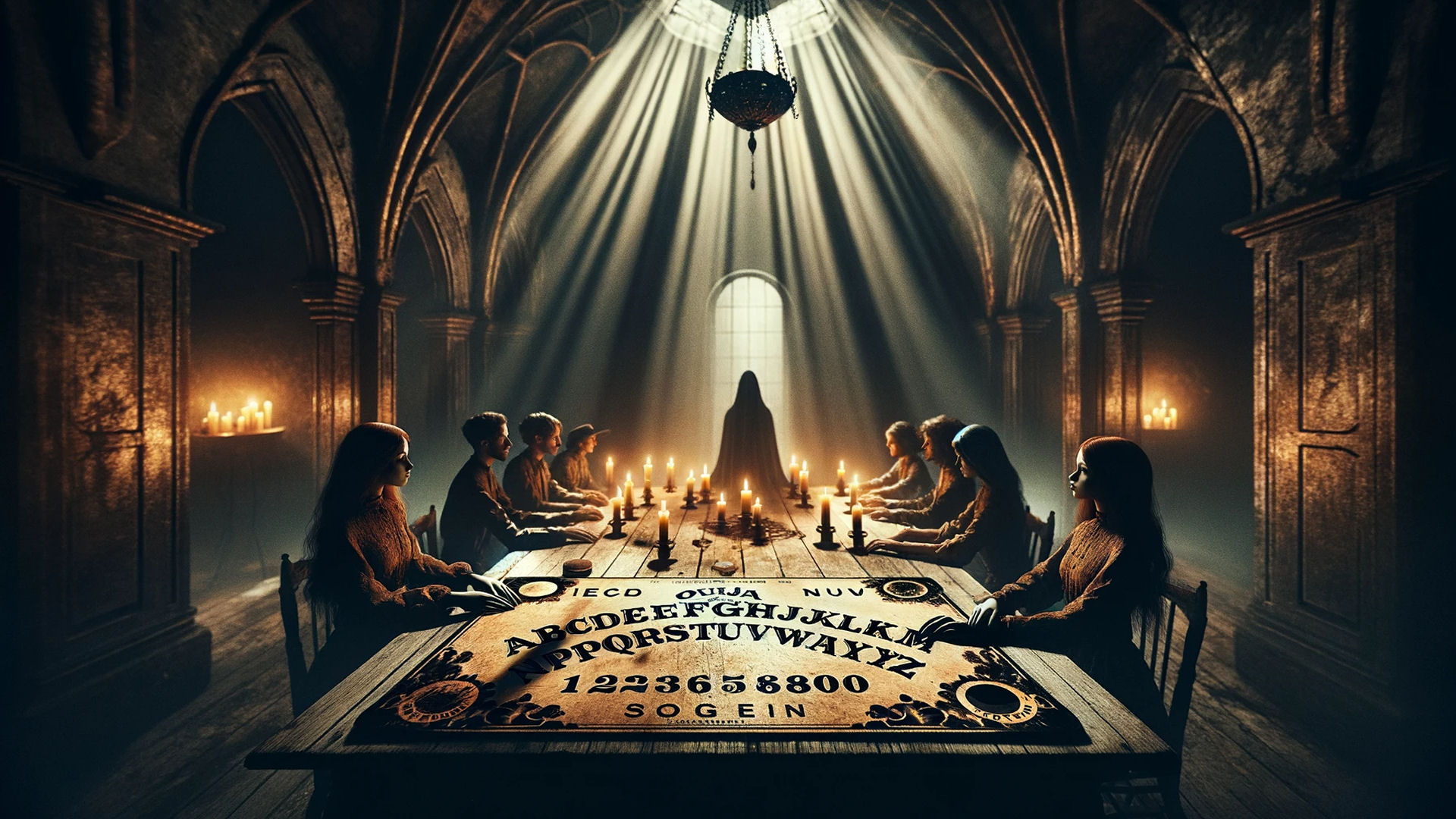
Art delves into a variety of topics, setting the stage for a night filled with mystery and exploration. He opens the show by mentioning an upcoming interview with Vance Davis, a former military personnel who, along with five others, embarked on an unusual odyssey influenced by a Ouija board, leading to their AWOL status and subsequently, an honorable discharge. This story, which seems more like a myth, has piqued the curiosity of many, including Art himself. Vance, now in New Mexico, is poised to share the real story behind their adventure, offering insights into the events that unfolded and the information they received through the Ouija board. The episode also touches upon the group’s interest in parapsychology and their investigations into various phenomena, including tarot cards and hypnosis, in an attempt to discern the genuine from the fraudulent. Art and Vance’s discussion is set against the backdrop of their military life in Augsburg, Germany, where they were stationed at one of the largest listening posts in the free world at the time. Their journey from skepticism to encountering undeniable experiences forms the crux of this captivating segment.
Art delves into a peculiar story involving six military personnel who embarked on an unusual journey influenced by a Ouija board and subsequently received honorable discharges under mysterious circumstances. Art introduces Vance Davis, a member of the group, who shares insights into their experiences. The group, stationed in Augsburg, Germany, engaged in parapsychology research out of personal interest, eventually turning to a Ouija board in an attempt to conclude their investigations. Despite skepticism and warnings about dabbling in the unknown, they proceeded without alcohol or drugs, experiencing a significant energetic presence during their session. The entity they communicated with, identifying herself as Sapphire from Georgia, offered cryptic responses to their inquiries, suggesting they were chosen for communication because they wouldn’t listen otherwise.
Vance Davis and his group, after their initial session with the Ouija board, decided to delve deeper into the paranormal. Despite their military backgrounds and analytical skills, they approached their next meeting with both skepticism and an open mind, hoping to validate the phenomena they encountered. Their subsequent sessions, spanning eight hours, introduced them to new entities and predictions about future events in Europe and beyond. One remarkable instance was a prediction about a major earthquake in Tehran, which tragically came true within the specified timeframe, killing over 300,000 people.
The group meticulously recorded these sessions, accumulating over 1500 pages of notes and various recordings, which later attracted the attention of the FBI. Despite their rigorous documentation, they remained cautious, distinguishing between prophecies and predictions with the hope that the latter could prevent adverse events if heeded in time. Their experiences, including accurate predictions of significant events such as the 1993 New York City bombing and the Los Angeles earthquake, left them both astonished and unsettled, highlighting the profound impact these encounters had on their perspectives and beliefs.
Art Bell shifts focus slightly to discuss a wide array of predictions and prophecies, emphasizing a specific date, June 9th, associated with significant global change. This date, cited by various sources from religious programs to New Age circles, hints at an event poised to alter the world’s perception, ranging from the lifting of a “veil of evil” to potential extraordinary occurrences. Vance Davis, re-engaging in the conversation, shares his knowledge on the topic, including speculations on the rapture and a major UFO sighting potentially caught on national television, each carrying implications that could indeed change the world as we know it.
Further, the distinction between predictions and prophecies is elaborated upon, with predictions seen as alterable insights into possible futures, whereas prophecies are deemed immutable divine revelations. This segment of the discussion underscores the belief that while some events, particularly those of a political or social nature, may be influenced or altered by human action, others, like significant earth changes, lie beyond human control. The dialogue then transitions back to the predictions received through the Ouija board, with Davis hinting at major tectonic events predicted for California in 1996, suggesting significant geological upheavals that resonate with broader predictions of transformative global changes around the year 2000.
Art and Vance delve into discussions about imminent geological and extraterrestrial events predicted through their Ouija board sessions. They discuss the heightened activity of earth changes, citing recent major earthquakes as precursors to more significant events, including a substantial earthquake in California predicted for 1996 and another seismic event in Seattle that could potentially trigger Mount Rainier’s activity. Additionally, they touch upon the intriguing prediction of humanity being introduced to an alien race by 1996, a prospect that piques both Art’s and Vance’s interest, speculating about the monumental impact such an event would have on a global scale.
The conversation also shifts to personal experiences and validations of the Ouija board sessions, with Vance detailing the extraordinary accuracy and phenomena they encountered, including instances where the planchette moved with precision even when participants doubted or tested the process. This part of their story brings a mix of skepticism and belief within the group, leading to a broader discussion on the implications of their findings and the distinction between physical manifestations and spiritual or extraterrestrial communication.
The narrative takes a more personal turn as Vance recounts the group’s eventual arrest and the motivations driving them from Germany to the United States, specifically to Gulf Breeze, Florida. Their journey was fueled by a belief in the need to act upon the dire predictions received, including political changes and threats to personal freedoms within the U.S. This conviction led them to take drastic measures, believing they were acting in defense of constitutional rights against perceived domestic threats, highlighting a complex interplay of duty, belief, and the desire to alert the public to potential future crises.
Vance Davis recounts the group’s journey from Germany to the United States, initially planning to lay low in Colorado to await predicted events. Their conviction in the prophecies, particularly concerning the erosion of constitutional rights and the imposition of stringent gun laws, propelled them into action. This belief led them to Gulf Breeze, Florida, to consult with a psychic who had previously worked with the FBI, seeking further insights into their findings.
The group’s disappearance from their military post in Germany was swift, using forged leave papers to evade detection. However, within days, their absence was noted, and military authorities, along with the FBI, launched an investigation into their whereabouts. Upon their capture in Gulf Breeze, the treatment they received was a mix of caution and severity, with Davis and his companions labeled as “armed and dangerous.” Despite the aggressive arrest, their treatment post-capture was unusually lenient, including orders for guards not to engage with them and their eventual release following intervention from high-level governmental authorities.
Driven by a mix of prophecy, patriotism, and a sense of duty, their actions led to significant legal and military repercussions. Their story raises questions about the influence of supernatural beliefs on rational decision-making, the boundaries of military obedience, and the challenges of navigating perceived threats to personal freedoms and national security.
Art Bell continues his engaging discussion with Vance Davis, delving deeper into the unusual circumstances surrounding the group’s arrest and subsequent release. Vance reveals that their release was reportedly ordered by President Bush and Bob Dole, a detail that adds an even more intriguing layer to their story. Despite the high-profile involvement, the rationale behind their release remains a mystery, leaving Vance and his group puzzled over the decision not to prosecute them further, especially given the international attention their case received.
Following their release, Vance shares that they were discharged under honorable conditions without specific charges, aside from a failure to report for duty, described as “unsatisfactory performance.” Post-discharge, Vance married one of the women he had visited in Florida, and they started a family. He reflects on the impact of their story, noting that it has remained significant over the years, awakening public interest and speculation about the predictions and their implications for American society and global events.
Art then transitions the conversation to allow listeners to engage directly with Vance, offering them the opportunity to ask questions about his experiences, the predictions, and their aftermath. This opening promises to broaden the discussion, inviting wider public interaction and further exploration of the themes surrounding government secrecy, paranormal phenomena, and the potential for future global changes as predicted by the group’s Ouija board sessions.
Vance Davis emphasizes his Christian faith and his desire to educate people about the military and intelligence operations, underlining the power individuals have to enact change. Vance also addresses a caller’s question about his involvement with the occult, stating that he has not touched a Ouija board since the events discussed and maintains his Christian faith.
The conversation touches on Vance’s brief imprisonment and the mental state during that period, revealing the group’s readiness to face severe consequences for their actions, despite the seemingly bizarre nature of their story involving ouija boards and predictions. This readiness was juxtaposed with the actual outcome – their release ordered by high-level political figures without clear explanation, hinting at the possibility that their predictions were taken seriously at some level within the government.
Furthermore, Vance discusses the peculiar interest in their case, highlighted by the fact that some of their predictions remained classified, suggesting that their information might have been credible or valuable to some extent. The discussion shifts towards UFO sightings and connections to Gulf Breeze, Florida, known for its UFO activity, but Vance clarifies that their visit there was unrelated to UFOs, although he shares a personal sighting experience in Las Vegas, illustrating the prevalence of unexplainable phenomena in certain areas, particularly near military bases like Area 51.
Vance Davis addresses a caller’s concern about the potential dangers of sharing sensitive information publicly. Vance reassures listeners that he has not been approached or threatened since his discharge from the military and believes that by educating the public without causing panic, he’s actually safer. He emphasizes that his goal is not to reveal classified military operations but to inform the public about the realities of intelligence work and the potential for societal influence and change. The conversation also touches upon an earthquake in Bolivia, drawing connections to the discussed predictions and the mysterious June 9th date that has been circulating among various sources.
Vance explains that after their release, they were instructed to report any further predictions to the authorities, highlighting the peculiar interest the military had in their activities. He also mentions efforts to obtain and review 700 pages of released documents related to their case, noting the absence of a final report typically present at the conclusion of such investigations. This omission adds to the mystique of their story, leaving Vance and his team, as well as the public, searching for answers.
The discussion shifts to broader topics, including the earth’s magnetic pole reversal, which occurs approximately every 10,000 years and is overdue according to some experts. A caller compares Vance’s experiences to the book “Messages from Michael,” suggesting similarities in channeling entities through a Ouija board. Vance acknowledges the comparison but stresses the importance of their intention and protection prayers in ensuring they communicated with benevolent entities.
Vance Davis explores the possibility that the government might have been aware of the predictions he and his group made through the Ouija board, suggesting that their eventual release could have been because their revelations merely confirmed what the government already suspected or knew from other sources. This speculation extends to the idea that perhaps sensitive information revealed through their sessions, particularly about the Gulf War and its outcomes, might have contributed to their being let off easily, under the directive of high-level officials like President Bush or Bob Dole.
Further discussion delves into other mysterious occurrences and predictions, including a recent earthquake in Bolivia and reports of angelic beings appearing to people in California, warning of an impending great earthquake. Such events feed into the narrative of ongoing supernatural or preternatural activities that seem to align with the predictions made by Davis and his group.
Vance Davis takes a deeper dive into the unshared predictions and their implications. Vance discusses the delicate balance of sharing information, emphasizing that certain predictions, due to their speculative nature or potential to incite fear, were intentionally withheld from the public discourse. Notably, Vance hints at prophecies concerning the Papacy and the emergence of an antichrist figure already in power within Europe, underlining the esoteric and potentially divisive nature of some revelations received through their sessions.
A caller’s question redirects the focus towards practical concerns, such as financial instability and geopolitical tensions, particularly relating to North Korea’s aggressive posture and its perception by other nations. Vance shares insights suggesting that North Korea views Western diplomatic efforts through a contemptuous lens, potentially exacerbating international tensions.
Additionally, Vance touches on the spiritual and protective role attributed to Native Americans in safeguarding the United States from impending chaos, a notion that aligns with broader themes of spiritual guardianship and indigenous wisdom. This conversation strand also delves into economic predictions, including a possible stock market crash that was averted through intervention, reflecting on the interconnectedness of economic policies, investor behavior, and systemic safeguards like circuit breakers designed to prevent such collapses.
Throughout the discussion, Vance maintains a focus on the spiritual lessons and personal growth stemming from his experiences, reaffirming his Christian faith and its guiding influence on his actions and interpretations of the events around him. The dialogue encapsulates a complex web of spiritual, prophetic, and worldly concerns, framing Vance’s journey as one of introspection, faith, and a continuous quest for understanding amidst uncertainty.
Vance Davis shares insights on the continued relevance of their predictions and the impact of their experiences, both personally and on public awareness. He emphasizes the importance of thinking independently and being aware of the changes happening around, particularly regarding the gradual erosion of rights and the potential for martial law in major cities. Vance expresses concern about these developments without intending to incite panic, highlighting the need for awareness and thoughtful consideration of current trends and events.
A caller questions the possibility of chaos in the United States, to which Vance responds by affirming that while the country may be less affected by global turmoil, it won’t entirely escape it. He hints at predictions from 1994 and 1995 about major cities potentially being placed under martial law, citing recent calls for martial law in Chicago and Washington, D.C., as indicative of these predictions coming to fruition.
Vance also discusses financial predictions, including a potential stock market crash in 1994 unless intervention occurred, which he suggests might have been averted by raising interest rates to protect elderly investors. Despite the safeguards like circuit breakers designed to prevent a market crash, Vance and Art Bell agree that if a crash were to happen, these measures might not ultimately stop it.
One of the more startling revelations includes a prediction that the Antichrist is already in power in Europe, unknown even to himself, and the assertion that 1996 could see the last president elected in the United States.
Vance Davis stresses the importance of thinking for oneself rather than being told what to think, highlighting the personal growth and positive outcomes he’s experienced since the events, including meeting his wife and starting a family. Vance remains adamant about not engaging with the Ouija board again, emphasizing the dangers associated with its use and his decision to focus on helping people through education and sharing knowledge.
The conversation touches on the accuracy of their predictions, with Vance noting that while it’s challenging to pin down exact dates, many of their forecasts are still unfolding. He mentions significant events like the Los Angeles earthquake and the potential eruption of Mount Rainier, underscoring the difficulty of making precise long-term predictions.
Listeners call in with questions about potential financial collapses, wars, and the specific implications of certain predictions, such as martial law being declared in major cities. Vance shares his views on these topics, suggesting that while some predictions are still relevant, the focus should be on actionable intelligence and preparedness rather than fear.
A significant point of discussion revolves around the prediction that 1996 might see the last president elected in the United States, a statement Vance hesitates to fully endorse due to the lack of concrete evidence. This prediction, along with others about the Antichrist’s presence in Europe and the special role of Native Americans in protecting the land, adds a mystique to the conversation, blending elements of prophecy, political speculation, and spiritual belief.
Art Bell expresses unease after learning about a deep earthquake in Bolivia and its potential connection to the discussed predictions, highlighting the impact of such discussions on listeners and even the host himself.
The conversation on “Coast to Coast AM” shifts to a caller’s personal experience with necrotizing fasciitis, a severe infection that can destroy skin, fat, and muscle tissue. The caller, who survived the condition, shares his harrowing story of undergoing multiple surgeries, including skin grafts, after an infected hair follicle led to a life-threatening situation. This segment highlights the rarity of the disease at the time and the skepticism surrounding official assurances of its infrequency, reflecting broader concerns about public health transparency.
Art Bell expresses doubt about the reliability of public health officials’ statements, suggesting that there might be a tendency to downplay serious health threats to avoid public panic. This skepticism taps into a common theme of distrust in official narratives, especially in the context of emerging or re-emerging infectious diseases. The conversation briefly touches on “The Stand,” a novel by Stephen King that depicts a pandemic, drawing parallels between fiction and potential real-world scenarios.
The discussion then veers into political commentary, with a caller congratulating President Clinton on receiving a doctorate in civil law from Oxford and making a tongue-in-cheek reference to his religious expressions during a commemoration at Normandy. This caller, identifying as “Dr. Democrat,” begins to critique the Republican position on healthcare, suggesting it will lead to increased government intervention, though the conversation cuts off before delving deeper into this topic.
The discussion transitions into a debate about health care reform, with a caller expressing support for individual mandates over employer mandates, arguing that many people cannot afford health care premiums and that government subsidies for the working poor are necessary. This leads to a broader conversation about the implications of various health care plans on the deficit and the private sector. The caller, identifying as “Dr. Democrat,” critiques the Republican stance on health care as potentially leading to bigger government, despite their small government rhetoric.
Art Bell humorously suggests checking the caller’s food for possible poisoning due to his “perverted, strange views,” continuing the show’s trend of blending serious discussion with light-hearted banter. The conversation then shifts to a listener’s experience with the NRA, expressing dissatisfaction with the organization’s communication style and feeling treated like a child rather than an adult. This segment touches on the listener’s disappointment with a letter from the NRA, which seemed to assume a personal connection with an individual the caller had never met, highlighting a sense of disconnect and disillusionment with the organization’s approach to its members.
The conversation shifts to a more serious note with a caller suggesting a prediction of a civil war by 1997, hypothesizing a scenario where Colin Powell, if elected president in 1996, could be targeted, leading to significant national turmoil.
Art Bell reflects on the myriad of unusual and concerning topics discussed on the show, from flesh-eating bacteria and deep earthquakes in Bolivia to mysterious predictions about the future, encapsulating the sense of unease and fascination that such discussions provoke. He humorously notes the strange times we live in, underscored by a wide range of dire predictions and global events.
The show takes another turn when a caller running a literacy ministry from her home in Phoenix shares her confusion over the significance of June 9th, a date that has been mentioned by several callers with various interpretations and predictions associated with it. She emphasizes a biblical perspective, suggesting that while signs and times may be noted, the exact day of significant events, such as the rapture, cannot be known. This leads to a broader discussion on biblical prophecy and its interpretation in contemporary times, with the caller cautioning against taking speculative predictions at face value without considering their source.
One caller runs a literacy ministry and discusses biblical prophecies, suggesting that while significant events are foretold, the exact timing remains unknown, emphasizing that “no man shall know the time.”
Art Bell shares his own sense of unease, a “vague gnawing feeling” that something significant is looming, though he cannot specify what it might be. This feeling is echoed by callers who discuss a range of predictions about the end of the world, the appearance of the Messiah, and the presence of the Antichrist. These conversations reflect a broader societal fascination with apocalyptic predictions and the search for signs in current events.
The discussion briefly shifts to a concern about U.S. foreign policy, particularly in relation to North Korea, reflecting anxieties about potential military conflicts and the consequences of political decisions. A caller from New Orleans expresses worry about the potential for war and the inherent nature of the military to “kill people and break things,” highlighting fears of escalation and the desire to avoid conflict.
Art Bell clarifies that while there are indeed solar cycles that affect radio signal propagation, particularly the ionosphere’s impact on medium and shortwave bands, there hasn’t been scientific evidence linking these to inner Earth magnetic shifts. The conversation touches on the current low point in the 11-year solar cycle, explaining the unusual radio propagation conditions experienced by listeners and broadcasters alike.
Subsequently, a caller from Reno, Nevada, brings up California Assembly Bill 1030, introduced by Assembly Member Ferguson, aimed at protecting religious gatherings from disturbances, making such disruptions a misdemeanor. This law seeks to provide the same level of protection to religious assemblies as existing laws offer to abortion clinics against blockades and protests. The discussion reflects on the importance of safeguarding the rights of individuals to participate in religious worship without interference, drawing parallels to the protection of legal rights in other contexts.
The program then shifts to a lighter note with a caller humorously predicting fantastical events for the 21st of the month, prompting Art Bell to caution against prolonged silly talk for fear of unwanted personal transformations.
A caller from Littleton, Colorado, initiates a query about Richard Hoagland’s assertions regarding large crystalline structures on the moon, leading to a broader inquiry about the availability of video or photographic evidence to substantiate Hoagland’s claims.
Subsequent callers delve into speculative topics, including the potential for a magnetic pole reversal and its impact on radio signal propagation. The dialogue emphasizes the challenge in distinguishing between scientific fact and speculative theory, highlighting the complex relationship between verified scientific phenomena and the more esoteric theories often discussed on the program.
A particularly contentious moment arises when a caller alleges family ties to the CIA and claims direct knowledge of governmental collusion with terrorists related to Pan Am Flight 103. Bell approaches the claim with caution, advocating for private communication to verify the caller’s story without compromising security or privacy.
Another segment of the show delves into the complex issue of near-death experiences, with a caller expressing skepticism about claims of dying and returning to life. This prompts a discussion about the scientific potential for reviving the dead in the future, touching upon the intersection of science, religion, and the human desire for immortality.
The conversation shifts to international politics, focusing on North Korea’s nuclear ambitions and the U.S. administration’s response. A caller praises the administration’s handling of the situation, while Art Bell questions the ethics and practicality of preemptive military action against a sovereign nation for internal developments like nuclear weapon production. This segment reflects on the moral dilemmas and geopolitical strategies involved in preventing nuclear proliferation versus respecting national sovereignty.