
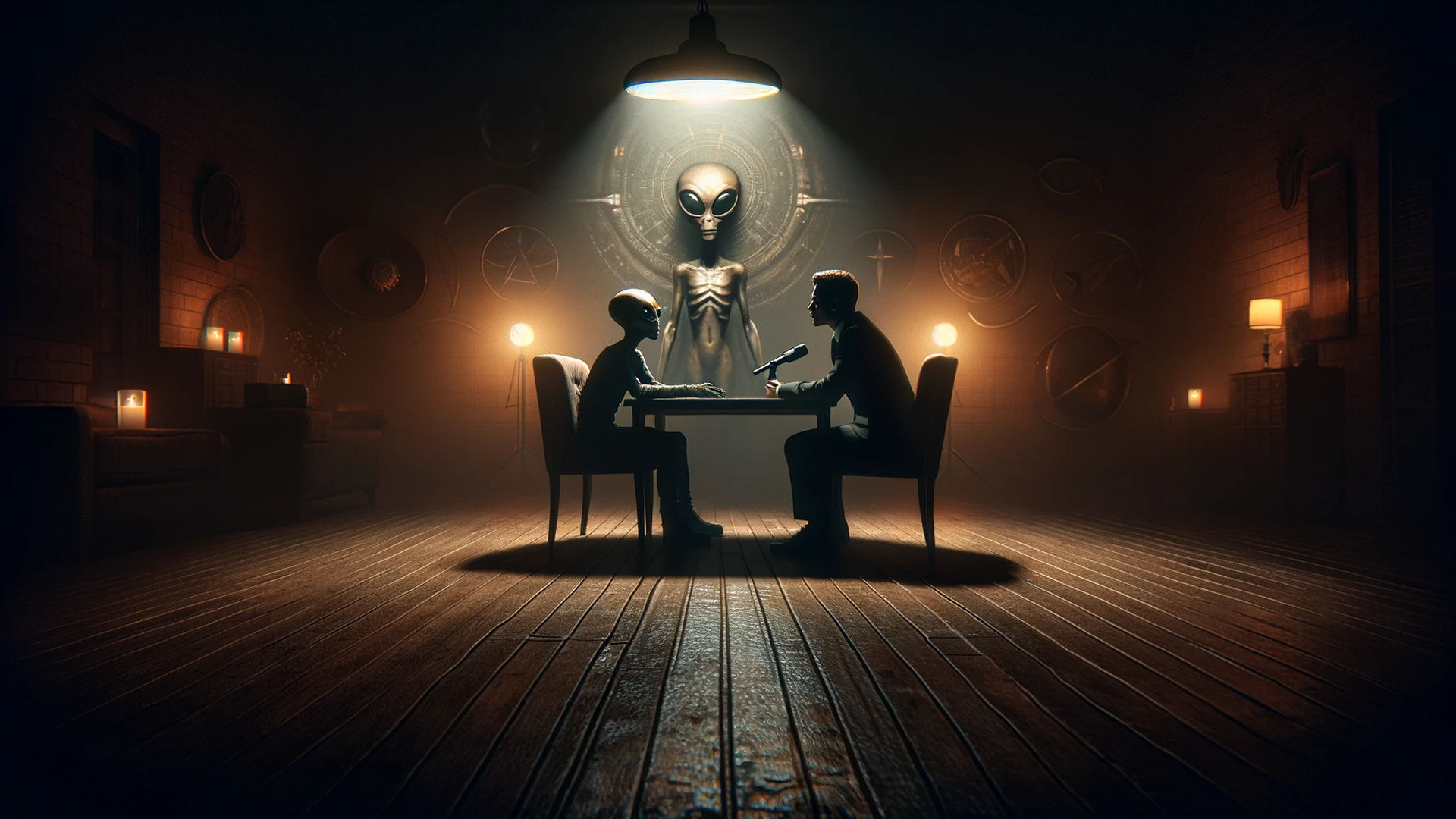
Art welcomes the audience to “Dreamland,” a program that explores the uncharted territories of human experience, focusing on phenomena that challenge conventional understanding. The episode features Katharina Wilson, an abductee who authored “The Alien Jigsaw,” promising an intriguing discussion about her experiences. Linda Howe joins from Philadelphia, sharing insights into mysterious crafts and beams of light observed near the Oregon and Nevada borders, hinting at a deeper investigation into potential government interactions with UFOs. A standout testimony comes from John T. Vasquez, a veteran who recounts a perplexing event from 1977 involving 1200 soldiers witnessing an unidentified flying object that induced a state of paralysis and unconsciousness among the troops.
Following the dramatic recount by John T. Vasquez about the unsettling event at Fort Benning in 1977, the narrative continues with further details of the encounter. Vasquez describes a moment of intense brightness, likened to staring directly into car headlights, that envelops the surroundings, affecting him and the soldiers nearby. This mysterious light induces physical discomfort and telepathic communication, suggesting a powerful encounter that leaves participants disoriented and in pain. Despite the shared experience, the soldiers find themselves unharmed but deeply confused about the ordeal, with differing accounts of the time lost during the incident.
In the aftermath, Vasquez seeks treatment for severe muscle spasms and experiences nightmares, leading him to file numerous FOIA requests in an attempt to uncover official records of the event. However, his efforts are met with denials of the existence of Delta Company and his presence at Fort Benning during the time of the incident, adding to his frustration and the mystery surrounding the event. Linda Howe, the reporter, hints at similar unreported incidents within the military and a large corporation, suggesting a broader pattern of encounters with unidentified phenomena that leave witnesses with altered memories or delayed recollections, often surfacing through nightmares or flashbacks.
Linda Howe concludes her report with a call for anyone with information on the mysterious Delta Company incident to come forward, emphasizing the importance of confidentiality and anonymity for contributors. Art Bell then transitions to welcoming Katharina Wilson, an abductee who has written about her experiences in “Alien Jigsaw.” The book chronicles the first 32 years of Wilson’s life, detailing her encounters with aliens and her search for understanding and coping with the reality of being an abductee. Despite undergoing psychological and physiological examinations that found no abnormalities, Wilson’s memories of her abduction experiences remain vivid.
Wilson’s journey into the world of UFO phenomena began in 1987 after reading “Intruders: The Incredible Visitations at Copley Woods” by Budd Hopkins. This led her to fill out a questionnaire in Omni Magazine, which in turn prompted Hopkins to contact her for an interview and subsequent investigation. Over the years, Wilson has worked with various investigators and undergone regressive hypnosis sessions to explore her abduction experiences further.
Katharina Wilson shares her early experiences with Art Bell, recounting how her journey into understanding her abductions began in childhood with instances of missing time and unusual memories. She speaks of her struggle to cope with these memories, which she initially attributed to divine intervention. As she grew older, these experiences led to significant anxiety, prompting drastic measures in her home life to ensure safety. Her anxiety reached a peak when she began actively searching for aliens behind her house, driven by a blend of fear and curiosity despite not knowing what she was looking for.
Wilson’s turning point came in 1987 when she stumbled upon “Intruders: The Incredible Visitations at Copley Woods” by Budd Hopkins in a bookstore. Reading the book was a moment of revelation for her; it felt like reading about her own life, confirming her suspicions and experiences with alien encounters. This led her to fill out a questionnaire in Omni Magazine, catching the attention of Budd Hopkins, which marked the beginning of a deeper investigation into her experiences. She recalls a UFO sighting at 16, which was dismissed and ridiculed by her peers, causing her to suppress her experiences for a decade.
Katharina Wilson’s exploration into her abduction experiences deepens as she details the process of awakening to her past and the role Budd Hopkins played in this journey. After sending Hopkins an extensive account of her experiences, based on a detailed questionnaire, Wilson prepared herself for any outcome, including disbelief or dismissal. However, Hopkins’s interest and subsequent interviews and regressive hypnosis sessions opened new avenues for understanding her encounters.
During these sessions, though no alien information was directly retrieved, Wilson describes breaking through mental barriers, possibly imposed by her own mind or the alien beings, allowing her to access previously obscured childhood memories. This breakthrough led to a flood of spontaneous memories, likened to opening a cluttered closet, revealing encounters of flying, telepathic communication, and physical marks left on her body by non-human entities.
Wilson recounts specific memories of being floated, naked and communicating telepathically with an important but forgotten message. She describes interactions with hybrid beings, indicating a deeper involvement with these entities beyond mere observation. One vivid memory includes a humanoid in a white lab coat, telling her she would find a hole in her arm where he had performed a procedure, a prediction that materialized the following day. This mark, described as a crater-like scar, was a tangible reminder of her experiences, though met with disbelief and avoidance by her mother.
Katharina Wilson’s recounting of her abduction experiences becomes even more detailed as she describes vivid memories that have come to the forefront of her consciousness. She explains that the clarity of these memories is as real to her as her waking reality, distinguishing between the vivid, detailed recollections she shares in her book and the vague memories and dreams she chose not to publish.
A significant part of her narrative involves a hybrid being she refers to as “the doctor,” who she has seen multiple times and who told her he had been visiting her since 1965. Wilson describes the craft these encounters typically take place on as very large, sometimes referring to them as “motherships” or likening them to a three-story mall. The interior of these crafts contains hospital or clinic-type areas with wide hallways and clinical rooms, often bare except for a bed or a glass box.
One particularly vivid experience Wilson shares involves being presented with a black infant in a glass box, which the doctor claimed was her child. This moment was deeply confusing for her, especially given the racial discrepancy, leading her to explore the ship further. During her exploration, she encounters a human woman with a child in another glass box, this time a child with blond white hair and gold eyes, who appeared to be very sick. Wilson’s ability to walk around the ship and interact with its inhabitants is noted as unusual by her and researchers, indicating a degree of autonomy not commonly reported by other abductees.
Wilson touches on the hybridization program she believes to be at the core of her abduction experiences, suggesting that the aliens are mixing different races to create beings with varying degrees of human and alien characteristics. While she feels she knows the reason behind these activities, she also believes that the aliens withhold certain information, leaving her with unanswered questions about the true purpose behind the creation of these hybrid children.
Katharina Wilson elaborates on the complexity of her experiences with alien beings, indicating a mixture of benevolent and malevolent interactions. She perceives a range of motives behind their actions, from psychological and physiological testing to causing or curing severe medical issues in abductees. Despite this ambiguity, Wilson advises against fear, suggesting that understanding these beings’ intentions is crucial, regardless of whether they are perceived as good or bad.
Wilson recounts moments when she felt like an experimental subject to the aliens, contrasted with times she felt loved and cared for, akin to how humans care for their children. This duality leads her to speculate that there are various types of beings with different agendas, some of which may be more concerned with human welfare than others. She acknowledges the difficulty in categorizing these interactions as purely positive or negative, noting that phenomena like animal mutilations, often viewed negatively, might have justifications unknown to humans.
Regarding communication with the aliens, Wilson states that she hasn’t been given explicit messages to convey to humanity. Her understanding of the aliens’ purposes comes from personal experiences rather than direct information, suggesting that much remains hidden from her conscious awareness. She is open to further regression to uncover more memories but is cautious, given the extensive and vivid recollections she already consciously processes.
Katharina Wilson explores the correlation between her abduction experiences and her menstrual cycle, suggesting a pattern that aligns with the ovulation period. This observation, derived from her meticulous documentation related to her severe menstrual pain and migraines, offers a potential link between alien abductions and human reproductive cycles. While she hasn’t conducted statistical analysis on this data, Wilson’s findings raise intriguing questions about the genetic motives behind alien abductions.
Wilson has discussed these patterns with other women who have had similar experiences, noting that abductions during ovulation are not isolated to her case alone. This shared experience among abductees supports the hypothesis that there may be a genetic experimentation aspect to the abductions, particularly focused on human reproduction.
In her efforts to encourage further research, Wilson has shared her personal experiences publicly, hoping to inspire other women to document their experiences in relation to their menstrual cycles. She believes that compiling this correlational data is a crucial first step toward gaining the medical community’s attention and validating the abduction phenomenon’s reproductive aspects.
Wilson has encountered a variety of beings during her abductions, including different types of hybrids and entities she classifies as “grays,” ranging from short to tall, with varying physical characteristics. Among the most unusual beings she describes is one resembling a praying mantis, suggesting a diversity in the alien presence that complicates the understanding of their motives and activities on Earth.
Katharina Wilson shares the outcomes of her psychological evaluations, highlighting that despite her extraordinary experiences, she was found to be psychologically normal with no signs of paranoia or schizophrenia. The evaluations, one by a psychologist skeptical of UFOs and another by one more open to the possibility, both concluded that Wilson was a normally functioning individual dealing with self-esteem issues and severe PMS, rather than any psychological disorder. These findings were important to Wilson, providing a form of validation that her experiences were not the result of mental illness.
Wilson has also undergone physical exams, including a CAT scan, to investigate any abnormalities that might be linked to her abduction experiences, especially after sensations of having something removed or inserted into her sinus area. These exams have so far returned normal results, reinforcing Wilson’s belief in the reality of her experiences while also maintaining an openness to future scientific explanations that might emerge with advances in medicine.
Wilson’s husband, who has had his own experiences, prefers not to delve deeply into them, a stance that Wilson respects. She emphasizes the importance of investigating abduction experiences only if they significantly disrupt one’s life, advising against unnecessary scrutiny if one’s experiences do not cause distress. This pragmatic approach to dealing with the aftermath of abduction experiences underscores the personal and varied ways individuals cope with such events.
A caller from Eagle River, Alaska shares insights from a book they read, suggesting that alien abductions and the creation of hybrid babies might be preparing humanity for a future transformation or continuation of life in a different form. This idea resonates with theories within the UFO community about a significant shift in human existence, possibly involving spiritual evolution or a transition to different bodies.
Katharina Wilson relates this to her acquaintance’s experiences, where the individual witnessed the transfer of life force between bodies and was encouraged to practice leaving her body for another. This notion supports the theory that something transformative might happen during our lifetime, requiring a shift to new physical forms. Wilson expresses interest in exploring these concepts further, indicating a broader spectrum of alien objectives that might include not only genetic experimentation but also preparation for existential changes.
Wilson discusses her own observation on a ship, where she witnessed the life force of a gray alien being transferred into a blond child, illustrating the complexity and diversity of alien activities. This event, while fascinating, also evoked sadness in Wilson, highlighting the emotional impact such experiences can have on abductees. The incident raises questions about the voluntary nature of this transfer and the broader implications for the individuals involved, particularly the young boy who displayed telekinetic abilities post-transfer.
One caller from Albany, Oregon, inquires if it’s possible to initiate contact with aliens if one has never been abducted. Wilson acknowledges she has tried to send messages to the beings when she senses their presence, indicating a form of mental or telepathic communication. However, she warns against actively seeking out contact, emphasizing the unpredictable and potentially dangerous nature of opening oneself to unknown entities, akin to the risks associated with using a Ouija board.
Another caller questions the prevalence of aliens integrating into human society and expresses discomfort with the idea of humans being used for alien experimentation. Wilson speculates on the number of aliens among us, suggesting it’s not in the millions but possibly increasing. She remains open-minded about the phenomenon, balancing her belief in the reality of her experiences with a willingness to consider new scientific understandings of the brain and consciousness in the future.
Wilson’s conversation touches on profound topics like the existence of the soul, reincarnation, and the possibility of alien souls incarnating on Earth. She views the potential integration of alien consciousness into human or humanoid bodies not as a threat but as part of a broader, possibly divine creation that transcends human understanding.
One caller from Phoenix compliments Wilson on her well-adjusted attitude towards her abduction experiences and suggests she demand something in return for her cooperation, such as knowledge about upcoming Earth changes. Wilson acknowledges this as a good point, indicating she might be too compliant and could indeed press for answers during future encounters.
Wilson expresses a desire for truth above all, wanting to understand the aliens’ motives and actions regardless of the implications. She notes that while she often asks for this truth when she senses their presence, she has yet to receive a clear answer, suggesting that either she is not allowed to remember it consciously or is not ready to understand it.
When asked about moments of terror during her abductions, Wilson recalls the intense fear associated with encounters with a specific type of being she identifies as a “mind probe” or “mind controller.” Initially, their alien presence terrified her, but as she became familiar with their appearance and intentions, her fear diminished. The most terrifying aspect for her is the sensation of being taken from her bed, suggesting a physical or astral projection that transcends ordinary physical reality.
A faxed question probes Wilson’s feelings about the future, the reason for the aliens’ presence at this point in history, and when a public appearance might occur. Wilson admits her feelings about the future are “pretty dim” but does not provide specific insights into the aliens’ timing or intentions regarding a public disclosure. She highlights the difficulty in cutting through speculation to reach the heart of the alien abduction phenomenon, acknowledging the challenge in obtaining concrete answers from her experiences and those of other abductees.
Katharina Wilson shares her thoughts on the potential motivations behind alien visits and the nature of the abductions. She speculates on the possibility of an impending catastrophic event, suggesting that aliens might be collecting samples of life from Earth to preserve them against a disaster they foresee but cannot prevent. This theory aligns with her observations of the aliens’ actions, which, while not openly hostile, seem secretive and manipulative, raising questions about their true intentions toward humanity.
Wilson also touches on the broader implications of these actions, comparing them to human activities like genetic manipulation of plants and animals, and questioning the ethical considerations of both. She implies that if humans can justify their actions for the sake of advancement or survival, it might be worth considering the aliens’ actions from a similar perspective, despite the inherent discomfort in being the subjects rather than the actors in such scenarios.
The discussion then shifts to the possibility that significant numbers of missing persons worldwide could be attributed to alien abductions, with some abductees never returned. Wilson acknowledges this as a potential explanation for some disappearances, though she also notes the tragic reality that many missing persons cases involve more mundane and malevolent human actions.
A caller’s question leads Wilson to reflect on whether she might be an alien or have a non-human origin, highlighting a moment of personal crisis when she questioned her own nature and place in the world. This introspection reveals the profound impact that abduction experiences can have on individuals, leading them to reevaluate their identity, their understanding of the universe, and their beliefs about life and consciousness.
Katharina Wilson delves deeper into her personal history and the broader implications of her abduction experiences. She recounts a startling revelation from her mother, who offhandedly suggested that Wilson’s father might have been an alien. This comment sparked Wilson to ponder deeply about her own origins and the peculiar circumstances surrounding her conception and birth, including a mysterious period during her mother’s pregnancy when it seemed as if the pregnancy had vanished only to reappear later.
Wilson’s musings extend to the emotional and psychological impact of her experiences, including the possibility of her being partly non-human or having a unique genetic makeup influenced by alien intervention. This speculation is rooted in her mother’s unusual pregnancy experience and her own deep-seated feelings of being different or not entirely human.
The discussion also touches on the concept of Wilson acting as a surrogate mother for alien children, a role she believes she has fulfilled multiple times. She expresses a profound emotional connection to these children, harboring a hope that she might one day reunite with them.
A caller then shifts the conversation towards the involvement of the military and government in abduction experiences, referencing the work of other researchers and abductees who have reported seeing military personnel during their encounters. Wilson shares her own observations of encountering individuals she believed to be associated with the CIA, as well as being in underground bases and seeing military personnel. These experiences contribute to her suspicion that the government may be deeply involved in the abduction phenomenon, possibly as part of ongoing secretive experiments on humans reminiscent of historical abuses.
A caller from Aloha, Oregon, expresses unease about Wilson’s attitude towards her experiences, particularly focusing on the notion of free will and how alien encounters might infringe upon it. This leads to a discussion about the morality of both human and alien experimentation, with Wilson clarifying that she does not justify alien experimentation on humans by comparing it to human experimentation on animals. Instead, she suggests that observing human behavior towards other species might offer aliens insight into human nature.
Wilson also touches on her perceived role in the abduction phenomenon. She sees herself as a spokesperson or educator, aiming to present information neutrally without instilling fear or negativity. This stance leads to a sense of detachment, as though she views the human experience from an outsider’s perspective, which some find unsettling.
The conversation shifts to the government’s role in abductions, with Wilson speculating on continued unethical experimentation reminiscent of past government misconduct. She emphasizes her opposition to such actions, whether by aliens or the government, underlining the importance of ethical conduct across all beings.
A faxed question prompts Wilson to reflect on the life force transfer she witnessed between a gray alien and a five-year-old boy, raising questions about the nature of the child (whether hybrid or soulless) and the fate of the child’s original life force. Wilson reiterates her belief in the sanctity of life, asserting that all living beings possess souls. She also addresses the black child presented to her as hers, emphasizing a deep emotional connection and hope for future reunions with these children, suggesting a complex web of relationships and ethical dilemmas stemming from her experiences.
Katharina Wilson describes the transfer as a sharing or augmentation of the child’s vitality, rather than a complete takeover, implying that the child was left stronger and more “alive” as a result. Wilson grapples with the complex emotions surrounding this observation, feeling a sense of loss for the gray alien whose life force was depleted, yet also acknowledging the potential positive outcomes for the child involved.
Wilson’s response to callers continues to reflect her nuanced understanding of her experiences. She emphasizes her desire not to be seen as a victim and her efforts to maintain a balanced and neutral perspective, despite the deeply personal and often painful nature of her abductions. This approach is underscored by her refusal to view herself solely through the lens of her experiences, focusing instead on the broader implications and seeking to provide a thoughtful analysis of the phenomena she has witnessed.
A caller inquires about the appearance of the life force transfer, to which Wilson responds with a description of it as an energy movement, highlighting her emotional response to the event. Another caller suggests a theory that grays are seeking to restore lost emotions through hybridization with humans, prompting Wilson to consider the motivations behind the aliens’ actions and the potential benefits to both parties involved in such exchanges.
The conversation also touches on biblical references to alien presences and angelic beings, suggesting a historical precedent for human interaction with non-human entities. This perspective broadens the discussion, inviting speculation on the relationship between ancient religious experiences and contemporary alien encounters.
Katharina Wilson further explores her experiences and perspectives on alien abductions, addressing the phenomenon of missing time, the physical and mental impact of her experiences, and the frequency of her abductions since publishing her book.
Missing Time:
Wilson describes “missing time” as a common indicator of abduction, where individuals lose track of hours without any memory of what occurred during that time. She shares an anecdote of a friend who experienced missing time, driving home the unsettling nature of such experiences and the emotional impact they can have.
Physical and Mental Impact:
While acknowledging the physical pain associated with her abductions, including instances of waking up with injuries, Wilson emphasizes the mental and emotional toll as more challenging. The anxiety and fear of knowing abductions will continue are significant, yet she stresses the importance of moving beyond fear to lead a fulfilling life.
Frequency of Abductions:
Wilson notes that her abductions have continued since her book’s publication, occurring roughly once a month, though not on a regular schedule. She mentions that abductions can cluster over several days and then stop for months, highlighting the unpredictable nature of these events.
Throughout the discussion, Wilson maintains her stance of not viewing herself as a victim and speaks to the resilience and strength required to cope with and move beyond the abduction experiences. She advocates for recognition of the strength and courage of abductees who share their stories and work towards understanding the phenomenon, rather than casting them in a light of suspicion or pity.
Katharina Wilson shares her personal strategies for coping with the abduction experiences, emphasizing her reliance on prayer and her belief in a higher creative force. Despite seeking the truth and being tired of the deception involved in her abductions, Wilson asserts her free will and clarifies that she never invites these encounters.
Wilson also provides information for those interested in obtaining an autographed copy of her book, indicating where it can be purchased and offering to personally sign copies ordered directly from her.
Throughout the interview, Wilson’s unique perspective and approach to discussing her experiences as an abductee are highlighted. She is commended for her neutral and balanced presentation, which avoids instilling fear. Wilson expresses gratitude for the opportunity to share her story and emphasizes the importance of not viewing oneself as a victim, a stance that resonates with the broader conversation around personal agency and resilience in the face of unexplained phenomena.
The show closes with details on how listeners can order recordings of the program or subscribe to a related newsletter, pointing towards continued exploration of similar topics in future broadcasts.