
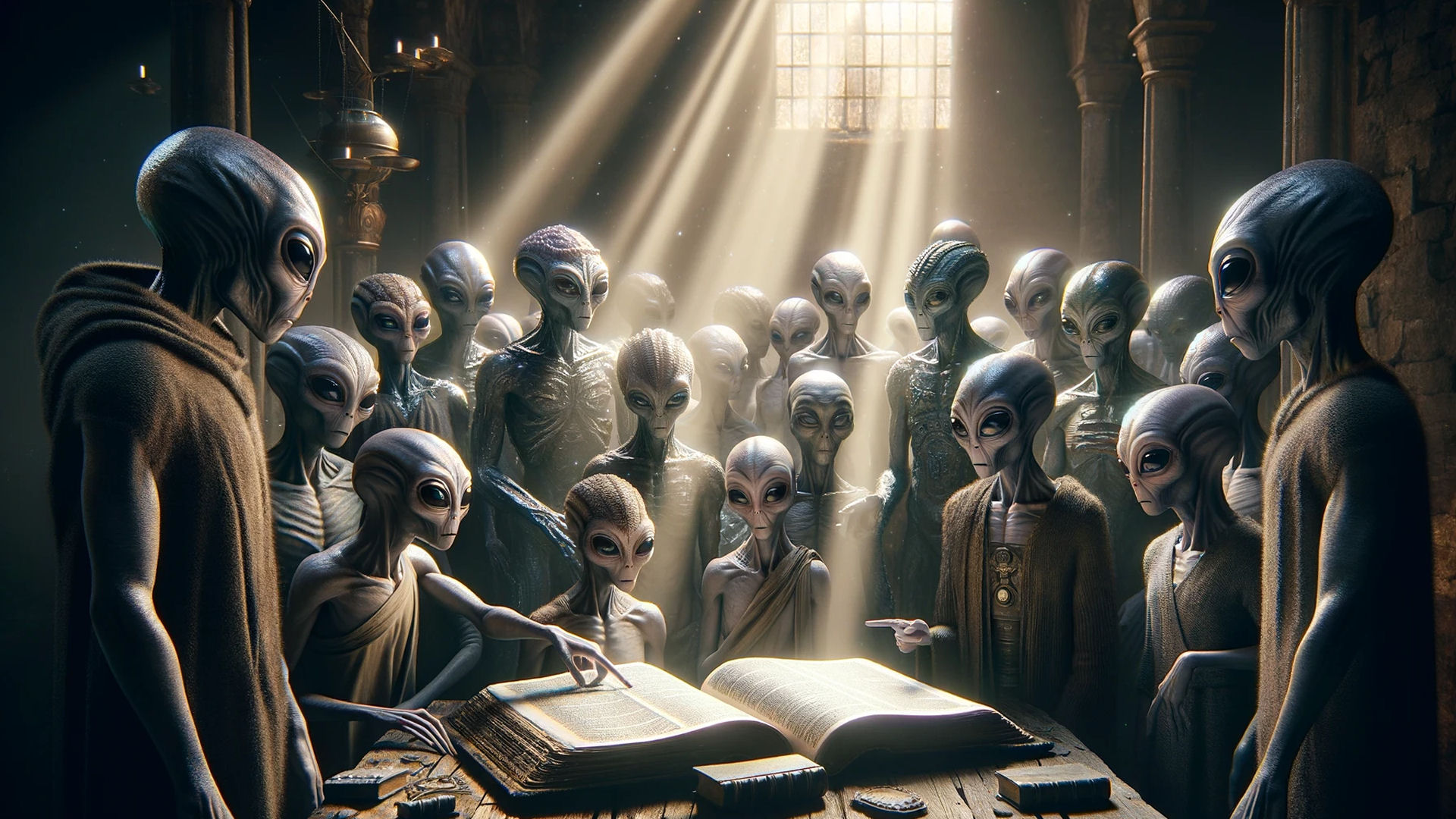
Art opens a particularly controversial episode by introducing his guest, Jim Deardorff, the author of “Celestial Teachings,” a book that suggests Jesus was an extraterrestrial. This premise sets the stage for a night of challenging conventional beliefs and exploring the fringes of scientific inquiry and spirituality.
The discussion transitions to Linda Howe, a researcher and expert on cattle mutilation, broadcasting from Colorado. Linda shares recent findings on cattle and buffalo mutilations that defy straightforward explanations, pointing towards high precision and unknown causes of death, devoid of bacterial or viral presence. These incidents raise more questions than answers, hinting at non-human involvement and advanced technologies beyond current human understanding.
Eyewitness accounts of unexplained phenomena, such as mysterious lights and unidentifiable flying objects associated with these mutilations, further complicate the narrative. Some witnesses describe seeing animals being lifted by beams of light, suggesting interactions with otherworldly intelligence. The conversation touches on the challenges of recognizing and accepting the reality of non-human entities and their possible influence on earthly matters.
Art Bell’s discussion moves into the realm of camouflage and advanced technology with an interview highlighting the testimony of Mike Harris from Atlanta, Georgia. Harris recounts witnessing an anomalous aerial event involving what appeared to be a large object, possibly utilizing some form of camouflage technology, which momentarily blocked the sky and exhibited characteristics not consistent with conventional aircraft. This testimony feeds into the broader theme of unidentified flying objects (UFOs) and their potential for using sophisticated means to remain undetected or misidentified, often speculated to mimic or blend with their surroundings to evade clear observation.
The conversation deepens with explorations into the possibility of these phenomena being linked to off-planet origins or advanced earthly technologies that are not yet publicly recognized. This includes discussions on the interaction between these unidentified objects and military aircraft, suggesting either a form of escort or monitoring, raising questions about the extent of human understanding and interaction with these unexplained presences. The dialogue touches on historical UFO sightings where objects would suddenly disappear from sight, hinting at technologies capable of altering their visibility or blending into the sky, possibly through photon manipulation or holography, concepts once relegated to science fiction but now pondered as plausible explanations for these mysterious observations.
Linda Howe and Art Bell contemplate the potential parallels between visual and auditory stealth technologies, considering the development of noise-canceling capabilities as a known technological advancement. This speculation extends to visual stealth, suggesting a theoretical technology that could cancel or alter light in a way that renders objects invisible or indistinguishable from their surroundings.
Continuing the exploration of advanced technologies and their implications, the conversation shifts toward the potential for holography and deflection as methods to render objects invisible or altered in perception. This part of the discussion is anchored in the concept that if photons do not reach our retina, the object effectively disappears from sight, suggesting a sophisticated understanding and manipulation of light and visibility that could be beyond current public knowledge.
Linda Howe, further engaging with the audience, announces upcoming speaking events in Manhattan and Toronto, encouraging interaction and sharing of eyewitness accounts, especially from individuals with government knowledge or personal encounters related to unexplained phenomena. This call to action highlights the importance of firsthand accounts in building a comprehensive understanding of mysterious occurrences and the potential involvement of advanced technologies or extraterrestrial intelligence.
Art Bell delves into the background of the Billy Meier case with Jim Deardorff, focusing on Meier’s claims of extraterrestrial contact from a young age and his encounters with beings from the Pleiades. Meier’s journey led him to discover the Talmud of Jmmanuel in a cave near Jerusalem, a document purportedly containing the true teachings of Jesus, suggesting an extraterrestrial influence on biblical narratives. This document, originally in Aramaic and translated into German with the help of a priest, challenges conventional religious teachings and offers a radically different perspective on Jesus’ origins and teachings.
Deardorff discusses his efforts to translate and understand the document amidst skepticism and the potential implications for Christianity and historical understanding. He suggests that the Gospel of Matthew and other biblical texts may have been derived from the Talmud of Jmmanuel, filtered through early Christian doctrines to remove any elements incompatible with the emerging faith. This notion introduces the possibility that extraterrestrial beings influenced religious teachings, a concept further complicated by discussions of hybrid beings, such as the suggestion that Jesus was the product of a human and alien union.
The discussion transitions into an analysis of the Star of Bethlehem, conceptualized by Jim Deardorff as a UFO, providing a novel interpretation of biblical narratives through the lens of extraterrestrial involvement. This perspective reimagines the guiding “star” as an intelligently controlled craft, directing the Magi to Jesus’ birthplace, a concept aligning with modern UFO sightings and suggesting advanced communication methods, such as mental telepathy, used by extraterrestrials.
Deardorff elaborates on the alterations made by the compiler of Matthew’s Gospel to fit the narrative into acceptable religious frameworks of the time, transforming inexplicable phenomena into more familiar, divine interventions. This approach challenges traditional interpretations of the scriptures, proposing that many biblical events might have extraterrestrial explanations, including the baptism of Jesus, where a UFO, not a dove, descended from the sky, indicating Jesus’ direct contact with extraterrestrial beings rather than a purely spiritual encounter.
Further discussions reveal Emmanuel’s (Jesus’) time spent in India, corroborating theories of his presence in various parts of the world, and suggest a comprehensive, albeit controversial, rewriting of his life story and mission. Deardorff contends that the Talmud of Jmmanuel provides a more detailed account than the Gospel of Matthew, offering insights into Jesus’ teachings and experiences that challenge the foundations of Christian theology.
Despite potential alterations and corrections to the Talmud of Jmmanuel over time, Deardorff believes in the authenticity of the document, admitting the possibility of inaccuracies but maintaining that the core message remains intact. This narrative posits Jesus as a hybrid being, part human, part alien, sent from the Pleiades, to fulfill a mission on Earth, radically diverging from orthodox Christian beliefs and inviting listeners to reconsider the origins and implications of religious texts in light of potential extraterrestrial influences.
Jim Deardorff continues to unravel the teachings of Emmanuel (Jesus), emphasizing reincarnation and karma over resurrection, aligning more with Eastern philosophies than traditional Christian doctrines. This perspective posits that the human spirit originates from a divine essence referred to as “Creation” rather than a singular creator, suggesting a pantheistic view where divinity permeates all aspects of the universe. Emmanuel’s teachings, as interpreted by Deardorff, propose that the soul evolves through countless lifetimes, contributing to the collective knowledge and evolution of the universe.
The discussion also touches upon Emmanuel’s life after the biblical narrative, suggesting he traveled extensively, including through Anatolia (modern-day Turkey) and eventually to India and Kashmir, where he purportedly lived out his remaining years. This narrative challenges conventional accounts of Jesus’ life and death, proposing an extended lifespan and influence beyond the Middle East.
Addressing the Book of Revelation, Deardorff clarifies that the Talmud of Jmmanuel does not directly impact this biblical book, focusing instead on the Gospel of Matthew and teachings related to Emmanuel’s life and philosophies. The document suggests a form of reincarnation for Emmanuel, aligning with a predicted return not explicitly tied to conventional eschatological expectations.
These revelations starkly contrast with orthodox Christian teachings, presenting Emmanuel as a figure whose life and spiritual journey extend far beyond the boundaries of traditional religious texts.
Jim Deardorff discusses the potential alignment of his findings with predictions attributed to the Pope in 1995, mentioning visitors from other worlds that could play a significant role in Earth’s future, both ecologically and through potential catastrophes. Deardorff clarifies that the Talmud of Jmmanuel does not specifically address these predictions but notes that any extraterrestrial intervention would be more about dealing with the aftermath of various global catastrophes rather than reviving Earth from an ecological standpoint. This interpretation suggests a nuanced view of potential extraterrestrial involvement in human affairs, distinguishing it from more optimistic prophesies of ecological restoration.
Further elaborating on the authenticity of the Talmud of Jmmanuel, Deardorff compares minor points within the Gospel of Matthew and the Talmud of Jmmanuel to argue against the document being a hoax. He highlights a specific example where the Talmud provides a clearer context for a biblical story that has puzzled scholars for years, offering what he sees as evidence of the Talmud’s genuineness. This meticulous comparison underscores his belief in the document’s authenticity and its potential to offer insights into historical religious narratives.
Jim Deardorff continues to emphasize his perspective on the authenticity of the Talmud of Jmmanuel, acknowledging the challenges and skepticism it faces, especially from religious communities. He suggests that historical alterations to religious texts were made to avoid embarrassment or contradiction within the early church, a practice he sees as not uncommon in human history. This approach to scripture and religious narrative invites a reexamination of accepted doctrines, encouraging a broader understanding of spiritual teachings.
The conversation shifts as Art Bell begins to take calls from the audience, introducing perspectives from listeners who are open to or supportive of Deardorff’s research, including theories on extraterrestrial influence in biblical events. One caller, identifying as a parapsychologist and ufologist, expresses belief in the notion that figures like Mary could have been subjects of extraterrestrial intervention, a concept that aligns with Deardorff’s interpretations of the Talmud of Jmmanuel.
Deardorff further discusses the motivations and intentions behind the alleged extraterrestrial interactions with humanity, suggesting that these beings aimed to introduce beneficial ideas and teachings to Earth’s inhabitants without imposing their views. This narrative paints a complex picture of extraterrestrial involvement in human development, implying a relationship based on genetic similarity and historical intervention, albeit with morally ambiguous actions in the distant past.
The discussion touches on the depiction of these extraterrestrial beings as deities in ancient mythologies, influenced by their long-term presence on Earth and interactions with early humans. Deardorff criticizes their actions as exploitative, contributing to the development of religions that deviated significantly from their original teachings.
One caller inquires about Jesus’ travels and teachings in India, speculating on their influence on local religious practices. Deardorff suggests that while Hinduism predated Jesus by centuries, his presence could have reinforced similar spiritual teachings. However, Deardorff does not delve into the possibility of Jesus’ travels to North America, noting the lack of historical evidence or translations supporting such a journey.
Further questions from callers and faxed inquiries touch on the reconciliation of Deardorff’s findings with other Gospel accounts and non-biblical historical records, such as those by Flavius Josephus. Deardorff postulates that early Christian interpretations of Jesus as “God’s son” could have evolved from his supposed extraterrestrial origins, a notion that aligns with Hellenistic literature familiar to Paul and early Christians.
The discussion also briefly addresses predictions of natural disasters and Earth changes, with Deardorff stating that the Talmud of Jmmanuel hints at future upheavals but provides no specific timelines or details. He admits to receiving little to no support from mainstream religious scholars or communities, highlighting the contentious nature of his work and its deviation from established Christian doctrines.
Deardorff suggests that Joseph of Arimathea, knowing Jesus wasn’t dead, played a crucial role in his post-crucifixion care, enlisting help from skilled friends in Jerusalem. As for karma, Deardorff clarifies that the Talmud of Jmmanuel indeed supports the concept, aligning with Hindu beliefs and indicating a cosmic justice system where actions in one life influence future existences.
One caller’s inquiry about the soul’s entry into the fetus prompts Deardorff to speculate on the timing, which remains unclear in the Talmud of Jmmanuel. This discussion naturally leads to the moral implications of karma and reincarnation, with Deardorff acknowledging the difficulty in reconciling these concepts with perceived fairness, especially without conscious recollection of past lives.
Further, Deardorff discusses the Gnostic belief regarding the demiurge, suggesting that many Old Testament depictions of God or angels might actually represent extraterrestrial interactions, thus challenging traditional interpretations of these divine encounters.
The conversation also touches on the editorial influence of early scholars on biblical texts, with Deardorff and a caller lamenting the potential for significant alterations to fit societal or theological comfort zones. This concern extends to the portrayal of God in the New Testament, where inconsistencies in description may reflect early Christians’ efforts to humanize or deify the concept of God in familiar terms.
A caller from Portland raises concerns about anti-Jewish sentiments in the Talmud of Jmmanuel. Deardorff responds by emphasizing personal discernment in accepting or rejecting teachings, even if they stem from a source believed to be genuine. He speculates that any negative portrayals might reflect historical grievances or cultural biases present at the time of writing, rather than inherent truths about Jewish people or practices.
Jim Deardorff delves into discussions about the controversies surrounding the teachings of Christ, especially focusing on Joseph of Arimathea’s role after the crucifixion and the concept of karma. Deardorff suggests that Joseph recognized Jesus (Emmanuel) wasn’t dead and played a crucial role in his recovery, indicating the involvement of skilled individuals from India who were in Jerusalem at the time. This narrative continues to challenge traditional biblical accounts, integrating elements of Eastern spirituality and healing practices.
Deardorff further elaborates on karma, explaining it as a Hindu concept closely associated with reincarnation, where one’s actions in life influence future incarnations. This leads to a broader discussion on the dismissal of reincarnation by the early Christian church, indicating a significant theological shift that diverged from some of the original teachings attributed to Jesus. Deardorff points out that the concept of reincarnation was declared anathema, showcasing the church’s active role in shaping Christian doctrine to exclude beliefs that conflicted with the emerging orthodox framework.
The conversation touches on the Councils of Nicaea and their influence on Christian doctrine, highlighting the exclusion of reincarnation from official teachings. This aligns with Deardorff’s assertion that many original teachings could have been altered or omitted to fit the new Christian narrative, further complicating the historical understanding of Jesus’ teachings.
Deardorff also responds to questions about the name “Emmanuel” as another name for Jesus, explaining the significance of this name in the context of prophetic fulfillment and its relationship to the Gospel of Matthew.
Jim Deardorff discusses the challenges in validating the Talmud of Jmmanuel, noting the absence of carbon dating and photographs due to the document’s destruction in 1974. This leaves scholars with claims of a historical Aramaic document but no physical evidence to examine directly. Deardorff also addresses inquiries about Jesus’ travels post-crucifixion, emphasizing his research into Jesus’ movements through Iran, Iraq, Afghanistan, Pakistan, and particularly Kashmir, where the “Tomb of Yuz Asaf” is believed by some to be Jesus’ final resting place.
A caller from Washington inquires about contacting Deardorff, leading to the sharing of his email address for those interested in his research. This exchange underscores the cautious approach needed when sharing personal information publicly.
The discussion then shifts to a caller from Washington who introduces the concept of the Photon Belt, suggesting it will bring knowledge to humanity that challenges traditional religious beliefs. This caller asserts that Jesus, known as Emmanuel after his death, had his teachings significantly altered by Saul of Tarsus (Paul), leading to the foundation of Christianity as known today rather than a direct reflection of Emmanuel’s teachings. This perspective aligns with Deardorff’s views on the suppression and alteration of original teachings to fit the emerging Christian doctrine.
Further, the caller claims humanity’s genetic origins trace back to the Pleiades, hinting at a revelation of this information in the future. Deardorff expresses skepticism about such predictions, noting failed prophecies in the past but acknowledges the mythological significance of Pleiadian origins among various indigenous tribes in the United States.
Jim Deardorff further elaborates on the concept of Samadhi, suggesting that Jesus (Emmanuel) might have been in an out-of-body state during his comatose condition post-crucifixion. This idea introduces the possibility of Jesus using advanced meditation techniques to survive the ordeal, challenging traditional interpretations of his death and resurrection.
Callers continue to express support and curiosity, asking about the potential for a second coming and how it might manifest, as well as the role of abductees in the broader context of Emmanuel’s teachings. Deardorff speculates that mankind was deemed ready for advanced teachings during Jesus’ time, which led to his birth and mission on Earth. Regarding a second coming, Deardorff admits uncertainty but acknowledges editorial alterations in the Gospel of Matthew from the Talmud of Jmmanuel, leaving the exact nature of a second coming unclear.
The conversation shifts to the concept of the Rapture, where Deardorff indicates that the Talmud of Jmmanuel does not specifically address this idea, suggesting it may have been an addition by the scribe who wrote the Gospel of Matthew. This further emphasizes the divergence between traditional Christian teachings and the interpretations presented in the Talmud of Jmmanuel.
Deardorff addresses the abduction phenomenon, acknowledging it as a modern enigma not covered in the Talmud of Jmmanuel. He theorizes that extraterrestrial interventions, possibly through abductions, could be aimed at ensuring some form of human survival following predicted global catastrophes.
In response to a question about his connections to other religious figures or movements, Deardorff clarifies he has no direct affiliation with figures like Benjamin Creme or L. Ron Hubbard, though he acknowledges some agreement with Hubbard’s views on reincarnation.
A caller’s question about the parable of the wheat and the tares leads Deardorff to explain that while the parable appears in the Talmud of Jmmanuel, its interpretation, especially regarding the devil, differs significantly from the Gospel of Matthew. This highlights the Talmud’s tendency to omit or reinterpret traditional elements of Christian doctrine, such as the concept of the devil, in favor of teachings more aligned with Emmanuel’s supposed original messages.
Jim Deardorff elaborates on the Talmud of Jmmanuel’s meaning, suggesting it signifies “teachings received by a disciple,” and clarifies Emmanuel’s experiences. The conversation expands to include discussions on various religious figures and documents, such as Abraham, Moses, Muhammad, and Joseph Smith, indicating a comprehensive approach to understanding spiritual teachings across different traditions.
A caller introduces the concept of Emmanuel’s reincarnations, suggesting that he may have had various lives before and after the biblical era. Deardorff entertains the idea but acknowledges the speculative nature of such claims, emphasizing the importance of individual research and exploration to ascertain the legitimacy of the Talmud of Jmmanuel.
Deardorff also addresses the Billy Meier case, defending his support despite skepticism within the UFO community. He argues that the rejection of Meier’s photographs and films by some does not diminish the case’s overall credibility, suggesting that the extraordinary nature of Meier’s evidence often surpasses the technological capabilities of his time.
The discussion touches on contemporary phenomena such as animal mutilations and crop circles. Deardorff distinguishes these from his main focus on the Talmud of Jmmanuel, though he mentions that misinformation might be provided to Meier about crop circles, suggesting a complex interplay of beliefs and disinformation within the UFO community.
A caller questions Deardorff’s belief in the Bible, prompting a reflection on the necessity of discerning truth among various religious teachings. Deardorff asserts that while he does not dismiss the Bible entirely, he believes in critically evaluating its teachings to distinguish truth, highlighting the importance of the Golden Rule as a universal principle.
Jim Deardorff discusses the Golden Rule’s presence in the Talmud of Jmmanuel, despite some scholars’ belief that it was a later addition not originally spoken by Jesus or Emmanuel. This conversation leads to various inquiries about Deardorff’s research, including his support for Billy Meier and connections to other controversial topics and figures in the spiritual and UFO communities.
A caller from Seattle inquires about sending correspondence to Deardorff through his publisher, Wildflower Press, offering a way for interested individuals to reach him indirectly. This highlights the interest in Deardorff’s work and the desire for further engagement from the public.
The discussion then shifts to an account shared by a caller who recalls a narrative involving Mary’s visitation to a spaceship for the purpose of Jesus’ conception, suggesting advanced, possibly extraterrestrial intervention. This story aligns with Deardorff’s themes of unconventional interpretations of biblical events, although he clarifies that the Talmud of Jmmanuel does not explicitly support this specific scenario.
Deardorff addresses questions about the legitimacy of the Talmud of Jmmanuel, emphasizing personal exploration and research as essential for forming an opinion on its authenticity. He acknowledges the speculative nature of claims about Emmanuel’s past and possible future lives, as well as the broader implications of his findings for understanding the origins and development of humanity.
The conversation also touches on crop circles and animal mutilations, with Deardorff distancing these phenomena from his primary research focus while suggesting that misinformation may play a role in their interpretation within the UFO community.
A caller from Anchorage brings up the Apocrypha and other non-canonical texts, prompting Deardorff to comment on the complexities of ancient writings and their contributions to understanding Jesus’ life, especially his supposed travels to India. Deardorff’s responses throughout these exchanges highlight the intricate web of beliefs, historical interpretations, and speculative ideas that define his work and the broader fields of religious studies and ufology.
One caller’s query about hackers diverting from the main topic led Deardorff to clarify his focus on UFOs and related phenomena, reinforcing the scope of his research and interest areas.
Discussions also veered into speculative narratives about Mary’s impregnation, with one caller suggesting a controversial theory drastically different from the immaculate conception story, which Deardorff dismissed as not aligned with the Talmud of Jmmanuel’s account. This interaction underscores the wide range of interpretations and beliefs surrounding biblical stories and the figures within them.
Deardorff responds to questions about the Romans’ expertise in confirming death, suggesting that Emmanuel’s (Jesus’) spiritual practices might have enabled him to enter a state that could be mistaken for death. This idea introduces alternative explanations for the crucifixion and subsequent events, challenging traditional Christian doctrines.
The conversation also touched on the role of extraterrestrial interventions in biblical events, such as the removal of the stone from Jesus’ tomb, positing that extraterrestrial beings played a part in demonstrating Jesus’ survival post-crucifixion. This perspective further blends religious narratives with extraterrestrial theories, offering unconventional explanations for miraculous events.
Inquiries about Jesus’ travels to Egypt, India, Persia, and possibly North America after the crucifixion were also discussed, with Deardorff noting the lack of evidence in the Talmud of Jmmanuel about these journeys, except for the early childhood flight to Egypt. This highlights the speculative nature of discussions about Jesus’ life and the challenges in distinguishing historical facts from legends or spiritual interpretations.
Deardorff addressed the animosity between Judaism and Christianity, suggesting it emerged naturally as Christianity developed from Paul’s teachings, highlighting the disappointment among early Christians that more Jews did not convert.
The final segment of the discussion attempted to address a caller’s request for Jim Deardorff to share the Lord’s Prayer as it appears in the Talmud of Jmmanuel. However, due to time constraints, Deardorff was unable to provide the specific differences between the traditional Lord’s Prayer and its counterpart in the Talmud of Jmmanuel. He mentions that the prayer is titled differently in his book, suggesting significant variations from the version commonly known from the Bible.
As the program concludes, Art thanks Professor Deardorff for his participation in a session that explored a wide range of thought-provoking topics, from biblical narratives and extraterrestrial theories to the reinterpretation of religious texts. Art’s closing remarks also address a previous caller’s comment on Deardorff’s speech patterns, suggesting that the focus should remain on the content of the discussion rather than personal attributes of the speakers.