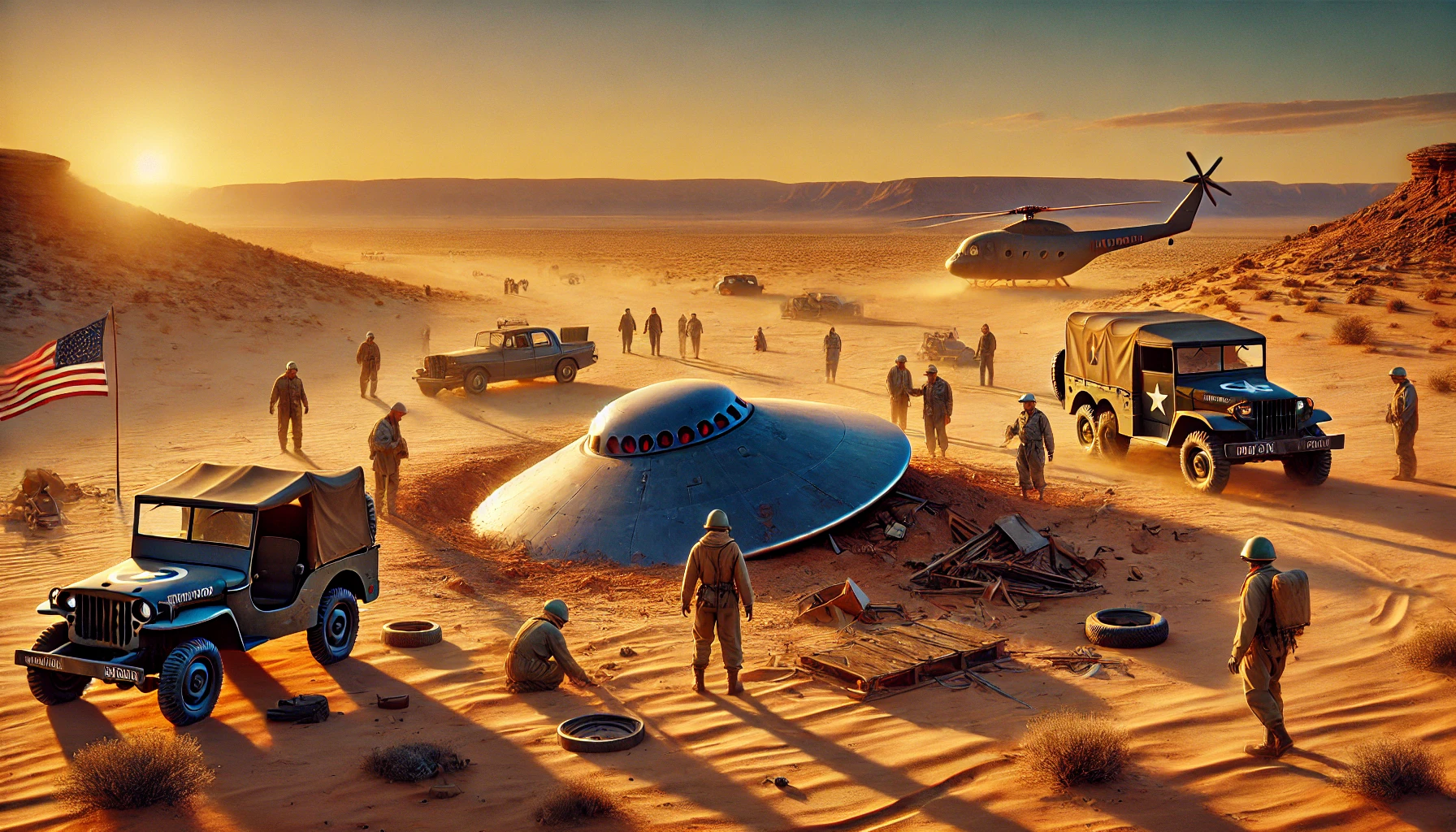
Art begins the show by introducing Coast to Coast AM, mentioning its wide reach across the Americas and even to the North Pole. He welcomes new listeners from various regions and talks about the growth of the network. Art then introduces Congressman Stephen Schiff from New Mexico to discuss the Roswell incident. Schiff recounts receiving numerous letters from constituents questioning the military’s explanation of a weather balloon for the 1947 Roswell crash. He clarifies that his goal was to make government records about Roswell public, not to investigate the incident itself.
Schiff explains that his initial request for information from the Department of Defense resulted in a dismissive response directing him to the National Archives, which had no relevant records. Frustrated, he contacted the General Accounting Office (GAO), the investigative arm of Congress, hoping they could uncover any existing records related to the Roswell incident. Schiff emphasizes that something undeniably crashed near Roswell in 1947 and that the Army initially described it as a “flying disc,” which was later retracted as a weather balloon. Despite differing opinions on the nature of the crash, the initial announcement of a flying disc created significant controversy.
Schiff mentions that his request to the Department of Defense, which he assumed would be routine, was met with an unexpected and unhelpful response, essentially redirecting him to the National Archives. He details his repeated attempts to get a clear answer and how he was eventually told by the National Archives that they had no information about Roswell, despite receiving many similar inquiries. Schiff’s efforts highlight the bureaucratic runaround he experienced while trying to serve his constituents’ interests.
Schiff explains that during a meeting with GAO officials on other matters, he mentioned the Roswell issue, suggesting there must be records of what happened. The GAO agreed to search for records as time permitted, given the unusual subject matter and potential ridicule associated with investigating UFOs. Schiff emphasized the public’s right to government information and the importance of transparency. The GAO began their search, acknowledging the challenge due to the incident being 50 years old. Schiff instructed them to prioritize other urgent requests from Congress, which contributed to the delay.
In 1994, the GAO report revealed that many records from the Roswell time period were inexplicably destroyed. This finding contradicted the Albuquerque Journal’s claim that Schiff concluded the incident involved a weather balloon. Schiff clarified that the Air Force’s 1994 report admitted the object was not a weather balloon, a theory they had maintained for almost 50 years. The Air Force suggested it was a different type of balloon, yet Schiff highlighted the implausibility of the high security measures taken for what they claimed was a simple balloon crash. These actions, including transporting remnants to Wright-Patterson Air Force Base under strict security, suggested the incident involved more than a weather balloon.
Schiff explains that the Air Force’s 1994 report stated that the crash involved a classified balloon project to detect Soviet nuclear tests, not a weather balloon. He clarifies that he never accepted the weather balloon explanation and did not conclude that the new Air Force explanation was correct. The Albuquerque Journal misrepresented his statements, implying he accepted the new balloon theory. Schiff emphasizes that his only stated conclusion was disbelief in the weather balloon story.
Art takes a break, and upon returning, Schiff continues discussing the inaccurate reporting by the Albuquerque Journal. He reiterates that the report did not align with his statements and stresses that his disbelief in the weather balloon theory does not translate to accepting the new explanation. Schiff points out that the existing records from the era, like an FBI teletype and an internal base newsletter, referred to a weather balloon, but the Air Force’s later admission contradicts this.
Schiff reveals that the most potentially significant records, the outgoing messages from Roswell Army Airfield, were not found and had been destroyed without explanation. These messages were supposed to be permanent records, and their destruction raises further suspicion. Schiff directed the GAO to search these messages because they likely contained explanations to higher-ups about the incident. He speculates that, regardless of the true nature of the crash, there would have been internal military communications explaining the situation.
Schiff elaborates on the destruction of records, explaining that all outgoing messages from Roswell Army Airfield for the relevant years were destroyed without proper authorization. The Air Force couldn’t provide a reason for the destruction or identify who was responsible. The GAO’s investigation suggested the records were likely destroyed before 1956, making it difficult to hold anyone accountable or find more information.
Schiff notes that the destruction of such records was not unique to Roswell, as the Air Force cited other examples of records from that era being destroyed. He expresses frustration at reaching a dead end, emphasizing that the GAO had done all it could. Schiff mentions that other agencies like the CIA and FBI, when asked directly, also reported having no records on Roswell, though the FBI did acknowledge a teletype about the incident.
Art points out the widespread public distrust in the government, citing a survey where three out of four people expressed such sentiments. Schiff acknowledges this distrust, relating it to the Roswell incident and other government controversies. He stresses his commitment to transparency and the public’s right to information, criticizing the military’s initial dismissal of his inquiries by redirecting him to the National Archives.
Schiff criticizes the Air Force’s handling of the Roswell incident, noting that their actions, such as directing inquiries to the National Archives, created an impression of a cover-up even if none existed. This behavior has fueled public suspicion and distrust in the government. Schiff states that the matter remains unresolved. He has provided all available records and explanations but acknowledges that people will draw their own conclusions—some viewing it as a simple mistake, others as part of a conspiracy.
Art then discusses the widespread belief in a shadow government, asking Schiff if he shares these suspicions. Schiff denies seeing evidence of such control, explaining that while there might be suspicions about other branches of government, he hasn’t encountered anything to substantiate the idea of a government behind the government. They discuss the possibility of further investigation, mentioning that multiple members of Congress have shown interest in the GAO report, which can be requested from the GAO.
Art shifts the topic to a film purportedly showing an autopsy of an alien from the Roswell crash, mentioning still photographs that have circulated. Schiff reveals he has seen the video, which is part of a British documentary, and describes the depicted being as eerily almost human, contrasting with the typical image of little gray or green aliens.
Schiff elaborates on his viewing of the film purportedly showing an autopsy of an alien from the Roswell crash, emphasizing that the film could be a hoax but would require significant planning and resources to create. He describes the scene with doctors in protective garb conducting the autopsy, noting the precautions taken, similar to those for preventing the spread of smallpox. Schiff states that the British owners of the film are trying to verify its authenticity and mentions efforts to find a government agency or private source capable of assisting in this verification.
Art and Schiff discuss the origin of the film, said to be from a military photographer who wishes to remain anonymous. Schiff acknowledges that the anonymity of the source makes it difficult to verify the story. He finds the film intriguing, noting that it was not an obvious low-budget fake. They then move on to other topics, including Schiff’s role on the Waco committee, with Art preparing to ask about the Waco incident and open the phone lines for listener questions.
Schiff comments on the Waco hearings, emphasizing the importance of transparency and allowing the public to form their own opinions based on the testimonies. He discusses the controversy surrounding the involvement of the White House in the decision-making process during the Waco siege. Schiff notes that witnesses confirmed the president was kept informed, and he questions whether the president’s involvement should be viewed negatively.
He highlights critical questions for Attorney General Janet Reno’s upcoming testimony, particularly regarding her approval of the plan to use gas on the compound, the information she received, and who she consulted. Schiff expects Reno to argue that she believed there was no chance of voluntary surrender and that the gas insertion was the least threatening method to encourage the compound’s occupants to leave.
Art and Schiff discuss the FBI’s statements during the siege, which indicated patience but ultimately led to the decision to use gas. Schiff points out inconsistencies in the FBI’s contingency plans, questioning why an all-out assault was necessary if one tank faced resistance. He suggests that the decision to bring in all the tanks simultaneously, instead of withdrawing at the first sign of armed opposition, remains puzzling.
Schiff addresses the question of whether it would be more troubling if the President knew about the decision-making regarding the Waco siege or if he was not informed. He states that the most troubling scenario would be if the President was not truthful about his involvement. Schiff believes that it would not be inappropriate for the President to be involved, given the high stakes and publicity of the situation. He finds it hard to believe the President would merely be kept informed without having any input.
Schiff explains his dual membership on the subcommittees investigating Waco, expressing uncertainty about what the White House feels accused of. He highlights that the President wanted to be kept informed, which some witnesses confirmed. This does not concern Schiff unless the President is being dishonest about his level of involvement. Schiff compares this to the Roswell incident, suggesting that the reaction from the White House fuels suspicion.
Schiff mentions a memo from Altman to Secretary Bentsen predicting a catastrophe four days before the Waco siege’s tragic conclusion. He disagrees with claims that nothing new has emerged from the Waco hearings, asserting that significant information has come out, some favorable and some unfavorable to the government. Schiff believes that the fire at Waco was likely started inside the compound, possibly in multiple places, supporting the theory that the Davidians set it deliberately. However, he does not rule out the possibility that the chaos inside, including the use of lanterns for lighting, could have accidentally started the fire. He emphasizes that the evidence does not support the idea that the FBI started the fire.
Schiff concludes by noting the involvement of different agencies, specifically the Bureau of Alcohol, Tobacco, and Firearms (ATF) under the Treasury Department, which conducted the initial raid on February 28. After the raid failed, the situation escalated.
Schiff continues discussing the Waco incident, explaining the division of responsibility between the ATF, which initiated the raid, and the FBI, which took over during the siege under the Department of Justice. He criticizes Treasury Secretary Bentsen’s inaction after receiving a memo from Roger Altman, which warned of a potential tragedy from the planned gas insertion. Schiff believes Bentsen should have communicated these concerns to Attorney General Janet Reno, even if it was no longer the Treasury’s responsibility.
Schiff reflects on whether President Clinton should have accepted Reno’s offer to resign after the tragedy, suggesting it depends on one’s conclusions about the government’s handling of the situation. He emphasizes that the key issue is what information the FBI provided to Reno, particularly whether they fully explained all potential outcomes, including the possibility of a peaceful surrender by David Koresh.
Schiff finds it alarming that Reno indicated she would make the same decision under similar circumstances today, given the current environment with increasing militias and anti-government sentiments. He fears this mindset could lead to another Waco-like incident. Schiff underscores the importance of the hearings in allowing the public to form their own opinions and shares that he has reached some conclusions, which he will discuss further.
Schiff reiterates that the initial raid on the Branch Davidian compound by the ATF was based on a legitimate concern over the illegal conversion of semi-automatic weapons to automatic ones. He emphasizes that the government’s interest was in the firearms issue rather than targeting the group for their religious beliefs. As they transition to phone calls, Schiff discusses the fire investigation at Waco, noting that multiple investigators, including some with past ties to the ATF, concluded the fire started inside the compound at several locations simultaneously.
A caller from Madison, Wisconsin, praises Schiff for his persistence with the Roswell investigation and asks if there could be more hidden information. Schiff responds that the GAO exhausted all possibilities in their search and found no further records, suggesting that if anything still exists, there is no paper trail leading to it. He acknowledges that some mysteries, like Roswell, may never be fully resolved, and even undeniable evidence might be doubted due to the sheer volume of conspiracy theories.
Another caller from South Carolina references an FBI agent’s testimony about seeing someone light a fire inside the Waco compound. Schiff clarifies that while the testimony suggests the fire was deliberately set inside, he hasn’t entirely ruled out the possibility of an accident due to the chaotic circumstances, such as lanterns being used for light after the electricity was cut off.
Schiff acknowledges that the assault on the Waco compound was chaotic and raises the possibility of an accident involving lanterns. However, he agrees that most evidence supports the theory that the fire was deliberately set inside. Schiff criticizes the Treasury Department for not forwarding Altman’s memo to the Justice Department, suggesting that Attorney General Janet Reno should have had the opportunity to review it.
A caller from Houston expresses concern about the public’s ability to trust the government, citing historical incidents like the Kennedy assassination and Watergate. Schiff hopes that the Waco hearings will help restore some of this trust by allowing the public to see all available information and draw their own conclusions. Another caller discusses media manipulation and the involvement of the National Rifle Association (NRA) in the investigation. Schiff notes that any misrepresentation by an NRA-affiliated investigator does not taint the hearings themselves.
Schiff provides an example of media manipulation, describing how the testimony of a young girl who was allegedly raped by David Koresh was used to dominate the media narrative, despite the ATF’s focus on firearms violations. He criticizes the decision to publicize the child’s identity, which is typically protected in abuse cases. Schiff concludes by discussing the media’s predictable focus on sensational aspects of the hearings, overshadowing other important details.
Schiff comments on the use of a young girl’s testimony about being raped by David Koresh during the Waco hearings, criticizing it as a public relations tactic by the Democrats to dominate media coverage and distract from other critical testimonies. He argues that while child abuse is a serious crime, the ATF’s raid was about firearms violations, not child molestation, and using such testimony diverted attention from relevant issues, such as criticisms from Texas child abuse caseworkers and local sheriffs about the raid.
Schiff questions the government’s claim that the raid and the subsequent use of gas were for the benefit of the children in the compound, pointing out that the tragic outcome suggests otherwise. He doubts that the hearings will change many minds but emphasizes Congress’s role in ensuring transparency on issues of significant public interest.
As the interview concludes, Art Bell recaps the discussion, noting Schiff’s involvement in both the Roswell and Waco investigations. Bell mentions that Schiff provided detailed insights into the missing records related to Roswell and the complex issues surrounding the Waco siege, inviting listeners to catch a repeat of the interview.
Art Bell transitions from the interview with Congressman Schiff to address listeners from new affiliates in Hazleton, Pennsylvania, and Attleboro, Massachusetts. He then makes an important announcement about special photographs from the alleged Roswell film, available in the upcoming issue of his newsletter. Bell emphasizes the collectible nature of these photos, whether they ultimately prove to be a hoax or genuine.
Bell provides a brief weather update, mentioning Hurricane Erin, which is headed towards the Florida Keys. He predicts a severe hurricane season and suggests the weather might be undergoing significant changes. Returning to the Waco hearings, Bell recaps the serious accusations against President Clinton, who is accused of ordering the gas attack and covering up his involvement. Janet Reno’s upcoming testimony will be critical, with questions focusing on her decision-making process and whether she communicated with the President.
Bell discusses the implications of whether the President was involved in the decision or completely unaware. He notes that both scenarios are troubling and anticipates a significant day ahead in the hearings. Bell also mentions a major merger between Disney and ABC, which positions them as the top entertainment company globally, reflecting on the rapid financial impact of the deal.
Art Bell discusses the major corporate mergers and legislative changes in the telecommunications industry. He notes Disney’s acquisition of ABC, making it the largest entertainment company in the world, and other potential mergers, such as Westinghouse’s interest in CBS. Bell highlights the Telecommunications Bill, which aims to deregulate industries like cable and allow phone companies to compete more broadly. This bill could significantly impact the flow of information and media ownership in America.
Bell presents two perspectives: one viewing deregulation as beneficial for increasing competition and lowering prices, and another seeing it as a consolidation of power in the hands of a few, potentially limiting diversity in information. Bell advocates for less regulation, believing it will lead to more diversity in broadcasting and opposes the reinstatement of the Fairness Doctrine.
Bell shifts to political controversies, quoting House Speaker Newt Gingrich and New York Times columnist William Safire on the alleged suicide of Vince Foster and its potential connection to the Whitewater scandal. He raises serious questions about whether President Clinton took a bribe and obstructed the investigation, noting Safire’s claim that Republicans prefer not to pursue impeachment to have Clinton as an opponent in the next election. Bell emphasizes the importance of transparency and the public’s right to know the truth about significant issues like Roswell, Waco, Whitewater, and Vince Foster’s death.
Art Bell opens a special phone line for listeners from new affiliates in Attleboro, Massachusetts, and Hazleton, Pennsylvania, allowing them to call in and join the discussion. A caller from Federal Way, Washington, comments on various incidents where government actions resulted in suspects being burned out of their hideouts, expressing concern about the government’s trustworthiness. Bell agrees that cynicism is growing and that the Waco hearings are unlikely to change many opinions.
Another caller from the wildcard line asks about radio stations in Crescent City, California, and how to send faxes from photocopy stores. Bell suggests trying stations in Chico and explains the cost-effectiveness of faxing. He continues to remind listeners of the special call-in opportunity for the new affiliates.
Bell touches on the decision by the Senate Ethics Committee not to hold public hearings on Senator Packwood, mentioning the controversy around this decision and its potential to embarrass many people. He also notes recent developments in the O.J. Simpson trial, with Marcia Clark claiming to have proof that the bloody gloves belonged to Simpson.
Art Bell addresses a caller’s criticism that his show has become too political, emphasizing the diverse range of topics he covers, including recent discussions on Roswell and current events. He argues that his open format allows for a variety of subjects, unlike other shows that may focus solely on politics.
Bell takes a call from North Dakota, reminding the caller that the line is currently reserved for listeners from Massachusetts, Rhode Island, and Pennsylvania. Another caller from Palm Springs supports Bell, noting the relevance of political issues and the diversity of topics discussed on the show. They discuss recent earthquakes and predictions by Gordon Michael Scallion, expressing concern over a series of significant seismic events potentially signaling more to come.
Bell continues to engage with listeners, including a humorous segment about his cats, demonstrating the show’s lighthearted side. He reiterates his belief in the value of live talk radio and the importance of an open format that covers a wide array of subjects, providing a richer listening experience. Bell encourages new affiliates to call in, attempting to give them priority, though acknowledging the challenge due to the high volume of calls.
Art Bell continues to manage calls from listeners, addressing a caller’s perspective on the death penalty and how it should be used cautiously and not as a form of revenge. They discuss the case of Susan Smith in South Carolina, with the caller arguing that she should not receive the death penalty because she is not a danger to society as a whole.
Another caller from Rhode Island, encouraged by a friend in Phoenix, gets on the air. Bell clarifies his show’s format and explains that while he does discuss politics, his program covers a wide range of topics. They briefly touch on Bell’s nationwide reach and the hours his show airs in different locations.
Bell then takes a call from a listener, “Doctor Democrat,” who predicts that Janet Reno will handle the upcoming Waco hearings effectively, making Republicans look foolish. Bell ends the call humorously, noting the lack of proof backing the claim and encouraging listeners to stay tuned.
In response to a letter, Bell reflects on the Waco incident’s impact and the broader message perceived by some people, particularly regarding government actions against religious groups and gun ownership. He addresses a question about his religious beliefs, stating that he is a privately religious person, baptized as a Lutheran, and believes in God and Jesus but does not adhere to any specific structured religion.
Art Bell takes a call from a listener in Bozeman, Montana, who shares a Bigfoot sighting from 1978 near Denver, Colorado. The caller describes seeing a large creature beating a dead dog with a stick on a baseball field, and how it quickly ran away upon noticing them. Bell listens intently and appreciates the story, noting that ridicule often follows such extraordinary claims, but he treats the caller’s account with respect.
Another caller discusses the use of methylene chloride during the Waco siege, referencing a statement by Charles Schumer. The caller explains that while methylene chloride can be a flame retardant in liquid form, it is highly flammable when aerosolized. The caller’s brother, a chemist, clarifies that displacing air with any substance can be termed flame retardant under certain conditions, highlighting how information can be twisted.
Bell agrees that the day’s hearings will be crucial in uncovering the truth about Waco. The caller also touches on Vince Foster’s frequent trips to Switzerland before his death, suggesting there is more to the story. Bell acknowledges the unresolved nature of the Foster case and the serious allegations it involves.
Art Bell discusses the importance of transparency and truth from the government, expressing concern about the potential dangerous consequences if Americans don’t start perceiving they are getting the truth. A caller, “Radio Free America,” questions why key figures like Sarah Bain and James Bovada weren’t called to testify in the Waco hearings and highlights the missing infrared video, audio recordings, and ATF video. Bell acknowledges these concerns and emphasizes the importance of the upcoming testimony of Janet Reno.
Another caller speculates about potential connections between Waco and Whitewater, but Bell dismisses this, emphasizing the need to focus on the specific issues at hand rather than drawing far-fetched connections. He underscores the importance of examining the Waco incident thoroughly to ensure the American people perceive the truth.
A caller from Fairbanks, Alaska, criticizes Janet Reno for allegedly not understanding the implications of the gas used during the Waco siege. They argue that child molestation concerns should have been handled by local authorities, not federal agencies, and that none of the allegations justified the high number of deaths. Bell agrees, expressing disappointment with the overall handling of the situation and the apparent failure of the hearings to reveal the truth. The caller, a moderate conservative Republican, shares their disillusionment with the political process and the handling of the hearings, echoing Bell’s sentiments about the importance of honesty and transparency for the sake of the country.
Art Bell shares his concerns about the growing gap between the government and the people, emphasizing the potential dangers if key issues like Roswell, Waco, and Whitewater are not transparently addressed. He highlights the importance of the upcoming testimony of Janet Reno, stressing that the truth must come out to avoid further eroding public trust.
A caller from Berkeley, Todd, discusses the ongoing Waco investigation and the importance of uncovering the truth, referencing a memo from Mac McCarty indicating the White House was kept informed about Waco. Bell acknowledges that if the President lied about his involvement, it would be a significant issue. They discuss the potential political motivations behind the investigation and the broader implications for both political parties.
Another caller criticizes political operatives like “Doc Democrat” for their unwavering support of their party, regardless of the truth. Bell humorously suggests that such operatives would defend their party’s actions no matter how egregious.
Bell briefly updates listeners on a developing hurricane headed for southern Florida, emphasizing the importance of staying informed during the hurricane season.
Returning to the topic of Roswell, Bell mentions the international attention the alleged autopsy film is receiving, as reported by the London Observer. He notes that the film could either be a major scientific discovery or a significant hoax, and its upcoming broadcast is expected to generate considerable controversy. Bell encourages listeners interested in UFO research to obtain his newsletter to view the related photos.
Bell reads a letter linking the deaths of ATF agents at Waco to broader conspiracies, expressing the caller’s belief that the truth would cause a revolution. Another caller from New Orleans criticizes Janet Reno for refusing to accept responsibility for the Waco incident, further highlighting the public’s frustration with government accountability.
Art Bell continues to engage with callers, addressing their concerns about government transparency and accountability. A caller expresses frustration with high-level bureaucrats and their refusal to admit wrongdoing, arguing that people need to know the truth about their government, even if it means acknowledging that officials are liars. Bell counters that while knowing the truth is essential, it could lead to dangerous consequences if people lose all trust in their government.
Bell emphasizes the need to narrow the credibility gap between the government and the people, warning that if it continues to widen, it could result in something catastrophic. He expresses hope that future generations will not become complacent and accept dishonesty from their leaders.
A caller from KCMO challenges Bell’s opinion on the death penalty for Susan Smith, who drowned her two sons. Bell clarifies that he believes life in prison might be a harsher punishment for Smith than the death penalty, as it would force her to live with her actions. The caller argues that the punishment should fit the crime, advocating for the death penalty as a form of strict justice.
Bell acknowledges the caller’s points but reiterates his belief that the circumstances of Smith’s life and her mental state at the time of the crime should be considered. He differentiates between premeditated, cold-blooded murder and acts committed by individuals who are mentally unwell, stating that he does not support executing those who are severely mentally disturbed.
Art Bell discusses the sentencing of Susan Smith with a caller, noting that she will likely spend her life in isolation in prison, which he describes as a form of hell on earth. Another caller mentions that crimes against children are particularly reviled in prison, and those convicted often face severe retribution from other inmates. Bell agrees and reiterates that Smith will be kept in isolation to prevent such attacks.
A caller suggests that the General Accounting Office (GAO) should investigate other major UFO sightings, similar to the Roswell investigation, to uncover any remaining records. Bell explains that such requests need to come from Congress members like Schiff. He also notes the significant finding from the GAO about missing records from Roswell, which should have been headline news.
Bell engages with a caller from Portland, who humorously speculates about the future of ABC under Disney’s ownership and the potential impact on high-profile journalists like Ted Koppel. The caller also brings up the idea that the outcome of Waco might have been different if there had been a mass peaceful protest, similar to Tiananmen Square, to support the Branch Davidians. Bell appreciates the caller’s perspective but remains skeptical about the feasibility of such an action.
Another caller asks about the whereabouts of a tape called “The Big Lie,” which criticized the government’s handling of Waco. The caller claims that copies have been confiscated by the government and expresses concern about the video’s disappearance. Bell humorously suggests that he hasn’t had his copy taken yet and acknowledges the mysterious circumstances surrounding Linda Thompson, the creator of the tape.
Art Bell continues the conversation with a caller about the controversial Waco tapes by Linda Thompson. Bell acknowledges that Thompson became increasingly radical and removed herself from the public spotlight, but her tapes still exist and look real to him. He explains that some scenes in her tapes might have been taken out of context, such as the famous scene with the tank and a flame, which is actually a piece of burning drywall hanging on the tank.
A caller from St. Louis, Mike, talks about the effects of CS gas, comparing it to tear gas and describing his experiences with it during Army training. He emphasizes how disorienting and incapacitating the gas can be, suggesting that this might explain some of the chaos during the Waco siege. Bell and the caller discuss the challenges faced by the people inside the building, including the tanks knocking down stairwells, which made it difficult for them to escape.