
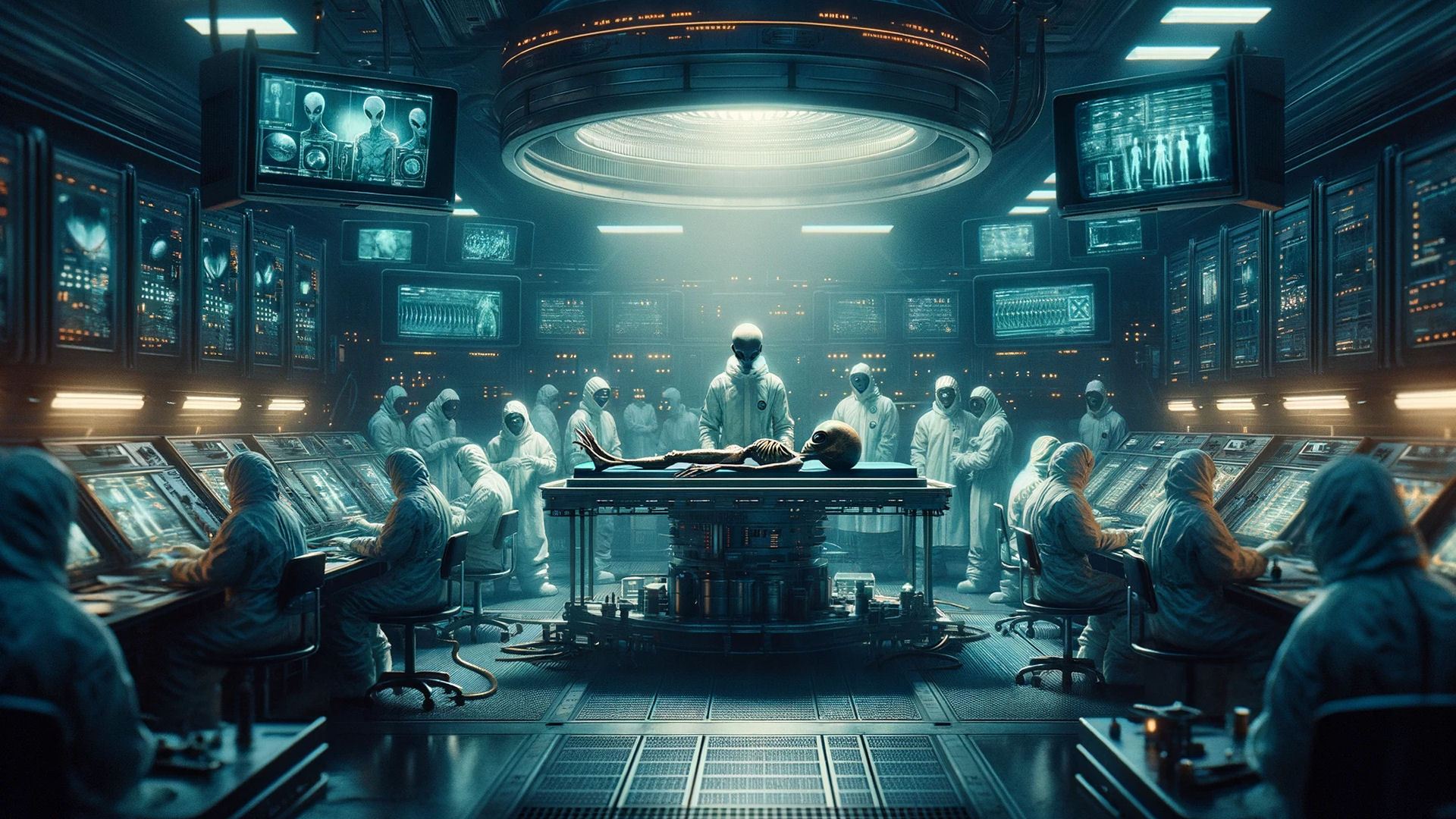
Art dives into the enigmatic world of alien autopsies, sparked by a Fox broadcast claiming to show an extraterrestrial post-mortem. Enter Bob Shell, a seasoned photo analyst with ties to the FBI and CIA, who comes forward with potentially groundbreaking information on the Roswell incident. Broadcasting directly from Washington D.C., Shell shares his expertise in photography and film analysis, notably challenging the authenticity of the alien autopsy film featured by Fox. According to Shell, Kodak’s analysis dates the film to 1927, 1947, or 1967 based on the film’s edge markings, but he points out that the physical material of the film varies across these years, suggesting a deeper investigation is needed. Shell, having personally examined pieces of the film, preliminarily confirms its 1947 origin, aligning with the cameraman’s claims. This revelation, if true, could substantiate the film’s authenticity and its depiction of a 1947 alien autopsy, igniting further debate and investigation into one of the most enduring UFO mysteries.
Shell reveals having viewed about 20 minutes of unreleased film, showcasing debris rather than a crash site, with pieces displayed in a manner inconsistent with descriptions by previous witnesses like Jesse Marcel. The material shown, including large metal I-beams with unique inscriptions resembling ancient alphabets, starkly contrasts with Marcel’s accounts of hieroglyphic-like symbols.
This discrepancy raises intriguing questions about the debris’s origins and the authenticity of the witnesses’ accounts. Shell’s insights into the film’s coding and the physical material used further support the 1947 dating, particularly noting the differences in film base materials across decades. Additionally, Shell touches on the elaborate nature of the hoax, if it were one, highlighting the significant costs and efforts involved in replicating such detailed and historically congruent artifacts.
Shell addresses why black and white film was likely used instead of color for the autopsy footage. Due to the need for quick, internal processing for security reasons, black and white film was the practical choice, as color film required more light and had to be sent out for processing, which was not feasible given the security implications. This detail adds a layer of realism to the film’s context, emphasizing the era’s technological and procedural limitations.
Shell also comments on the authenticity cues within the film, such as the period-appropriate clock and telephone, and notes nothing he has seen definitively disproves the film’s validity. However, he raises a cautionary flag about the anonymity of individuals in the film, suggesting their obscured faces might be a measure to prevent identification for security reasons, rather than evidence of a hoax.
The discussion shifts to the compelling nature of the film itself. Shell finds the “gut feeling of reality” it produces, especially when viewed in its entirety, to be a strong argument for its authenticity. This sentiment is echoed by comments from Stan Winston, a renowned special effects artist, who admitted that the craftsmanship displayed in the autopsy film surpassed even what was achievable in contemporary cinema, such as “Jurassic Park.”
Critiques about the film’s focus, particularly the cameraman’s tendency to blur at critical moments, are addressed. Shell does not see this as suspicious but rather as corroborating evidence of the film’s age and authenticity, given the technological limitations of the time. This perspective challenges skeptics and supports the argument that the film could indeed be a genuine document from the 1940s, further complicating the debate over its origins and veracity.
Shell reveals a significant detail not disclosed by Fox: there are two separate autopsies captured on film, with only one being partially shown to the public. In the first autopsy, the individuals conducting the procedure are not wearing the full protective suits seen in the second autopsy, only face masks, and the film maintains focus during close-ups. This distinction addresses criticisms regarding the blurriness of the footage, suggesting that the cameraman’s inability to focus in the second autopsy was due to wearing a protective suit, complicating his operation of the camera.
The discussion also touches on the criticisms of the film’s quality, including its lack of color and occasional blurriness. Shell argues that these characteristics could be seen as evidence of authenticity rather than grounds for skepticism, suggesting that perfect clarity and color might have led to accusations of fabrication. The physical condition of the film, being old and sometimes damaged, presents challenges for transfer to video but does not detract from the content’s credibility.
Fox’s exclusive focus on the best portions of the film is highlighted, alongside the mention of a vast amount of additional footage, varying in quality and still undergoing restoration. Intriguingly, Shell mentions a roll of film labeled “Truman,” indicating that President Truman might appear on it, inspecting the crash site. This roll, yet to be restored, could potentially offer groundbreaking evidence if Truman is indeed shown, further complicating the narrative around the Roswell incident.
One caller inquires about a detail under a “danger” sign in the film, which Bob Shell admits has not been enhanced for readability yet, but he anticipates that digital enhancement will reveal more. Another caller questions the use of a 12-hour clock instead of a 24-hour military clock in the footage. Shell mentions that he has seen other military photos from the same period featuring similar 12-hour clocks, suggesting that their use does not necessarily discredit the film.
Shell expresses a cautious inclination toward believing the film is authentic, though he hasn’t fully convinced himself. This openness to the film’s potential veracity is mirrored in discussions about specific aspects of the alien’s anatomy, such as the presence of nipples, which remains unresolved despite detailed analysis.
Callers also ponder the feasibility and motive behind such a sophisticated hoax, especially considering the substantial costs associated with creating a forgery of this magnitude in 1947. Speculation arises about the government’s potential role, whether as the creator of the hoax to influence public perception or as part of a psychological operation aimed at foreign adversaries, like the Russians, by suggesting the U.S. had access to alien technology.
Shell, drawing on his intelligence background, deems the likelihood of the film being a government psyop to mislead the Russians as low, considering more straightforward methods to intimidate were available during the onset of the nuclear age.
Bob Shell expresses skepticism that the film, even if proven authentic, would significantly alter the views of confirmed skeptics. He underscores the depth of disbelief surrounding extraordinary claims, suggesting that even incontrovertible evidence might not sway those firmly entrenched in their views.
The conversation also touches on the potential for the film to encourage more eyewitnesses of the Roswell incident and similar events to come forward before it’s too late. The silence from the U.S. government on the matter is noted, with speculation about the reasons behind this stance. Shell and Art Bell discuss the complex legal and ethical quandaries surrounding the copyright of potentially government-owned material, highlighting the paradoxical situation where acknowledging ownership would require the government to admit the film’s authenticity.
Further, Shell shares insights into the government’s possible strategy of allowing the film to circulate without official comment, reflecting a broader pattern of secrecy and selective disclosure. This approach is likened to other historical instances where the government maintained secrecy on controversial or unethical practices until public disclosure became unavoidable.
The evolving narrative around the Roswell incident, marked by shifting explanations and admissions from the government, is also examined. This shifting narrative is compared to other instances of public deception, emphasizing the challenges in discerning truth amidst government secrecy and misinformation.
Shell, with over 30 years of experience in photography and consulting for various government agencies including the FBI, emphasizes his dual expertise in virology and photography as instrumental in evaluating the film. He discusses the preliminary conclusions that suggest the film is a valid document produced around 1947, based on the type of film stock used and the absence of cosmic radiation fogging, which indicates the film was exposed and processed while still fresh.
A caller challenges Shell’s assertion, questioning the ability to authenticate the age of the film based on the film stock and suggesting that stored film could remain usable for many decades. Shell refutes this by noting Kodak’s confirmation that they did produce 16mm nitrate film, contrary to the caller’s claim that Kodak never marketed such film. This detail supports the notion that the film could indeed be from the 1940s.
Shell also addresses the skepticism surrounding the film’s authenticity due to its well-preserved condition, explaining that the fast speed of the film and its sensitivity to cosmic radiation make it unlikely that the film could have been stored for long periods without showing signs of fogging. This absence of fogging supports the timeline that the film was indeed from the late 1940s.
The conversation touches on Shell’s relationship with Fox, the broadcaster of the alien autopsy film. Shell expresses frustration over the network’s push for definitive conclusions within an unrealistic timeframe and their failure to credit him in the special’s end credits. Despite this, Shell remains committed to thorough and accurate analysis, underscoring the importance of scientific rigor over sensationalism in verifying the film’s authenticity.
Bob Shell shares a reaction to the cameraman’s statement, describing how the injured aliens were mishandled and mistreated, leading to the death of one after being struck and having an item forcibly taken from it. This narrative evokes a sense of sadness and raises questions about humanity’s capacity for empathy and ethical conduct in the face of the unknown.
Shell also addresses the privacy of the cameraman, underscoring his commitment to respecting the individual’s privacy despite public curiosity and pressure to reveal his identity. This stance highlights the delicate balance between uncovering the truth and respecting personal boundaries.
The conversation shifts to Shell’s preparation for an extensive interview with the cameraman, where he plans to ask detailed questions about the film, the camera equipment used, and observations about the alien creatures, such as skin and blood color—details that cannot be discerned from the black-and-white film.
Furthermore, Shell clarifies that the film and crash site the cameraman documented are not related to the traditional Roswell incident but occurred a month earlier and in a different location. This revelation adds a new layer to the UFO phenomena, suggesting multiple incidents and further complicating the narrative.
Bob Shell delves deeper into the narrative surrounding the alien crash, suggesting that what was initially believed to be a Russian spy plane shot down turned out to be something entirely different. This revelation adds a layer of complexity to the story, indicating a mix-up of identities and intentions at the crash site. Shell’s reaction to the treatment of the alien creatures by humans is one of sadness, highlighting the ethical considerations in handling extraterrestrial life forms.
Shell criticizes Fox’s decision not to use footage of the debris, which does not fit their narrative of linking the crash to the Roswell incident. He suggests that the debris came from a communication dish on the bottom of the craft, not the craft itself, which was intact. This point underscores the potential gaps in the story presented to the public.
Furthermore, Shell mentions an unprocessed canister of film purportedly showing President Truman, hinting at the high level of government involvement and secrecy surrounding the incident. He also discusses a mysterious crystal-like object extracted from one of the creatures, emphasizing its unfamiliarity even to someone with his background in autopsies and dissections.
Bob Shell delves into the nuances of the autopsy footage, highlighting the ambiguous state of the alien creature during the examination. The discussion raises the possibility that the creature might have been alive, albeit comatose or unconscious, during some parts of the procedure, as indicated by actions that suggest medical treatment rather than post-mortem examination.
Shell’s relationship with Rick Santelli and the cooperation from Santelli’s company, Merlin, are described as forthcoming and collaborative, contrasting with his more strained interactions with Fox. This cooperation has facilitated Shell’s access to information and footage, although the pace of disclosure has been challenged by the global interest and logistical issues.
The conversation also touches on the presence of a still photographer during the autopsy, filling in gaps when the motion picture cameraman was reloading film. This detail supports the thorough documentation of the event, suggesting that color photographs might exist alongside the black-and-white footage.
Regarding the cameraman’s fears, Shell speculates that concerns about the IRS and the desire to protect his family’s financial interests might be motivating his preference for anonymity and cash transactions for the film.
Shell clarifies misconceptions about the film’s quality, explaining that some rolls required special processing due to exposure variations and the photographer’s techniques to compensate for challenging lighting conditions. This nuanced approach to film processing highlights the technical challenges faced in documenting the autopsy.
Bob Shell discusses the examination of the alien bodies further, noting the absence of visible reproductive organs and the difficulty in identifying certain internal organs due to the unique anatomy presented in the autopsy footage. The possibility of identifying the doctors present during the first autopsy through facial recognition technology is mentioned, along with the existence of a notepad that lists the names of the doctors involved, one of whom has been confirmed as a military pathologist with the appropriate security clearance.
Shell shares insights on the challenges of replicating the chemical composition of 1947 film to fool experts today, suggesting that while theoretically possible, the likelihood is very low. Upcoming tests by Kodak, which involve spectroscopic analysis, are expected to provide further confirmation of the film’s authenticity.
The discussion then turns to the broader implications of the alien autopsy footage, including the potential for setting up an independent board to protect the photographer’s identity while allowing further investigation. Questions from callers touch on technical aspects of the film’s analysis and the broader context of the story, including the use of a B-26 bomber cover story and the possibility of the film being kept in an inert or cold atmosphere before exposure.
Shell reflects on the lack of extensive coverage in the U.S. compared to international media, speculating that cultural and religious beliefs may play a role in the public’s reception of evidence of extraterrestrial life. He challenges the notion that the existence of aliens contradicts religious teachings, noting that nothing in the Bible explicitly denies the possibility of life on other planets.
Bob Shell further discusses the anatomical and physiological characteristics of the alien bodies depicted in the autopsy footage. He notes the brain’s smooth appearance, lacking the folds associated with high intelligence in humans, yet acknowledges its size is relatively large but not disproportionate for the size of the head. This observation fuels speculation about the creatures’ intelligence level and biological makeup. Shell also mentions the skull’s thickness and toughness, distinguishing it from human anatomy.
The discussion shifts to ponder the creatures’ intelligence, with a caller suggesting that their apparent lack of preparation for a crash scenario could indicate a different kind of intelligence or understanding. Shell and the caller speculate on the aliens’ reconnaissance capabilities and their potential underestimation of human hostility.
Shell agrees that the area where the crash occurred was highly sensitive due to nuclear testing, making any unidentified flying object a target for being shot down. This context suggests that the aliens might not have anticipated the level of aggression they encountered.
The conversation touches on how humans might react if a similar event occurred today. Both Shell and the caller express skepticism that humanity’s response would be significantly more enlightened or deferential, especially if the military were the first to encounter such a craft. This skepticism extends to whether humans would refrain from shooting down an unidentified craft, with Shell noting the proximity of such incidents to sensitive military areas like Area 51.
Bob Shell elaborates on the controversial decision by Fox to censor the genital area in the alien autopsy footage, a move he finds unnecessary and without precedent in broadcasts outside the United States. He describes the alien’s genital area as resembling that of a prepubescent human female, with no discernible features that would typically warrant censorship.
Shell addresses speculation surrounding the creature’s sex and the possibility of pregnancy, clarifying that pathologists who have reviewed the footage do not support the theory of pregnancy, attributing the creature’s bloated abdomen to postmortem changes rather than gestation. This observation contrasts with earlier speculation and suggests a lack of reproductive organs as traditionally understood.
The conversation then shifts to the first autopsy film, which is clearer and shows the creatures with flat abdomens, contradicting any notions of pregnancy or postmortem bloating present in the second autopsy. This discrepancy raises further questions about the differences between the two autopsies and the conditions of the creatures examined.
Listeners’ questions bring up topics such as the potential for the alien beings to possess life support systems and the fate of these systems, as well as the storied Hangar 18 at Wright-Patterson Air Force Base. Shell notes that, according to the cameraman, the remains and possibly the craft were taken to Wright-Patterson for study, but he has no comments on Hangar 18, indicating a gap in the lore surrounding the incident.
The mention of a conversation between Barry Goldwater and General Curtis LeMay about Wright-Patterson adds a layer of intrigue and credibility to rumors about the base’s involvement in UFO research, suggesting high-level military awareness and possible concealment of alien artifacts.
Bob Shell continues his exploration of the alien autopsy footage, addressing the intriguing possibilities if the film proves to be genuine. He expresses a personal commitment to the investigation, driven by the potential historical significance of confirming extraterrestrial life.
A caller from Seaside, Oregon, raises a question about the possibility that the bodies could be the result of Nazi experiments or human manipulation rather than extraterrestrial beings. Shell and Art quickly dismiss the idea, noting the improbability of such genetic anomalies being replicated in the creatures observed in the footage.
Shell reflects on his extensive experience with dissections and anatomical studies, underscoring his familiarity with human and animal biology, which further validates his assessment of the alien bodies as being outside the realm of known genetic disorders. This expertise lends credibility to his assertion that the creatures’ anatomy and the consistency across multiple specimens cannot be explained by known medical conditions.
Discussion about Shell’s private conversations with government contacts reveals a widespread interest among officials and contractors in the footage, driven by longstanding rumors and a desire to understand classified projects. These conversations hint at a broader awareness within the government of unexplained phenomena, yet a lack of comprehensive access to information.
Shell provides detailed descriptions of devices associated with the alien beings, suggesting they were designed for beings with six fingers. This revelation about the devices’ design and functionality adds another layer of evidence against the theory that the creatures could be humans with genetic mutations. The devices imply a level of technological sophistication and biological adaptation that aligns with the hypothesis of extraterrestrial origin.
A caller from Seaside, Oregon, introduces a speculative question about the possibility of the alien bodies being the result of Nazi experiments or other human actions rather than extraterrestrial origins. Shell and Art dismiss this theory, emphasizing the uniqueness of the creatures’ anatomical features that cannot be explained by human manipulation or known genetic conditions.
Shell’s extensive background in anatomical photography and his familiarity with human and animal anatomy support his assertion that the creatures’ internal structure is unlike anything known in terrestrial biology. His insights add depth to the conversation about the non-human origin of the bodies depicted in the footage.
The discussion also touches on Shell’s interactions with government contacts and their keen interest in the footage, reflecting a broader curiosity within various agencies about unexplained phenomena. This interest hints at an undercurrent of acknowledgment within the government of the existence of unclassified materials or experiences related to extraterrestrial life.
Listeners’ reactions to the topic vary, with some expressing skepticism or outright denial of the possibility of extraterrestrial life. This range of responses highlights the societal and psychological challenges in accepting the reality of alien visitations. Shell suggests that anger and denial may stem from deeper, unaddressed issues, possibly related to personal experiences with the unexplained.
A caller from Roswell, New Mexico, introduces the topic of the Interplanetary Phenomena Unit of the Army, suggesting a structured military response to UFO incidents. This leads to speculation about the storage of information in the so-called “Blue Room” at Wright-Patterson Air Force Base, a topic that has been part of UFO lore and speculation for decades.
Bob Shell discusses his efforts to uncover more information through Freedom of Information Act (FOIA) requests, aiming to validate details provided by the cameraman and potentially uncover new insights into the incident and the government’s response. Shell’s cautious approach to revealing specific details of these inquiries underscores the sensitive nature of the investigation and the strategic value of withholding certain information until a more opportune moment.
The conversation reflects on the potential for the story to become a “90-day wonder,” comparing it to other significant historical events that have faded from public concern. Shell and Art speculate on the lasting impact of the revelation of extraterrestrial life on society, suggesting that while daily life may not change dramatically for most people, the emotional and philosophical implications could be profound.
The discussion centers on the examination of the alien bodies’ eyes in the autopsy footage. Bob Shell explains that a black, jelly-like substance was removed from the eyes, which might have been placed there to prevent drying before the autopsy. This detail adds to the mystery, as there’s speculation about whether this substance was part of the beings’ biology or an external application by the humans conducting the autopsy.
Listeners express various reactions to the unfolding revelations about the footage. One caller from Houston raises concerns about the government’s capabilities and intentions, reflecting widespread distrust and curiosity. Another caller speculates about the treatment of the alien visitors and expresses a desire for more information on the technology associated with them, hinting at the potential for such technology to impact human society.
Shell comments on the changes in the skin’s grayscale observed in the footage, attributing them to the density variation due to the film’s processing method. This technical detail suggests a level of authenticity in the footage, as such variations would be consistent with the manual processing of film from that era.
The uninterrupted version of the autopsy footage is discussed, with Shell noting that the complete film adds credibility to the event being genuine. However, he also acknowledges that the full autopsy, being quite lengthy and technical, might not be more compelling to those without a background in biology or medicine. This observation highlights the challenges in presenting such extraordinary content to a general audience without losing impact or causing distress due to its graphic nature.
Questions about why major networks haven’t pursued the story more aggressively are raised, with speculation that the exclusive rights held by Fox may have limited broader media coverage. Shell’s interactions with international media suggest a significant interest outside the U.S., contrasting with the domestic response.
Bob Shell speculates that given the elaborate nature of the dissection process depicted in the footage, it is reasonable to assume that samples were saved and possibly stored in cryogenic conditions. This preservation would allow for future analysis as technological capabilities advanced, including DNA sequencing, to glean more insights about the creatures.
The conversation also delves into the creatures’ eyes, with Shell noting their significantly larger size compared to human eyes, suggesting an evolutionary adaptation to dimmer light environments. This observation aligns with the theory that the black covering observed over the eyes in the autopsy footage could serve as protection against Earth’s relatively brighter light, indicating these beings might originate from a planet with different light conditions.
Listeners express skepticism about the widespread impact of the footage and its revelations, questioning whether it will become a fleeting curiosity or lead to substantial changes in public knowledge and perception. Shell maintains a cautious optimism that the ongoing investigation and potential future disclosures will contribute to a deeper understanding of the footage’s authenticity and its implications.
This segment transitions away from discussions of alien autopsy and towards real-time coverage of Hurricane Luis as it approaches the Caribbean, specifically the U.S. Virgin Islands. Art opens the lines to callers from the Caribbean to share updates and personal preparations for the incoming storm.
A caller named Roy from St. Thomas provides an on-the-ground perspective, detailing the community’s readiness efforts, the anticipation of the hurricane’s impact, and his role as a shelter manager. Roy’s account underscores the local emergency response, including the boarding up of windows and the organization of shelters for those in need.
The conversation also touches on the psychological impact of impending natural disasters, with callers expressing apprehension about the hurricane’s potential destruction. Art emphasizes the value of having emergency supplies, such as battery-operated radios and medical kits, underscoring the broader message of preparedness in the face of natural disasters.
Lee Carl, the news director of WSJ in Saint Thomas, provides detailed updates on the hurricane’s trajectory, the island’s preparations, and the expected impact. He reports that shelters have opened across the islands, including Saint Croix and Saint John, and that the community has learned lessons from previous hurricanes like Hugo in 1989. Many residents have reinforced their homes with hurricane hooks and other protective measures, although concerns remain for those in older houses or mobile homes.
Carl describes a sense of calm yet clammy atmosphere as the islands brace for the hurricane, with businesses boarded up and residents making last-minute preparations. He emphasizes the importance of community readiness, reflecting on the experiences of Hurricane Hugo as a benchmark for current efforts. The conversation highlights the critical role of local radio stations like WSJ in disseminating vital information and maintaining communication during such natural disasters.
The discussion also touches on the hurricane’s potential path, with Carl reading the latest forecasts indicating a west-northwest direction, which could bring the storm directly toward the Virgin Islands. The comparison to Hurricane Hugo, a powerful Category 4 hurricane, underscores the seriousness of the threat posed by Luis.
Lee Carl discusses the physical and infrastructural resilience of the islands, acknowledging improvements and lessons learned from Hurricane Hugo in 1989. Despite the robust construction practices, concerns about flooding and erosion persist, especially given the expected heavy rainfall from Luis. The directive from the Commissioner of the Department of Property and Procurement underscores the seriousness with which local authorities are taking the threat, ensuring that essential services and personnel are in place to address the hurricane’s aftermath.
The conversation touches on the broader context of increasing storm activity in the Atlantic, with speculation about the influence of global warming and environmental changes in Africa on hurricane formation. The Virgin Islands’ cultural practices, including a hurricane Thanksgiving day and a supplication day, highlight the community’s longstanding relationship with these powerful natural events.
As the hurricane nears, the possibility of communications disruptions is a significant concern, although the Governor assures satellite communication capabilities to maintain contact with FEMA and other federal agencies. An attempt to play a statement from the Governor of the US Virgin Islands underscores the gravity of the situation and the proactive measures being taken at the highest levels of local government.
This segment transitions from the immediate concerns about Hurricane Luis to broader discussions on the implications of alien visitations and the potential for social disorder. The caller from Berkeley highlights how cultural perceptions of alien encounters have shifted from fearful to more benign or even positive interpretations, thanks to popular media representations like E.T. and R2-D2. This shift suggests a greater public openness to the idea of extraterrestrial life, contrasting with the panic and skepticism of earlier decades.
The discussion also delves into the strategic reasons behind government secrecy regarding UFOs and alien technology. The caller speculates that any recovered extraterrestrial technology, especially with military applications, would be closely guarded to maintain a technological edge or as a “trump card” in future conflicts. This perspective aligns with common theories in UFOlogy about the motivations behind government cover-ups of alien encounters.
Furthermore, the conversation touches on the credibility of the alien autopsy footage discussed by Bob Shell and the Fox broadcast. The skepticism and curiosity about the dissection process, particularly the examination of non-human anatomical features like the hands and feet, reflect ongoing public interest and debate about the authenticity of such claims.
A caller from Cape Coral, Florida, shares his perspective as a Christian, stating that the idea of alien life does not threaten his faith or beliefs about Jesus. He references a biblical passage that is often interpreted to rule out reincarnation, highlighting the theological implications of extraterrestrial life. The caller mentions a conversation with a minister about whether the existence of life elsewhere would necessitate Jesus undergoing the same sacrificial process on other planets, a concept the caller seems to question.
The segment underscores the diversity of opinions within religious communities regarding the possibility of extraterrestrial beings and how these beliefs intersect with established religious doctrines. The caller’s open-mindedness and willingness to engage with these ideas without feeling threatened illustrate the broader dialogue occurring between faith, science, and speculation about the universe’s mysteries.
As the show concludes, Art reflects on the night’s discussions, from the pressing concerns of Hurricane Luis to the philosophical and theological questions raised by the possibility of alien life. The sign-off, “Goodnight America,” caps a night of varied and deep conversations.