
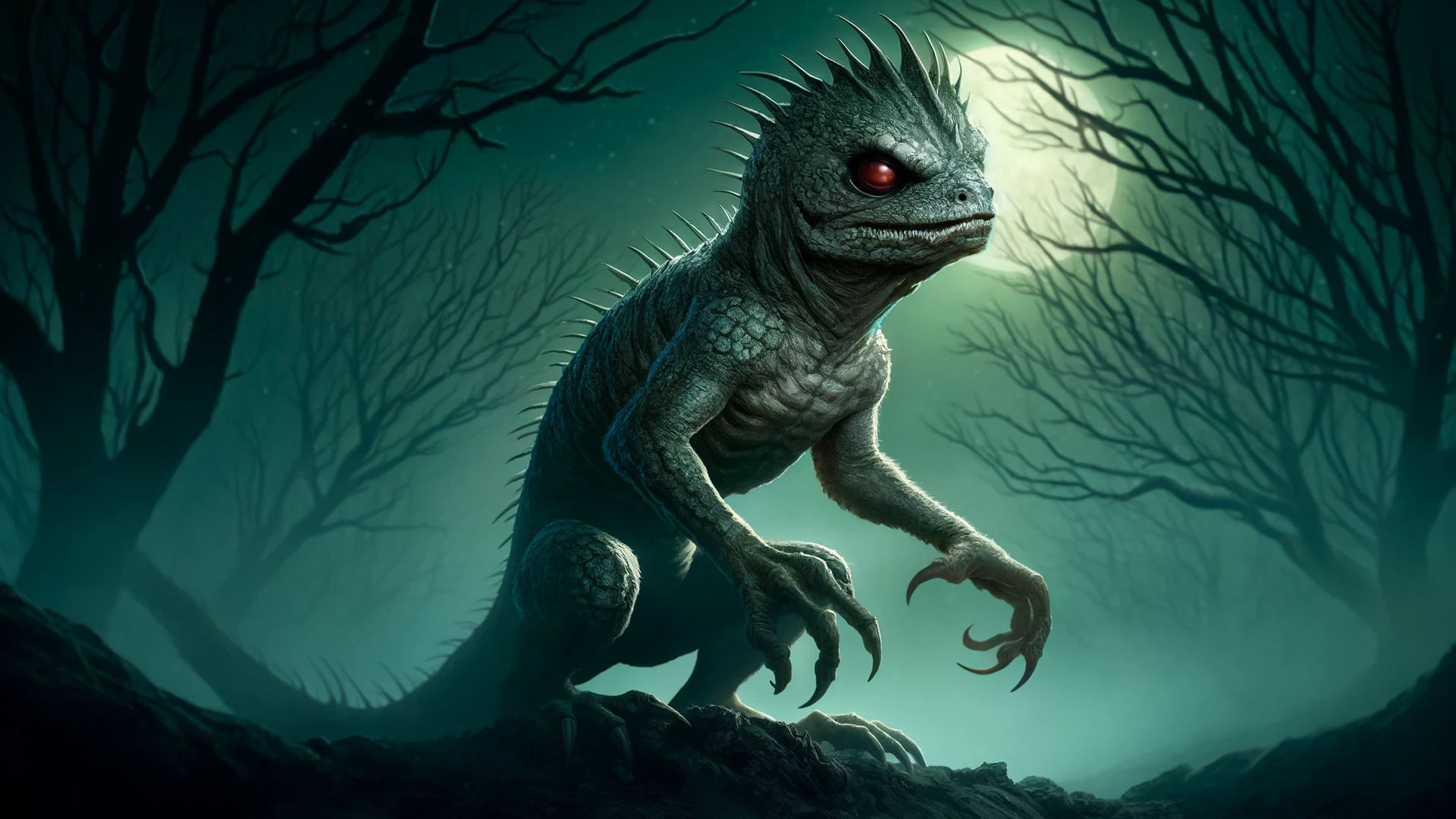
Art anticipates a night of intriguing discussions with a surprise guest and multiple emails from listeners about bizarre phenomena like the Chupacabra, a creature reportedly seen in Los Angeles. As the night unfolds, Art introduces Hector “Tito” Armstrong, a guest expert from Puerto Rico, currently a student at Princeton, who runs a website dedicated to the Chupacabra. They delve into the lore surrounding this creature, which is said to attack livestock and is feared in rural communities.
Tito describes the Chupacabra with vivid detail, comparing its appearance to a blend of a small kangaroo and a reptilian dinosaur, with large red eyes and spiny projections on its back. The creature’s ability to fly is debated, but reports of its sightings have spread from Puerto Rico to South America, Mexico, and now even to cities across the United States like Los Angeles and Oregon. Art and Tito discuss the rapid spread and growing awareness of the Chupacabra, pondering whether its emergence might be due to a recent increase in visibility or something more enigmatic. Tito expresses hesitance to definitively explain the origins of the creature, although theories range from alien involvement to genetic experiments. The dialogue takes a darker turn as they touch on reports of the creature expanding its diet to potentially include humans, raising concerns about future interactions between the Chupacabra and people.
The discussion progresses with Tito and Art exploring the possible origins and nature of the Chupacabra, including the intriguing theory that pollution and environmental toxins might have induced mutations, leading to the emergence of such creatures. Tito recounts the serious impact of the Chupacabra in Puerto Rico, where numerous animals have been found drained of blood, a situation that local communities have taken upon themselves to investigate due to governmental disinterest. He advocates for capturing and studying the creature if possible, rather than killing it, citing its unique biological characteristics as potentially valuable for scientific study.
Speculating further, Tito acknowledges that while some believe the Chupacabra could be a variation of a bat, the extent of blood drainage seen in its victims goes beyond typical bat behavior, suggesting something far more unusual. They also touch on the creature’s size, described by eyewitnesses as around four feet tall. Art shifts the conversation towards the personal, asking Tito if he would face the Chupacabra himself. Tito expresses a cautious willingness, underscored by a preference for safety and preparedness.
Tito contemplates the possibility of a biological link given the volume of UFO sightings, although conclusive evidence remains elusive. They discuss the creature’s breeding habits, hypothesizing that if it reproduces, it could mean a significant increase in its population, intensifying the economic impact on communities already affected by livestock losses.
The conversation shifts to consider the ecological and ethical implications of the Chupacabra’s existence. Comparing the Chupacabra to historical perceptions of wolves in America, Art muses about the complexities of potentially classifying the Chupacabra as an endangered species due to its harmful economic impact, paralleling past wildlife conservation debates. Tito emphasizes the importance of studying the creature to understand its behaviors and origins better, rather than eradicating it outright.
They also discuss Tito’s Chupacabra-focused website, which serves as a hub for information and community engagement around the Chupacabra phenomena, featuring articles from various sources and even Chupacabra-themed merchandise.
Art and Tito discuss the Chupacabra’s geographical spread, noting its movement from Puerto Rico to more temperate zones like Oregon, which suggests adaptability across different climates. Tito reports that sightings in Puerto Rico have decreased, whereas reports from Mexico and the U.S. have increased. They speculate about the creature’s nocturnal behavior, supported by accounts of sightings during the day as well, indicating that the Chupacabra may not be strictly nocturnal.
Further, there has been no photographic evidence of the Chupacabra, only artist renderings and computer-generated images. Art shifts the conversation to the cultural impact of the Chupacabra, noting how it has become a folkloric figure similar to a leprechaun in Ireland. The creature has been commercialized in Puerto Rico through merchandise like t-shirts and has inspired songs in the merengue genre. In Mexico, the term “chupacabra” is even used in political commentary to describe politicians as bloodsuckers.
The discussion takes a serious turn when Art mentions a report of a man in Mexico City who was allegedly attacked by the creature, suffering significant blood loss. This potential aggression towards humans adds a grave dimension to the Chupacabra’s mythos, contrasting with its earlier, more dispassionate discussion when it was believed to only attack livestock. Tito shares that, according to sources, the Chupacabra does not prefer human blood, although these claims are taken with skepticism due to the lack of direct evidence.
Art and Tito reflect on the media’s serious approach to the Chupacabra, contrasting with the often humorous tone taken with UFO reports. This shift indicates a broader recognition of the creature’s potential impact, suggesting that the phenomenon may warrant a more serious investigation. Callers join the conversation, with theories ranging from the Chupacabra being a survivor from ancient times living underground to potential government involvement in concealing its existence.
Theories discussed include the Chupacabra’s possible subterranean origins, which align with speculations about its ability to move through different climates and regions. Art queries Tito about blood samples found at attack sites, with Tito revealing that the blood type from these samples couldn’t be matched to any known animal or human types, hinting at the creature’s possibly unique biological properties.
As the hour concludes, Art hints at the prevalent theory of a government cover-up, similar to those associated with UFOs, suggesting that the government might be withholding information to prevent public panic.
Art Bell shifts the discussion slightly away from Chupacabra, providing updates on other topics and guests, including authors and celebrities he plans to interview, reflecting the diverse content of his show. However, he circles back to the Chupacabra phenomenon as callers continue to express interest and concern, particularly regarding the community impacts observed in areas like Bexar County, San Antonio, where people have reportedly witnessed the creature’s effects firsthand.
A caller’s comment leads into a conversation about the credibility of the Chupacabra stories, contrasting them with more light-hearted or skeptical UFO reports. This underscores the tangible fear and concern in communities directly impacted by the creature’s alleged presence. Art acknowledges these reports with a level of seriousness, suggesting the narrative around Chupacabra might be shifting within public perception and media treatment from myth to a more significant and possibly real threat.
Art also shares insights on media coverage and public perception around various topics, discussing how these narratives are shaped by political and social influences. Amidst these discussions, the topic of Chupacabra resurfaces briefly, intertwined with jokes about its origin being linked to pollution, indicating its continued relevance in the public’s interest.
Additionally, Art delves into issues of law and ethics, discussing controversial ideas such as drug interdiction strategies involving the potential poisoning of illegal drugs to deter usage.
Art Bell engages a caller from Boulder City, Nevada, who draws parallels between the Chupacabra and another elusive creature, the Sasquatch, noting similarities in their elusive nature and the difficulties in capturing concrete evidence of their existence. The conversation explores the cultural and mythical dimensions of these creatures, as the caller recounts an encounter in Peru with a shaman who described a protective spirit of a village, depicted as a winged creature with red-orange eyes. This depiction intrigues Art, who connects it to broader discussions about spiritual and mythical interpretations of such creatures.
The caller shares a personal experience of receiving a staff carved with the image of this creature, emphasizing its significance as a protector from the spirit world and possibly from “middle earth.” This narrative adds a layer of mystique to the discussion, blending folklore with eyewitness accounts, and suggests a deeper, possibly supernatural origin for such creatures.
A caller from Mesa, Arizona, discusses the properties of a South American herb used in a soda, believed to be an adrenaline stimulant, which segues into a playful debate about aphrodisiacs.
Another caller introduces a folklore story from the Philippines about a vampire-like creature, connecting it to psychological operations and alleged CIA activities, which adds a layer of intrigue and mystery to the discussion. This story parallels the Chupacabra in terms of being a creature of lore that evokes fear and curiosity.
A caller discusses previous reports from the late ’60s about mysterious cattle disappearances and large bird sightings, connecting historical anomalies to current Chupacabra sightings, suggesting a longstanding pattern of unexplained phenomena in these regions.
Another caller from Columbia, South Carolina, speculates that the Chupacabra might be linked to experimental technologies like those rumored to be part of the Philadelphia Experiment. She wonders if these experiments could have inadvertently opened portals or created unforeseen consequences, contributing to the Chupacabra sightings. This adds a layer of complexity to the creature’s mythology, intertwining it with conspiracy theories and government experiments.
Discussions also touch on cultural representations, such as hit songs about the Chupacabra in Puerto Rico, highlighting how the creature has permeated various aspects of culture beyond mere folklore.
A caller from Leavenworth, Kansas, shares a personal connection to the Chupacabra story, recounting how the mayor of a small town near the El Yunque National Forest in Puerto Rico initially reported the creature. This account highlights the local impact and the seriousness with which some community leaders address the Chupacabra phenomenon. The caller’s narrative is reinforced by coverage on Spanish-language television, which interviewed a veterinarian who examined the affected animals, adding a layer of credibility to the reports.
The conversation also touches on media representation and public perception, with mentions of the Chupacabra on shows like “Unsolved Mysteries” and investigations by notable figures in the paranormal community. This blend of local eyewitness accounts, media coverage, and scientific investigation paints a complex picture of the Chupacabra as more than just folklore.
Art Bell moderates a heated debate between Jay, a self-identified member of the Eastern Oregon militia, and Charlie, a liberal from Southern California. The discussion centers on the potential for violent action against the government, with both participants expressing strong, opposing views on the subject of constitutional rights, government overreach, and the ownership and use of firearms.
Jay insists that his views on gun ownership are about resisting what he perceives as government violations of constitutional rights, rather than promoting violence against government officials. In contrast, Charlie accuses Jay of endorsing actions that could escalate to violence, drawing parallels to acts of terrorism and questioning Jay’s respect for law enforcement and government authority.
Jay defends his militia’s standpoint, emphasizing a desire to protect personal freedoms against what he perceives as government overreach. He expresses concerns about the current administration pushing towards a socialist system, which he strongly opposes. Jay argues that he would use firearms to defend his rights under what he deems unconstitutional actions by the government.
Charlie challenges Jay’s position by questioning the rationality and legality of using violence to oppose government policies. He accuses Jay of endorsing actions that could be seen as terrorist, drawing parallels between historical acts of rebellion and current militia activities. Charlie’s position reflects a belief in working within the system through democratic processes rather than through armed insurrection.
Jay asserts that he would follow the commands of his militia leaders, indicating a preparedness to engage in violent actions if deemed necessary by his commanders. This readiness is based on a belief that such measures are required to protect personal freedoms against what he sees as government overreach. Charlie challenges this view by equating it to extremism, arguing that such actions can lead to unnecessary violence and have detrimental effects on the broader political spectrum, particularly for conservative and right-wing groups.
The conversation delves into constitutional rights, with Jay arguing that the right to bear arms is fundamental and should not be infringed by the government. He expresses frustration with what he perceives as liberal policies that restrict gun ownership, which he sees as a protective measure against government tyranny.
The debate between Jay and Charlie becomes intensely charged as they discuss the role and actions of militia groups in response to perceived government overreach. Jay maintains that he will act according to his commander’s orders, which may include taking up arms in defense of what he views as constitutional rights. Charlie, vehemently opposing Jay’s viewpoint, accuses him of preparing to commit acts akin to terrorism under the guise of defending freedoms.
Charlie challenges Jay’s trust in the jury system and questions whether Jay would receive a fair trial, likening it to other high-profile cases like O.J. Simpson’s, where public opinion and media portrayal heavily influenced perceptions of guilt and innocence. The discussion spirals into a confrontation about the potential consequences of militia actions, with Charlie warning that such actions could lead to unnecessary death and legal repercussions.
One caller, Gary from Phoenix, articulates the view that militia members are misguided in their approach to effecting change, highlighting the potential consequences of engaging the U.S. military. He argues that such actions would likely lead to defeat for the militias and could expose the country to foreign threats, ultimately harming America regardless of the outcome.
The conversation also touches on the legal and constitutional avenues available for change, with skepticism expressed about the militias’ claims of widespread support. The cycle of frustration, cynicism, and paranoia described by Gary suggests a dangerous trajectory for groups that start with constitutional intentions but become increasingly radicalized.
The debate extends to the responsibilities of the federal government in managing such standoffs, with comparisons drawn to past incidents like Waco. There is a call for a more measured, communicative approach that avoids escalation and violence, recognizing the need for media transparency and legal processes to resolve conflicts.
A caller references a 1973 Senate report that discusses emergency powers and claims that since 1933, Americans have been under a sort of undeclared war because of changes made during the Roosevelt administration. This viewpoint highlights a deep-seated mistrust of government authority among certain groups, tying it back to financial control and emergency powers.
Another caller expresses concern that any violent action by militias against the U.S. military would only trigger the severe national emergencies they fear, potentially leading to martial law, which would hurt the country economically and socially. This perspective underscores the fears of escalating government-militia conflicts into broader social chaos.
The debate touches on the legality and morality of militia activities, such as issuing liens and making pseudo-legal claims, which are often seen as fringe or outright illegal by mainstream society. Callers debate whether such actions are justified forms of protest or dangerous provocations that could lead to violence and societal disruption.
Listeners are urged to consider the consequences of their actions, with warnings against allowing extremist views to spiral into violence. The conversation also hints at possible government infiltration in militia groups, suggesting that some actions attributed to militias might be instigated or exacerbated by external actors, including federal agents.
One caller highlights historical government actions, such as the Trading with the Enemy Act, suggesting that since 1933, Americans have been in a state of emergency, which he believes justifies skepticism towards government intentions. He ties these concerns to a longstanding belief that financial powers have influenced governmental overreach, which he sees as a form of warfare against the American public.
Another caller emphasizes the futility of violence and the importance of seeking change through legal and electoral means. He encourages conservative listeners to actively participate in the political process rather than resorting to violent actions, which he views as counterproductive and harmful to the conservative cause.
The discussion also touches on the delicate balance the government must maintain in handling public knowledge of militia activities. There is debate over whether publicizing such events might incite further unrest or help in managing the situation by keeping the public informed.
Concerns are raised about the potential consequences of escalating conflicts between militias and the government, with fears that it could lead to a breakdown of societal norms and a descent into chaos. This is contrasted with historical examples where government actions, perceived as overreaches, have led to significant public backlash and standoffs, such as those in Waco and Ruby Ridge.
One caller emphasizes the historical patterns where small acts of defiance or perceived injustices can lead to larger conflicts, suggesting that even minor grievances about issues like gun restrictions could trigger significant reactions. This reflects a broader concern about the fragility of peace and the ease with which violence can erupt.
The discussion also touches on international comparisons, with callers noting that despite discontent with certain government actions, the level of freedom in the United States is still greater than in many other countries. This perspective is used to argue for resolving disputes through democratic processes rather than violence.
Another caller debates the likelihood of successful rebellion, suggesting that historical attempts at armed resistance within the U.S. have generally been quelled. However, there is also a warning that even small groups can ignite larger movements, and that declarations of attacking only military targets are often not credible once conflicts actually begin.
A caller reflects on the debates and discussions surrounding militia activities and the government’s potential response. The conversation critiques the effectiveness of these debates, emphasizing the importance of understanding the motivations and plans of militia groups rather than getting sidetracked by name-calling or personal attacks. The caller expresses concern that focusing on trivial aspects of the discussion can distract from addressing the serious implications of a militia planning to attack military targets.
Art, maintaining his stance on providing a platform for open debate, asserts that his show allows for uncensored dialogue that might not be heard elsewhere, defending his approach against criticisms of the debate’s conduct. This highlights the show’s role in facilitating tough conversations, even if they become contentious.
Additionally, the segment touches on the specifics of what might be considered military targets by militias, indicating a broad and potentially expansive interpretation that could include federal offices and other infrastructure. This underscores the growing tension and the seriousness with which these groups might act on their threats, reflecting broader national security concerns.