
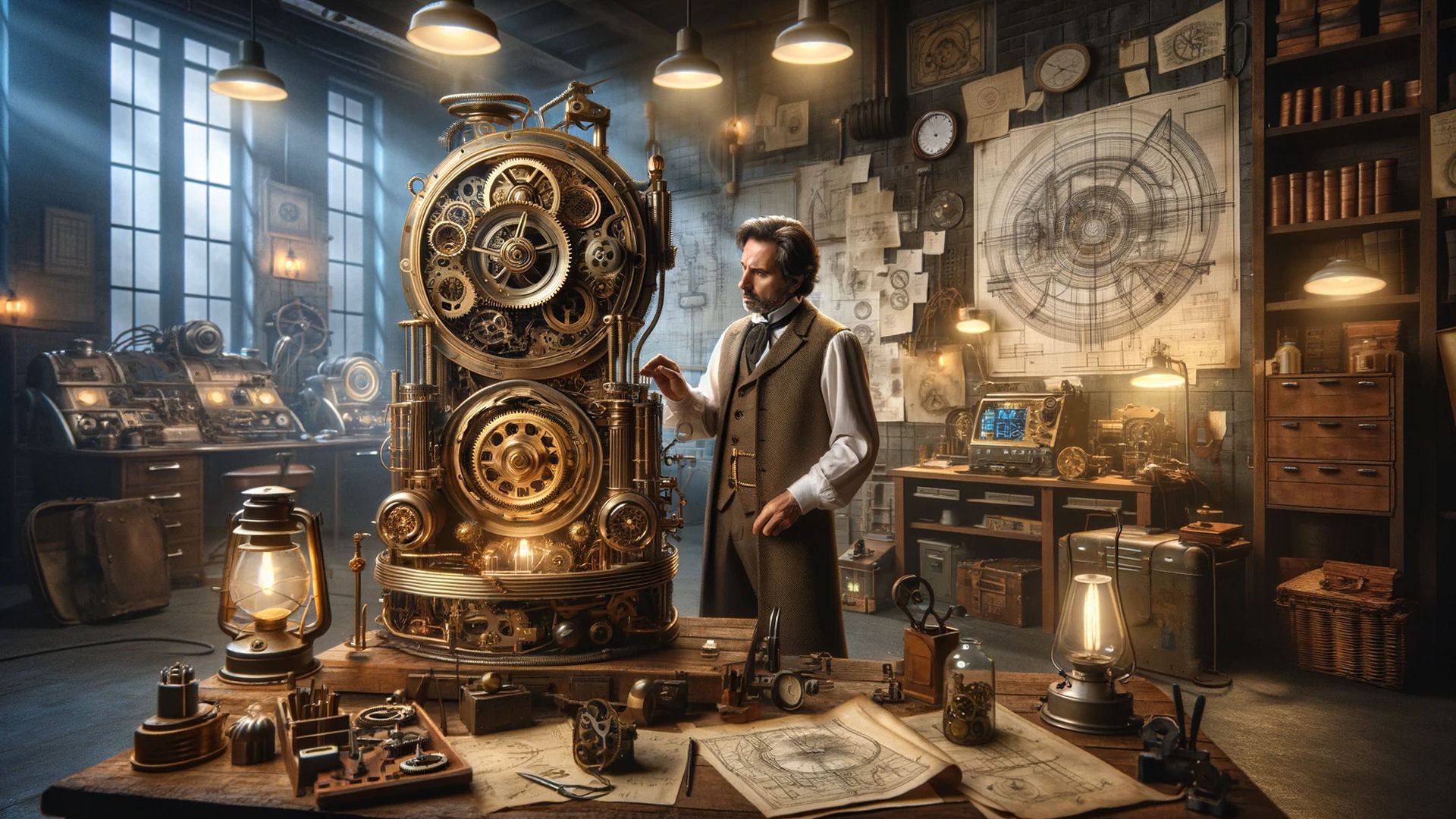
The night’s guest is Steven Gibbs, a man who claims to make time machines. Art shares his fascination with time travel and sets the stage for a conversation about the possibilities and skepticism surrounding it. Gibbs, described as a farm boy from Nebraska, is not to be judged by his vocabulary but by the details he provides about his time machine. The segment also touches on an annual sale by the C Crane Company, offering a product that enhances radio signal reception. The dialogue then shifts back to Gibbs, discussing his background and the mysterious origins of his time machine concept. Art questions the transition from farm life to time machine creation, highlighting Gibbs’s claim of being tapped into a “universal consciousness” that feeds him information. The segment ends with a mention of Gibbs’s time travel catalog, available for $1, sparking curiosity about its contents and the broader implications of time travel.
Art delves into the specifics of Steven Gibbs’s time machine, exploring its design and functionality. Gibbs describes the machine’s components, including three switches and a witness well, where an object representing the user (like a photograph or hair) is placed for time travel or health treatment. He explains the switches’ functions: one for power activation, another for operating an electromagnet, and a third for a multi-dimensional stabilizer, which supposedly enhances the machine’s performance.
Art is curious about the technical aspects, questioning the power usage and the origins of the machine’s design. Gibbs attributes the design to a mysterious time traveler, adding an element of intrigue and mystery. He mentions a third switch, the ‘clear’ switch, intended to remove any toxic radiation from the witness well. Gibbs also details the use of time coils, which are placed around the user’s head to channel energy into the machine, and dials for setting time travel coordinates or location ranges.
Art and Steven Gibbs continue discussing the operation of the time machine. Gibbs elaborates on the process of setting the machine’s controls, which involves placing time coils around the head and interacting with a rubbing plate to focus on a desired time period. The technique involves a mix of physical interaction and mental concentration, with users tuning dials based on where their fingers stick on the plate, indicating a connection with the intended time destination.
The conversation also touches on the broader implications of time travel, the ethics of choosing time periods to visit, and the machine’s energy dynamics, emphasizing the spiritual aspect where energy is channeled through the third eye into the device. The show takes a break, and Art teases the audience with a mystery photograph on his website, inviting listeners to identify a person.
After the break, Art shifts to discussing a new technology product unrelated to time travel, highlighting the show’s diverse range of topics. He talks about a device that converts video to still images, demonstrating the era’s technological advancements and Art’s interest in various tech innovations.
Art and Steven Gibbs delve deeper into the technical details of the time machine’s operation. Gibbs explains the use of an external electromagnet that is powered by a significant voltage to create a potent magnetic field. He discusses the practical aspects, such as the heating of the electromagnet and the necessity of cooling it down after use.
Gibbs also elaborates on the use of bar magnets to determine the polarity of the electromagnet and the significance of aligning it with the north field for the machine’s operation. He describes the placement of the electromagnet over the stomach chakra, suggesting it radiates a significant amount of energy, despite warnings from some scientists about potential negative effects.
The conversation shifts to the actual experience of time travel, with Gibbs describing a flash of white light as the activation signal, leading to physical transportation if positioned correctly over a grid point. He compares the experience to scenes from the movie “Contact,” illustrating the concept of time dilation and the observer effect.
Art then inquires about Gibbs’s history with time machines, tracing back to his early experiments in the 1980s involving the modification of a radio into a rudimentary time machine. Gibbs acknowledges the imperfections of his early work compared to his current machine.
Gibbs touches on testimonials from individuals who have purportedly used his machine, mentioning a particular case involving a customer from Australia, though details are withheld to avoid legal issues. This segment underscores the blend of scientific discussion, speculative theory, and personal anecdotes that characterize the show’s exploration of time travel.
Art explores a peculiar incident involving one of Steven Gibbs’s time machines. A man in Australia, after acquiring a machine, claims to have engaged in significant time travel. He arranges to meet with an editor from a magazine in the future, but the editor never receives the promised call, leading to a mysterious scenario where individuals sent to check on the Australian man also vanish without a trace.
Gibbs speculates that a vortex or doorway might have been inadvertently created, causing these disappearances. He explains that if the machine is programmed to accompany the user, it will travel with them; otherwise, it remains behind. This leads to a discussion about the potential risks of leaving the machine running unattended.
Adding to the intrigue, Gibbs mentions letters received with postmarks indicating they were sent from the future or the past, suggesting the machine’s user managed to manipulate time to send correspondence. This anecdote raises questions about the nature of time and the reliability of such extraordinary claims.
Moreover, Gibbs shares an encounter with officials, presumably from the FBI, who express interest in the time machine under the guise of using it for a movie project. After acquiring a machine, they contact Gibbs for advice, fearing the consequences of activating it inappropriately. Gibbs humorously suggests that sending the officials through time might be a fitting comeuppance for their skepticism and accusations of fraud.
Art delves into a curious case where individuals associated with the FBI allegedly vanished after meddling with one of Steven Gibbs’s time machines, despite warnings not to activate it. This incident adds an eerie and mysterious layer to the narrative, raising questions about the machine’s power and the consequences of tampering with such technology.
Steven also discusses the sales history of his machines, mentioning that he has handcrafted and sold over three to four hundred units since 1986. He describes how word of mouth and appearances on shows like Art Bell’s have boosted his sales, alongside advertising in various niche magazines.
The conversation shifts to the technical and regulatory aspects of the device, with Art questioning the lack of UL (Underwriters Laboratories) approval, which is typically required for electrical devices. Steven asserts that his time machine can transport users across time, with the limitation and extent of travel dependent on the type of ‘grid point’ used, which he explains are specific points on Earth with unique magnetic properties.
Art transitions to discussing Steven’s online presence, revealing that Steven has a website with a catalog and diagrams of his time machine, which was news to Art.
Art introduces a new perspective by bringing on Augie, a user of one of Steven Gibbs’s time machines. Augie, originally from Norway but currently residing in Omaha, Nebraska, did not purchase the machine but had the opportunity to use it through his acquaintance with Steven.
Augie describes his experience with the time machine, noting the physical setup involving coils wrapped around the forehead and a powerful electromagnet placed at the body’s center. He discusses the machine’s operation, emphasizing the intense heat generated by the coil and the need to switch hands to maintain contact.
The conversation shifts to a more theoretical discussion about time, where Augie distinguishes between mental and physical time travel. He challenges the conventional notion of linear time, suggesting that time is wave-like and based on frequency. Augie posits that to navigate time, one must enter a zero-point vacuum, a concept aligning with theories of hyperdimensional energy.
Augie describes a vivid vision he had while using the machine, where he saw a volcano erupting on July 7, 1999, a date and event he specifically targeted. Despite the intensity of the experience, including feeling dizzy and nervous due to the high voltage and heat generated by the machine, Augie considers it a phenomenal experience worth trying.
Art then transitions back to Steven Gibbs, who confirms his acquaintance with Augie. As Art is about to receive a time machine from Steven, he seeks advice and cautionary guidance. Steven emphasizes the importance of location when activating the machine, noting that Las Vegas is built over a negative grid point, which could result in unfavorable experiences. He advises that if Art were to travel physically, especially to a time before electricity, he should have a vehicle with a DC to AC inverter, enabling the machine’s use in any era.
The conversation also touches on the potential cultural and physical risks of appearing in a past era with modern technology, suggesting that one might be perceived as a space traveler or a threat, leading to dangerous situations like being burned at the stake.
Steven Gibbs discusses the pricing and availability of his time machines, which sell for $360 each. He explains that due to the handmade nature of the devices, he can only produce 5 to 7 units per month, leading to a backlog of orders. He mentions that new orders might not be processed until the end of the year or even into the next, depending on when the order is placed.
Steven also touches on the possibility of individuals building their own time machines by following instructions in his catalog, specifically referring to report number nine, which provides detailed guidance for constructing a device similar to his own. This report is sold separately and contains information that Steven claims nearly cost him his life due to government harassment during a trip to Calgary, Canada, where he was interrogated about his time machine.
The conversation shifts to the potential legal and border issues Steven faced, hinting at the controversial nature of his work and the skepticism and opposition he encounters. Following this, Art prepares to open the lines for listeners to call in with questions for Steven, transitioning from the technical and logistical aspects of the time machines to interactive audience engagement.
A caller from Hawaii raises concerns about the potential health risks associated with time travel, specifically the possibility of contracting future viruses and bringing them back to the present. Gibbs responds by asserting that the time machine creates a protective tachyon field that repels viruses, although the effectiveness of this claim remains speculative.
Another caller inquires about catastrophic events predicted for May 5, 2005, due to planetary alignment. Gibbs clarifies that he has not personally traveled to 2005 but references another user’s experience with the machine, hinting at a dystopian future.
One caller inquires about the dangers of using the machine, particularly the risk of internal combustion or bursting into flames due to the interaction of gemstones with the machine’s energy field. Steven advises against placing red-colored stones in the machine’s witness well, as they can step down the harmonics and potentially cause overheating.
Another caller from California questions the implications of time travel on one’s age and location, asking if he would revert to his 17-year-old self if he traveled back to 1971. Steven clarifies that the traveler would remain 43 years old, as they would be entering a parallel universe rather than their own past. He also explains that the traveler’s location in the past would depend on where they choose to go, not necessarily where they were at that age.
The concept of encountering one’s counterpart in a parallel universe is also touched upon, highlighting the complex and potentially risky nature of interacting with alternate versions of oneself.
One caller, Matt from Omaha, inquires about the duration one can stay in an alternate time period, to which Steven responds there’s a nine-hour limit before automatically returning to the present. He also touches on the risks of interacting with one’s alternate self and the potential for getting “locked” in another time period if the machine’s instructions aren’t followed properly.
Another caller raises a philosophical question about whether time travelers, when beyond time and space, can connect with the eternal or divine consciousness. Steven suggests that passing through the zero vector might offer a form of enlightenment or all-knowing state, albeit within the limits permitted by divine will, emphasizing that such experiences cannot substitute for personal faith.
The show wraps up with Art Bell reiterating how to obtain a time travel catalog from Steven Gibbs and teasing the anticipation of receiving his own machine.