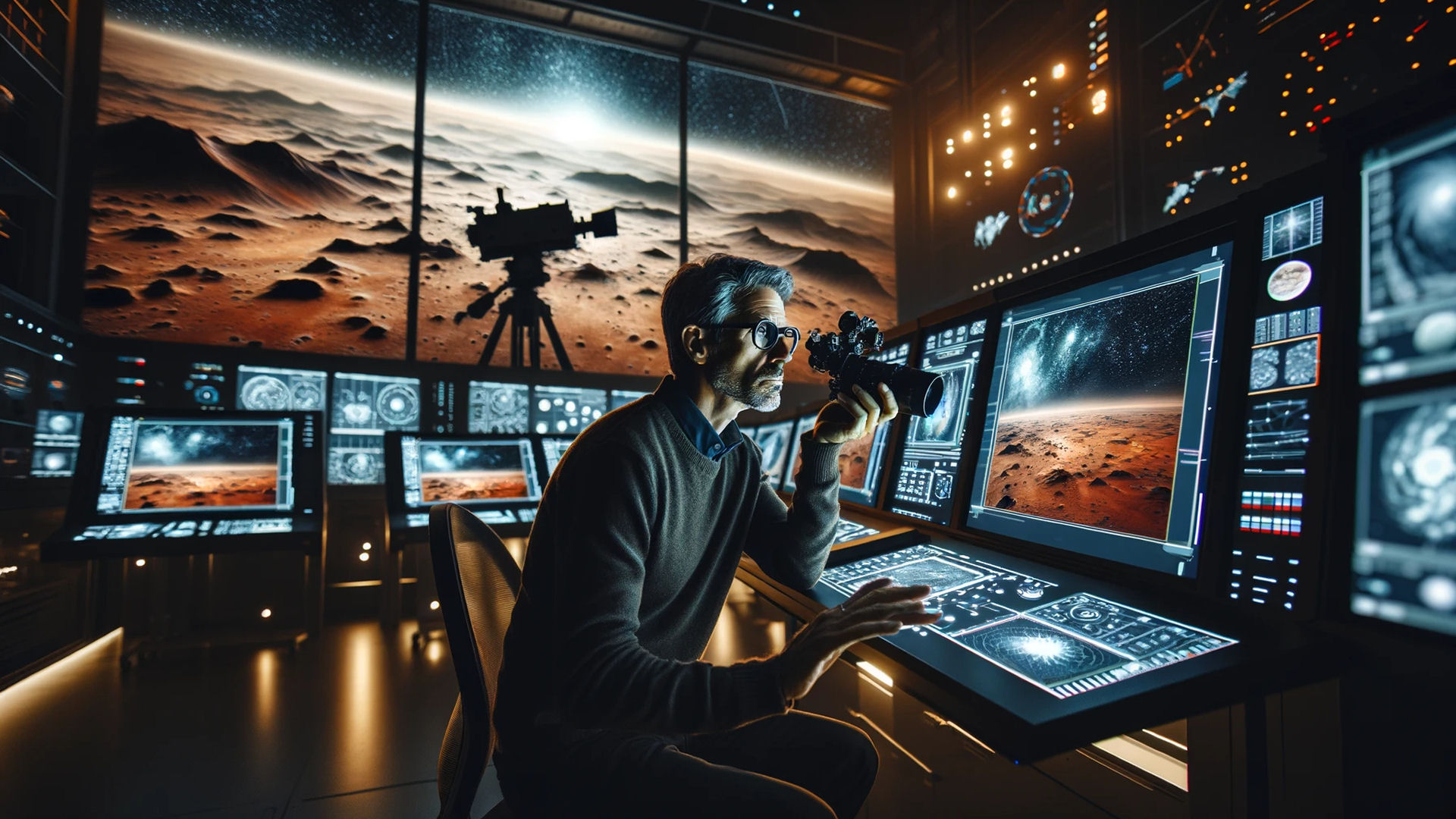
Art hosts a riveting episode of “Coast to Coast AM,” delving into the mysterious realms of Mars and its landscape. He expresses a newfound clarity in viewing enhanced Mars photographs, which, for the first time, reveal details that previously eluded him. These images provoke debates on the natural vs. artificial origins of Mars formations, stirring questions about potential past life or civilizations on the planet. Art plans to explore these topics further with the expert insights of Professor Tom Van Flandern. Additionally, Art reminds listeners of the upcoming Mother’s Day, humorously urging them not to disappoint their mothers and promotes a special offer on fresh flowers, complete with personalized cards.
Art and Dr. Van Flandern delve deeper into the intricacies of cosmology, discussing various theories that rival the Big Bang. Dr. Van Flandern critiques the centralized funding in science, which he believes stifles alternative cosmological models. They explore the Steady State model, which posits that as the universe expands, new matter is continuously created to fill the space, maintaining a constant density throughout the universe. Another intriguing concept discussed is plasma cosmology, suggesting a local ‘big bang’ within an infinite universe. Additionally, they touch on a model suggesting that redshifts in galaxy light may be due to energy loss rather than expansion, implying a static universe. The conversation also ventures into the philosophical, pondering the nature of space and time, particularly challenging the concept of infinity and the initial conditions before any cosmic event.
rt and Professor Tom Van Flandern continue their intriguing discussion on the latest enhancements of Mars photographs that Richard Hoagland worked on. Art, initially skeptical, now finds undeniable anomalies in the new images that suggest unnatural structures on Mars, which he hadn’t perceived in older photos. These structures, characterized by symmetry and angular designs, starkly contrast the natural fractal patterns usually found in cosmic imagery. Professor Van Flandern shares Art’s astonishment, pointing out the unique and seemingly artificial features present in the Cydonia region of Mars. These include objects with straight edges and right angles, reminiscent of architectural structures, sparking a debate on their possible artificial origins. Despite their excitement, Van Flandern acknowledges that some colleagues remain skeptical, attributing these features to natural phenomena and not fully embracing the broader implications of these anomalies.
Art and Professor Van Flandern delve deeper into the peculiarities of the Cydonia region on Mars, discussing a variety of images titled “The City Square,” “Archaeology Model Confirmed,” “Massive Tetrahedral Ruined,” and “Eroding Ruins.” Van Flandern emphasizes that while each image might be explained away as a natural formation when viewed individually, the collective features found exclusively in the Cydonia region suggest a very low probability of natural occurrence, hinting strongly at artificiality. He specifically discusses the “Face” structure initially identified in Viking photographs, noting that newer, higher-resolution images reveal more details that resemble facial features, which strengthens the argument for its artificial origin. Despite NASA’s reticence and somewhat dismissive attitude towards these findings, Van Flandern argues there is compelling evidence of artificial structures on Mars that should prompt further exploration and photographing, particularly of areas not yet fully observed.
Art and Professor Van Flandern discuss the challenges and skepticism within the scientific community regarding the interpretation of Mars photographs. Van Flandern expresses concern that many scientists may not be sufficiently open-minded or well-trained in the scientific method, which he feels has not been adequately taught in recent years. This, he argues, has led to a bias against recognizing potentially artificial structures on Mars due to a conflict of interest where scientists are reluctant to critically examine their own theories.
Van Flandern discusses the statistical unlikelihood of certain features being natural, suggesting that the odds are strongly in favor of them being artificial. However, he notes that some scientists have prematurely taken a public position against the artificiality of these features, which could bias them against acknowledging what could be a significant discovery.
The conversation also touches on NASA’s policy of not commenting on the Cydonia photographs, which Van Flandern interprets as a tactic to avoid controversy within the agency and the scientific community. Despite the silence from some critics who previously ridiculed the findings, the newer, enhanced images have quieted many skeptics. Art and Van Flandern hope that continued advocacy and new data will persuade NASA to further investigate Cydonia, amidst internal debates and the challenges posed by the spacecraft’s communication limitations due to its alignment with the sun.
Art and Professor Van Flandern explore the impending opportunities for further Mars exploration as the spacecraft emerges from a conjunction period, which temporarily hinders communication. They express optimism about capturing more detailed images of Cydonia, specifically the eastern side of the face and other intriguing structures like the ‘DNA pyramid.’ However, Van Flandern cautions that the window for capturing these images is closing rapidly due to the spacecraft’s increasing orbit altitude and the worsening sun angle, which would result in longer shadows and darker images.
Van Flandern underscores the urgency, noting that if these additional photographs aren’t taken in the next few months, it might not be possible again for a very long time, as the next Mars missions scheduled do not include cameras. He expresses a sense of critical timing, emphasizing that this could be the last chance to capture compelling evidence of artificial structures on Mars within their lifetimes.
The discussion concludes with Van Flandern promoting his book “Dark Matter, Missing Planets and New Comets,” available for purchase online, underscoring the public support that has made the imaging of Cydonia possible. Art wraps up, inviting listeners to view the discussed photographs and judge for themselves.