
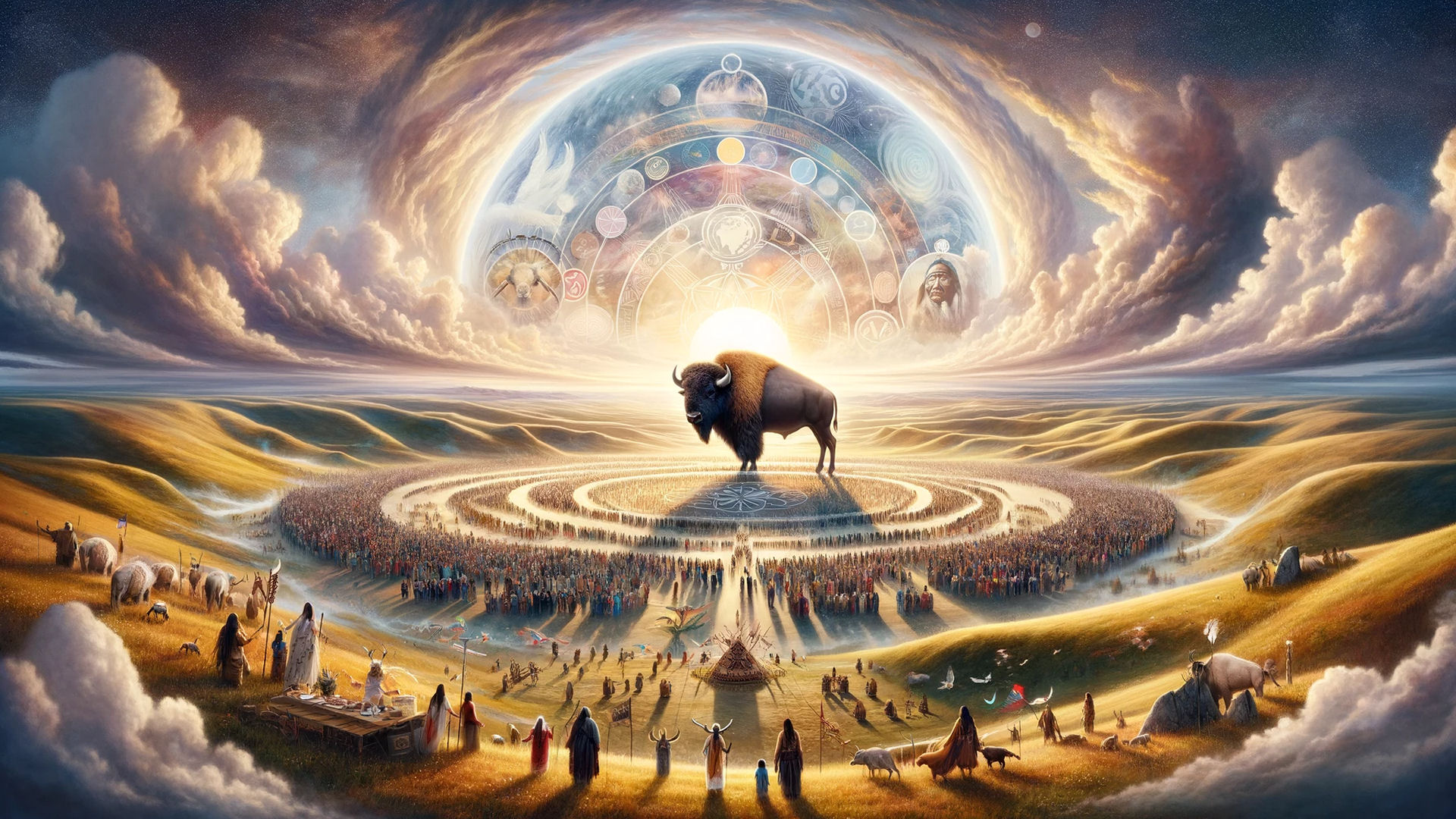
The guest is Chief Arvol Looking Horse. Born in 1954 on the Cheyenne River Reservation in South Dakota, Chief Looking Horse was raised by his grandparents and immersed in the Lakota culture and spirituality from a young age. At the age of 12, he became the youngest ever 19th generation keeper of the Sacred White Buffalo Calf Pipe, a significant spiritual responsibility for the Lakota, Dakota, and Nakota nations. Despite feeling overwhelmed by this duty, he dedicated his life to advocating for religious freedom, cultural survival, and the revival of his people’s traditions.
Chief Looking Horse actively participated in significant cultural events, like the Bigfoot Riders’ Mending the Sacred Hoop of the Nation prophecy and the Cry of the Earth Conference at the United Nations. His work also extends to the repatriation of sacred objects and ancestral remains from institutions like the Smithsonian. A key part of his mission involves organizing the World Peace and Prayer Day to bring awareness to sacred sites and prophecies.
During the interview, Art delves into the Chief’s experiences and beliefs. Chief Looking Horse explains the spiritual significance of the Sacred White Buffalo Calf Pipe and his inheritance of it through his grandmother’s vision. He also shares insights into the Lakota beliefs about the afterlife, detailing the spirit releasing ceremony, a year-long ritual to honor the deceased.
In this continuation of the “Coast to Coast AM” show, Chief Arvol Looking Horse further discusses the Lakota spiritual beliefs and practices. He explains the importance of letting the spirit of the deceased go into the spirit world, a process that is essential for both the spirit’s journey and the well-being of the bereaved family. This involves a ceremony where a spiritual leader guides the family in releasing the spirit, after which the community welcomes them back, symbolizing a return to normal life.
Art, the host, shares his personal background and doubts regarding his Christian faith, expressing envy for those with a strong, unwavering belief. He asks Chief Looking Horse about the nature of the spirit world and whether consciousness continues after death. The Chief describes the Lakota belief in a spiritual journey to the Milky Way, which is considered the realm of ancestors and the spirit world.
Chief Looking Horse also delves into the Lakota’s understanding of life’s four stages: birth, coming of age, self-sacrifice through rituals like the Sundance, and becoming an elder. Each stage is marked by specific ceremonies and rituals, reflecting a deep connection with nature and the cycle of life.
The conversation turns to the significance of the white buffalo in Lakota culture, symbolizing purity, sacrifice, and the sacred. Chief Looking Horse emphasizes the importance of offerings and respect in ceremonies like the Sundance and the role of the white buffalo as a powerful spiritual symbol.
Art expresses a desire to learn more about the white buffalo and other aspects of Native American culture, acknowledging his limited knowledge. Chief Arvol Looking Horse elaborates on the significance of the white buffalo in Lakota prophecies and spirituality. He expresses surprise at witnessing the birth of a white buffalo in his lifetime, something he thought would happen far in the future. This event, he explains, was a profound and exciting moment for him and his community.
Chief Looking Horse then recounts his role as the spiritual leader during the Ride to Wounded Knee in 1986 and the subsequent ceremonies aimed at healing the community from negative emotions like hatred, anger, and jealousy. These ceremonies, including the Mending of the Sacred Hoop and the Wiping of Tears Ceremony, are integral to restoring peace within the individuals and the community.
The birth of the white buffalo, according to Chief Looking Horse, symbolizes a period of peace and harmony. This aligns with Lakota belief in the cyclical nature of events, where four years after a significant ceremony, a white buffalo calf was born, marking a new era of hope and transformation. This event coincided with prophecies and signaled a time of significant spiritual importance.
Chief Looking Horse also discusses the broader implications of these spiritual signs, emphasizing the importance of understanding and respecting Mother Nature. He touches upon the views of Hopi elders, who foresee significant Earth changes and believe these are unavoidable. Chief Looking Horse shares this perspective, noting the importance of the World Peace and Prayer Day on June 21st, which he believes is crucial in addressing these impending changes.
The conversation then shifts to the potential consequences of not following the correct spiritual path, with Chief Looking Horse warning about the possibility of chaos, disasters, and widespread suffering if humanity fails to heed these spiritual and natural signs.
Chief Arvol Looking Horse discusses the current state of Mother Earth and the responsibility of people in preserving it. He expresses deep concern over environmental changes, such as melting ice in Alaska and Antarctica and the increasing pollution of oceans. These changes, he believes, are signs that we are already experiencing significant shifts in our world.
Chief Looking Horse shares his experience at a meeting with NASA in Albuquerque, New Mexico, where he was shown evidence of climate change and environmental degradation. He believes that NASA’s invitation to him reflects a growing recognition of the need to understand and respect Mother Nature, as well as to incorporate indigenous wisdom and prophecies into discussions about environmental issues.
Art Bell, the host, acknowledges the importance of connecting with the Earth and respecting it as part of our existence. Chief Looking Horse recalls his trips to the United Nations and discussions about global warming, emphasizing the urgency of addressing these issues. He warns that while the Earth will survive, humanity might not if we continue to abuse our planet.
Discussing prophecies, Chief Looking Horse mentions a black cloud, symbolizing impending environmental and spiritual crises. He stresses the importance of being in tune with oneself and one’s spirituality to survive these challenges. He also touches on the spiritual weakening of society, which he believes leads to issues like suicide among the youth.
Chief Arvol Looking Horse addresses the escalating crisis of youth suicide, particularly among the Lakota. He emphasizes that this issue is not confined to Native American communities but is a global concern. Chief Looking Horse links the rise in youth suicide to a loss of community, communication, and spiritual connection, suggesting that modern societies have strayed from traditional values of nurturing and respect.
Chief Looking Horse further explains that the Lakota believe in nurturing children with love and compassion, teaching them respect through parental example. However, he notes that many societies have lost these values, leading to a sense of disconnection and despair among the youth.
The discussion then turns to the high suicide rates among Lakota youth, which have been alarmingly high for over two decades. Chief Looking Horse comments on the tragic reality of young children, even as young as nine, considering suicide. He attributes this crisis to the historical and ongoing struggles of the Lakota people, including the suppression of their culture and spirituality, which only became legal again in 1978.
Art Bell reflects on the broader implications of these issues, recognizing the need for a deeper understanding of spiritual and cultural connections to address the challenges facing today’s youth.
Chief Arvol Looking Horse delves into the historical suppression of Native American ceremonies and practices. He explains that, until 1978, their religious practices were outlawed, which had a profound impact on their culture and spirituality. This suppression extended to the point where children were sent to boarding schools to be assimilated, further eroding their cultural heritage.
Art Bell, the host, contrasts this with the American ideal of religious freedom, highlighting the irony in denying Native Americans this right. Chief Looking Horse also discusses the misuse and commercialization of sacred ceremonies, which he finds deeply troubling. He stresses that traditional spiritual leaders should not charge for ceremonies, as this goes against their cultural values.
The conversation then shifts to the Sundance ceremony, a significant spiritual event for many Native American tribes. Chief Looking Horse describes the Sundance as an act of self-sacrifice and commitment, where participants dance from sunup to sundown, sometimes involving piercing as a form of offering to the Creator. He emphasizes the ceremony’s importance in connecting with the tree of life and the sun, despite recent changes in the sun’s intensity affecting the environment and people.
Art Bell shares his own observations about environmental changes, noting crop failures due to unusual sun intensity, which aligns with the Hopi elders’ warnings about changes in the sun.
Chief Looking Horse then speaks about the power of collective prayer and its ability to bring about change. He mentions the World Peace and Prayer Day on June 21st, where people worldwide are encouraged to pray for healing and positive energy shifts. He believes in the collective power to create reality through spiritual means.
Art Bell shares his experience with an experiment where he asked his audience to pray for rain in drought-stricken areas, which surprisingly resulted in rain. However, he expresses concern about the potential consequences of such power and the current state of the world, marked by greed and corruption, questioning if there are enough people committed to making a positive change.
Chief Arvol Looking Horse and Art open the phone lines for listeners to ask questions. A significant topic of discussion is the importance of dreams and visions, particularly among indigenous people. Chief Looking Horse emphasizes that these dreams are crucial but notes a lack of communication and understanding, especially with younger generations, about their significance and connection to Mother Nature.
One caller, Eleanor from Nashville, originally from Nebraska, shares her connection to the Rosebud Sioux and her family background. She defends the Sundance ceremony, contrasting it with more dangerous religious practices in other communities. Eleanor also expresses her desire to learn more about Lakota ways and language, reflecting on her personal loss and belief in the spiritual world.
Another caller from the Northeast talks about unusual weather patterns, including tornadoes, and their own prophetic dreams about such events. They describe recent extreme weather in their area, including ice storms and power outages, which are unusual for the season. The caller’s experiences align with Chief Looking Horse’s earlier discussions about environmental changes and the importance of paying attention to natural signs and prophecies.
Listeners call in to discuss various topics with Chief Arvol Looking Horse. A key theme is the significance of dreams and visions, with callers from different parts of the U.S. and Canada sharing their experiences and seeking the Chief’s insights.
One caller from New Jersey talks about her dreams of black clouds, aligning with Chief Looking Horse’s earlier mention of similar dreams as part of Native prophecies. Another caller from Vancouver, Canada, brings up the topic of the collective consciousness and its ability to shape reality, asking if there are positive outcomes in the prophecies, depending on the choices people make. She expresses faith in the planet’s future and her role as a student of psychic and healing arts.
Chief Looking Horse acknowledges these perspectives, emphasizing the importance of prayer and collective positive intentions, particularly in relation to the designated day of prayer on June 21st. The conversation then shifts to the need for balance in the world and whether there’s enough positive energy to counteract the prevailing negativity.
Another caller from Pennsylvania mentions the film “The Education of Little Tree,” which portrays the loss of Native American culture and identity due to assimilation policies. This caller’s reflection prompts a discussion about the historical suppression of indigenous cultures in America.
Chief Arvol Looking Horse continues to address questions from callers. One significant topic is the historical suppression of Native American ceremonies by the white settlers. Chief Looking Horse explains that the ceremonies, being a core strength of their culture, were something the white settlers couldn’t control, leading to their prohibition.
A caller from Illinois asks what individuals can do to safeguard their way of life, particularly in the face of significant changes predicted for the year 2000. Chief Looking Horse emphasizes the importance of collective prayer and spiritual action, advocating for June 21st to be recognized internationally as a day of peace. He believes that such collective efforts can create positive energy and bring peace into people’s lives.
Art acknowledges the power of collective intention and prayer, having witnessed its effects in his own experiments with his radio audience. He invites Chief Looking Horse to stay for another hour to continue the conversation.
Another topic that comes up is the modern-day situation on reservations, particularly concerning gambling and casinos. Chief Looking Horse refrains from commenting directly on the issue of gambling but notes that it has become a means of survival for many Native American communities.
A caller from Honolulu, claiming to be a descendant of Sitting Bull, joins the conversation but is cut off before making their full comment.
A caller from Hawaii expresses the belief that one strong, aware individual can make a significant impact, countering many who are lost or unaware. Chief Looking Horse agrees, emphasizing the strength found in ceremonies and the spiritual circle where everyone supports each other.
The discussion then shifts to the use of peyote in ceremonies. Chief Looking Horse explains that while some Lakota people use peyote, he respects the diversity of spiritual practices and beliefs among his people. Art Bell reflects on the various paths to spirituality, including the use of natural substances like peyote.
Regarding the autonomy of reservations, Chief Looking Horse explains the complexity of laws that apply to reservations, involving traditional tribal laws, state laws, and federal laws. This layered legal structure requires a deep understanding of various legal systems to effectively navigate and protect the rights and traditions of Native American communities.
A caller from Hawaii shares her experience living near the Rosebud Reservation during the American Indian Movement, expressing admiration for the spiritual strength of Native Americans in overcoming anger and resentment. She inquires about letting go of fear for the future and identifying sacred areas. Chief Looking Horse advises that healing from fear involves embracing spiritual practices and ceremonies, which help in letting go of pain, anger, and fear. He also mentions that there are sacred areas every hundred miles around the world, with the Black Hills being a particularly sacred place for the Lakota people.
One caller discusses the idea of strong individuals making a difference in the world, to which Chief Looking Horse agrees, emphasizing the power of ceremonies and the importance of spiritual support within the community.
The conversation then turns to the sacredness of certain places, particularly the Black Hills, which Chief Looking Horse describes as a vital spiritual center for the Lakota people. He explains that there are sacred areas every hundred miles around the world, where people have prayed and created positive energy over time.
A caller from Hawaii discusses the struggle with fear about the future and asks how to let go of it. Chief Looking Horse advises that healing comes through participating in ceremonies and embracing spirituality, which helps to release pain, anger, and fear.
Art Bell shifts the discussion to the autonomy of reservations, questioning how much independence they truly have. Chief Looking Horse explains the complex layering of tribal, state, and federal laws affecting reservations, highlighting the need to be well-versed in various legal systems.
The show also touches on personal stories and struggles, with a caller from New York sharing his journey as a recovering addict and how participating in a sweat lodge ceremony helped him reconnect with his spirituality. He asks for guidance on specific rituals or practices to focus on during the Peace Prayer Day on June 21st. Chief Looking Horse explains that this date is significant due to its alignment with the summer solstice and the energy shift felt by many elders and spiritual leaders.
Chief Looking Horse clarifies that the Lakota, Dakota, and Nakota are all part of one nation, the Sioux Nation. He explains that ‘Sioux’ is a name given to them by others and that they prefer to identify themselves by their own terms.
A caller from New York inquires about the symbolism of the frog and its relevance in Indian medicine. Chief Looking Horse indicates that while he respects all beliefs and practices, the Lakota people primarily focus on the buffalo as their symbol, and he is less familiar with the symbolism of the frog.
The conversation then shifts to the diversity of religious beliefs. Chief Looking Horse expresses his respect for all spiritual paths, acknowledging that each individual finds their own way to connect spiritually.
A caller from Houston mentions the historical suppression of cultural and religious practices, drawing parallels with other cultures like the Scots, where bagpipes were once banned. The caller supports the idea of a new history starting with the World Peace and Prayer Day on June 21st.
Another caller, of Cherokee descent, shares her spiritual journey and her feeling of having reached a stalemate in her spiritual growth. She speaks about being drawn to a specific geographical location but being unable to visit it. Chief Looking Horse responds by emphasizing the ongoing nature of spiritual growth and the ups and downs individuals may experience on their spiritual paths.
One caller from Connecticut, feeling spiritually stuck, expresses a strong desire to visit a particular place in Montana. Chief Looking Horse encourages following such spiritual calls, emphasizing the significance of sacred sites and ceremonies in Native American culture. He mentions that gatherings are happening all over the world, which are listed on their website, especially in connection with the World Peace and Prayer Day on June 21st.
A caller inquires if the “black cloud” prophecy could be a reference to nuclear war, to which Chief Looking Horse agrees. This aligns with the fears and concerns expressed by other callers about the current state of the world and the need for spiritual healing.
Another caller, from Idaho, discusses the complex sovereignty issues on reservations, highlighting the struggle of Native American youth in connecting with their traditions and culture. This caller echoes the sentiments of others regarding the loss of cultural identity and the challenges faced by indigenous communities.
The show also touches on upcoming events, including a concert in Albuquerque featuring Willie Nelson, which Chief Looking Horse mentions in connection with cultural awareness and support.
A caller then references Crazy Horse’s prophecies, relating them to recent occurrences of white buffalo births and other signs, suggesting a time of renewal and healing is approaching. This discussion of prophecy and signs resonates with the theme of hope and spiritual awakening that has been prevalent throughout the show.
One caller from Connecticut, drawn to a particular place in Montana, discusses the challenge of making such a journey due to personal circumstances. Chief Looking Horse encourages following one’s spiritual call and suggests that if it’s meant to happen, a way will be found.
A caller inquires about whether the “black cloud” prophecy could be related to nuclear war, to which Chief Looking Horse agrees. This brings a sense of urgency and importance to the discussions about spiritual and cultural preservation.
Another caller, an artist, expresses gratitude to Chief Looking Horse for his spiritual leadership and brings up the lack of a national holiday to honor Native American ancestors. She proposes creating a ceremony to educate people about Native American culture and history, aligning with a Cree prophecy about people of all colors coming together to heal the Earth.
A question arises about the prophecies of Crazy Horse and whether they align with current events, particularly the birth of white buffaloes. Chief Looking Horse addresses the query, noting the importance of understanding and respecting these prophecies within their cultural context.
A Cherokee shaman shares insights from the Sun Calendar about June 21st, 1999, indicating a time of exhaustion and challenges for men, suggesting a pause in material prosperity and hinting at war efforts collapsing. This aligns with the significance of June 21st as the day for the World Peace and Prayer Day, emphasizing the importance of this date in various spiritual contexts.
Another caller discusses biblical references that they believe relate to Native American ceremonies and prophecies, drawing parallels between different spiritual traditions.
A caller from Mobile, Alabama, shares disturbing dreams about a black and red sun, along with a silver bird, and feels drawn to a specific location, possibly Stonehenge. This mirrors the experiences of other callers who have felt a strong spiritual pull towards certain places or have had similar visions.
Art reflects on the spiritual world’s intriguing nature and encourages exploring it, contrasting the day-to-day focus on survival and competition in the business world. He suggests that this focus creates a barrier to understanding and engaging with spiritual matters.
The segment also includes a caller who experienced a power outage, leading them to purchase a radio for emergency preparedness, highlighting how personal experiences often prompt action more effectively than mere warnings.
A caller discusses Y2K and the uncertainty surrounding its potential impact. Art Bell expresses skepticism about the government’s preparedness for Y2K, noting the lack of clear information on the readiness of essential services. The conversation reflects the widespread anxiety and speculation prevalent at the time regarding the possible effects of Y2K on societal infrastructure.
Another caller from Philadelphia brings up the Federal Reserve’s additional printing of currency in anticipation of Y2K, highlighting concerns about bank runs and the sufficiency of cash reserves. This discussion underscores the financial uncertainties associated with Y2K and the government’s response to these concerns.
A caller shares their spiritual beliefs and practices, suggesting that asking God directly can lead to insights and answers.
One caller discusses the societal problem of children’s access to pornographic content on the internet. They debate the challenges of protecting children from inappropriate material, considering the realities of modern family life and technological access. The conversation highlights the difficulty of balancing freedom of information with the protection of minors in the digital age.
Another caller shifts the focus to spiritual beliefs, particularly reincarnation. They share insights from medical journals in India documenting cases of children with memories of past lives. This leads to a broader discussion about the possibility of reincarnation and the afterlife, with Art Bell expressing his openness to these concepts while acknowledging they reside in his “gray basket” of uncertainty.
The conversation also touches on the impact of collective positive thought. A caller suggests that the power of a few individuals focusing on positive intentions can outweigh numerous negative forces, aligning with the themes of hope and spiritual influence discussed earlier in the show.
Another caller introduces a scientific concept related to modifying the climate. They propose creating a large, lightweight structure in space, similar to a flat screen, to act as a filter for sunlight, potentially mitigating issues related to ozone depletion. The caller mentions having sent this idea to a science committee in Washington but received feedback about high environmental impact study costs.
Art reflects on the difficulty of committing to beliefs that can’t be definitively proven, expressing his struggle with various topics and ideas presented on the show.
A caller from Sacramento, California, briefly comments, leading Art Bell to reflect on the show’s topics and his personal loss of a friend, John. Art mentions that he will always remember John as he saw him the day before and expresses a sense of treasuring their last meeting.
As the show wraps up, Art Bell shares his emotional state with the listeners, indicating he might have a drink to cope with his feelings.