
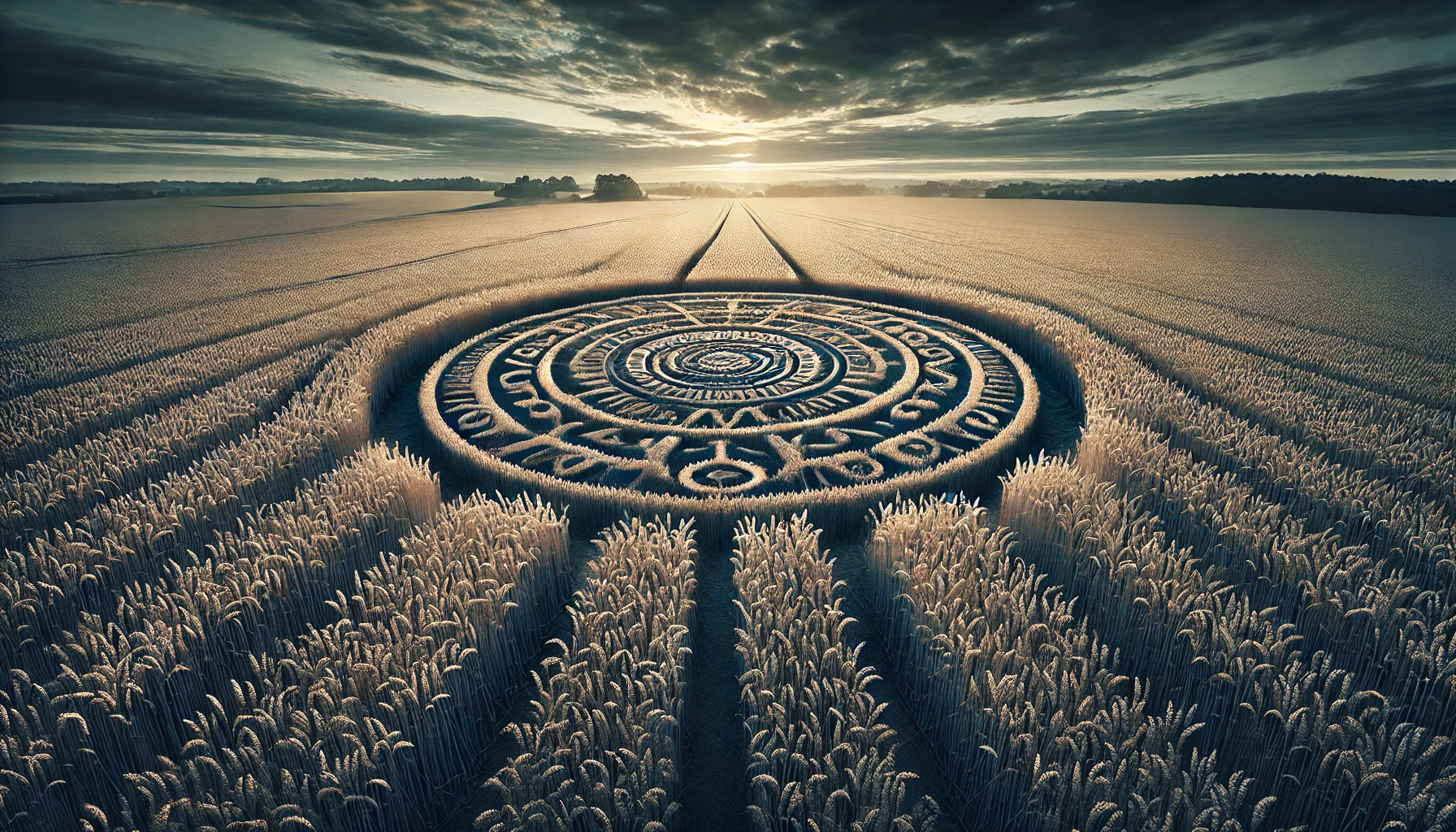
Art begins the show by introducing special guests, Linda Moulton Howe and Lucy Pringle, who discuss a recent back injury that had left Art in severe pain. Despite advice against surgery, Art shares how anti-inflammatory medication has helped him recover. The conversation then shifts to two extraordinary phenomena featured on Art’s website: a moving video of a ghost crossing a road in Nova Scotia and a detailed photograph of the largest crop circle ever recorded in Wiltshire, England, consisting of 409 circles in a fractal pattern. Linda and Lucy describe the complexities of the crop circle, emphasizing its size, precision, and the impossibility of it being man-made. They debate the potential involvement of supernatural forces or advanced technology in its creation. Andreas Müller, a German surveyor, adds that the crop circle’s formation in a rough, undulating field without any visible disturbance strongly suggests it was not created by humans. The discussion touches on the broader implications, hinting at a consciousness or intelligence behind such phenomena, possibly linked to Earth’s natural forces or other dimensions. At the end of the segment, Art teases the next topic on time travel with Professor John Gribbin, maintaining the show’s focus on mysterious and scientific explorations.
Art continues his conversation with Linda Moulton Howe and Lucy Pringle about the Milk Hill crop circle. They delve deeper into the intricate details of the formation, emphasizing its unprecedented size and the extraordinary precision with which it was created. The crop circle, consisting of 409 circles, is described as the most complex ever documented, and its formation on a rugged, uneven field without any signs of human intervention is highlighted as particularly baffling. Andreas Müller, the German surveyor, remarks on the challenge of creating such a formation, noting that even with advanced GPS technology, it would have taken days to achieve the same level of accuracy. This leads to a discussion about the possible explanations for the crop circle, with theories ranging from a highly advanced intelligence to natural forces beyond our current understanding. Lucy and Linda both express a belief that the phenomenon could be an environmental warning or a message from a higher consciousness, perhaps even a sign of something sacred in nature. The conversation remains speculative, but the participants agree that whatever created the crop circle is something far beyond human capability.
Art and his guests, Linda and Lucy, further explore the mysterious origins of the Milk Hill crop circle. They discuss the possibility that the formation could be a manifestation of a consciousness within nature, something that operates on a level of intelligence and precision far beyond human capabilities. Lucy mentions that the crop circle might have been created in just a few seconds, which adds to the enigma surrounding it. The discussion turns to the idea that this intelligence could be a form of hypernature, something inherent in the natural world but not fully understood by science. Andreas Müller also contributes to this theory, suggesting that the phenomenon could be a way for this intelligence to communicate with humanity, possibly to teach us something about our own nature and the environment. The guests express awe at the crop circle’s complexity, noting how it challenges our understanding of the natural world and hints at deeper, perhaps even spiritual, implications.
Art shifts the discussion to the broader implications of the crop circle phenomenon, exploring whether these formations could be linked to ancient knowledge or even carry religious significance. Lucy and Linda contemplate whether the crop circles, with their complex geometry and seemingly intentional designs, might be part of a larger, ongoing communication from a higher intelligence or consciousness. They discuss the possibility that the crop circles are not just random occurrences but might be intended to convey messages or warnings to humanity, particularly about environmental or spiritual matters.
Art also brings up the idea that the crop circles could be a form of sacred geometry, connecting them to ancient symbols and patterns found in religious and spiritual contexts. The guests agree that the formations seem to carry a profound significance that transcends simple explanations, suggesting that they might be related to the Earth’s energies or even to the consciousness of the planet itself.
The conversation then touches on the potential for these crop circles to be a call to action, urging humanity to pay more attention to the environment and to the subtle signs that nature might be sending us.
Art and his guests continue to delve into the spiritual and environmental implications of the crop circles. They speculate that these formations could be a form of communication from a higher intelligence, possibly urging humanity to reflect on its relationship with the Earth. The discussion emphasizes the idea that the crop circles might serve as a reminder of the interconnectedness of all life and the need to preserve the natural world.
Linda suggests that the precision and beauty of these formations could be a way of awakening a deeper awareness in people, encouraging them to consider the impact of their actions on the environment. Lucy echoes this sentiment, proposing that the crop circles could be seen as a form of sacred art, intended to inspire a sense of reverence for the Earth. They both agree that the phenomenon, while mysterious, has the potential to bring about a greater understanding of the natural world and our place within it.
Art concludes the segment by reflecting on the possibility that the crop circles are part of a larger, ongoing process of communication from the Earth or a higher consciousness. He suggests that these formations might be guiding us toward a more harmonious existence, one that respects the planet and all its inhabitants.
Art and his guests wrap up their discussion on the crop circles by contemplating their ultimate purpose and meaning. They consider whether these formations could be attempts by a higher intelligence or consciousness to communicate important messages to humanity. Linda suggests that the crop circles might be encouraging us to reconnect with the Earth and to pay closer attention to the signs and signals present in the natural world. Lucy adds that the formations could be viewed as a call to action, urging people to reconsider their environmental impact and to live in a way that is more harmonious with nature.
Art reflects on the broader implications of the crop circles, pondering whether they might be part of a larger spiritual awakening or a shift in consciousness. He suggests that these mysterious formations could be guiding humanity toward a deeper understanding of the universe and our place within it. The conversation ends on a note of wonder and curiosity, with Art and his guests agreeing that while the exact origins of the crop circles remain a mystery, they continue to inspire a sense of awe and reverence.
Art thanks Linda and Lucy for their insights and prepares to move on to the next topic on time travel with Professor John Gribbin.
Art introduces Professor John Gribbin, an esteemed scientist known for his work in physics and astronomy. The conversation shifts gears to focus on the intriguing topic of time travel, a subject that has captivated both scientific minds and the general public. Professor Gribbin begins by outlining the scientific theories that suggest time travel might be possible, particularly within the framework of Einstein’s theory of relativity. He explains how time dilation and the concept of wormholes could theoretically allow for travel through time, although these ideas remain speculative and beyond our current technological capabilities.
Art expresses his fascination with the idea of time travel and asks Gribbin about the potential implications if it were ever to become a reality. Gribbin discusses the paradoxes that could arise, such as the famous “grandfather paradox,” where a time traveler could potentially alter their own history. He also touches on the ethical and philosophical questions that time travel raises, including the possibility of altering the past and the consequences it could have on the present and future.
The segment concludes with Gribbin acknowledging that while time travel remains a theoretical concept, it continues to be a powerful source of inspiration and imagination. He emphasizes that the exploration of such ideas pushes the boundaries of science and helps us to better understand the nature of the universe. Art wraps up the conversation by thanking Professor Gribbin for his insights.