
The show begins with Art greeting listeners from across the globe and introducing new affiliates to the network, including WBM in Savannah, Georgia, and a station in Pahrump, Nevada, which he co-owns with his wife, Ramona. Art shares his excitement about the program’s growing audience, particularly in New York City, as evidenced by recent Arbitron survey results. He expresses his pride in being part of WABC, the station he grew up listening to, and the significant increase in listenership in the 25-54 age group.
Art then shifts to discussing his interest in music from the 1950s to the 1990s, with a particular fondness for the earlier decades. He observes a decline in the quality of music from the 1980s onwards but notes a recent renaissance in the music industry, with a return to more melodic and understandable tunes. Art invites listeners to send him lists of top music from these decades.
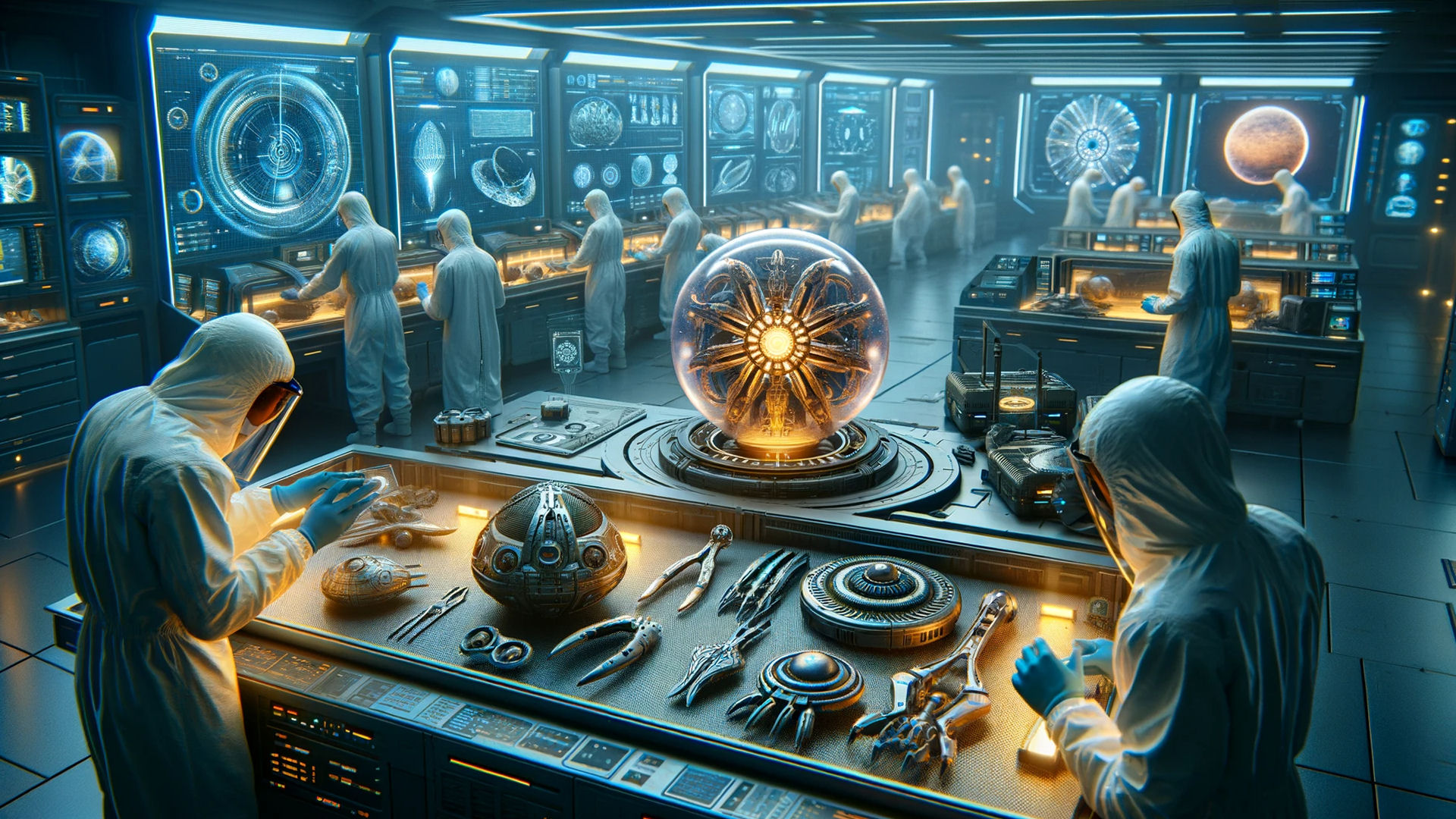
The main focus of the show is an intriguing classified ad from Florida, offering a piece of a UFO drive mechanism for $9 million, purportedly containing the secret of antigravity. Art contacts James Hughes, the man who placed the ad, to delve into the details. The ad, which appeared in the “Florida Today” newspaper, has already attracted significant attention, including a reported $7 million offer. Art plans to interview Hughes to uncover more about this mysterious offer and the alleged UFO technology.
Hughes recounts a story from 44 years ago when a friend of his witnessed a cigar-shaped UFO in New Jersey. The UFO hovered over a junkyard, opened a door, and discarded some metal pieces. Hughes’s friend, driven by curiosity, collected these pieces.
Hughes, who holds a degree in physics, was given one of these pieces by his friend, believing he could make more sense of it. For 44 years, Hughes kept this piece, occasionally telling people about it but mostly keeping it in a safe deposit box or drawer. Upon further examination, Hughes describes the piece as about two inches long, pyramid-shaped, with one smooth side and the other having a bubbly structure. The most notable feature, according to Hughes, is its layered structure, which he only noticed recently.
This layered structure aligns with Hughes’s own theory of the universe and antigravity, leading him to believe that this piece could be part of a UFO’s drive mechanism. He shares that this revelation came during a meeting with a group of people interested in the subject, where someone suggested the possibility of a layered structure. This newfound observation has reinforced Hughes’s belief that the piece is indeed part of a UFO’s drive mechanism, potentially offering insights into antigravity technology.
Hughes explains that he conducted initial tests on the metal piece, which did not dissolve in nitric acid but turned into a light yellowish powder. Seeking professional analysis, he approached Lehigh University, where the piece was identified as an alloy of indium and antimony. However, another analysis by MSL, a laboratory services company, contradicted this, stating the piece was pure antimony. This discrepancy puzzled Hughes until someone suggested the possibility of a layered structure, which resonated with his own theories.
Art Bell expresses his fascination with the idea that the piece could contain the secret of antigravity, a concept of immense scientific and potentially economic value. Hughes believes that the layered structure of the metal piece is key to its unique properties. The conversation then shifts to the rarity of antimony and the possibility of conducting tests to determine if the material is extraterrestrial in origin.
Hughes explains his decision to sell the piece for $9 million, a price he justifies by the potentially infinite value of antigravity technology. He humorously recounts how the price was initially set at $10 million but was reduced due to the advertising policy of “Florida Today,” the newspaper where he placed the ad.
Hughes confirms that he was indeed offered $7.5 million for the piece but the deal fell through. He expresses some regret about not finalizing the sale immediately. When asked about his rock-bottom price, Hughes suggests that he would consider offers of $1 million or more, especially from entities capable of analyzing the piece’s unique layered structure.
Art then inquires about photographs of the piece. Hughes confirms that photos exist and mentions that “Florida Today” is planning to feature an article with a picture of the piece. Art expresses interest in obtaining these photos for his website. Hughes’s friend Paul, a computer and website expert, joins the conversation. Paul discusses the challenges they faced in capturing good quality images of the piece and offers to send Art a video or digital photos.
Paul also mentions an interesting link about indium and antimony, the materials identified in the piece, and their use in semiconductors and nanotechnology. This link caught his attention due to its relevance to the layered structure of the UFO piece. Art is intrigued by this and requests that Paul send him the link and the photos for his website.
Hughes explains his motivation for finally bringing the piece into the public eye after 44 years. Frustrated by the scientific establishment’s disregard for his theory of the universe, Hughes saw the ad as a way to gain attention and potentially fund his interests in airport security and explosive detection technologies.
Hughes believes that America, representing all of mankind, should possess antigravity technology. He shares a personal anecdote about his father asking him to invent antigravity, a challenge that became a part of his life’s mission. Hughes then delves into his unique theory of gravity, suggesting that everything, including what we consider inanimate objects, is alive and complex. He proposes that electrons are composed of tiny creatures he calls “Kenneth,” which consume a substance named “Him.” This theory extends to the idea that even inanimate objects, like a telephone, might possess a soul.
Art listens as Hughes explains his theory, which involves the interaction of electrons with the sun, leading to a change in their vibrational state and the creation of gravitational waves. The conversation takes a more personal turn as Hughes contemplates giving out his phone number on national radio, acknowledging the vast audience but also his desire to share the concept of antigravity with everyone.
The focus shifts from James Hughes and his UFO piece to a new guest, David Brin. Before transitioning, Art Bell wraps up the conversation with Hughes, who provides his phone number for potential buyers interested in the UFO piece. Hughes expresses his willingness to work with potential buyers, including allowing tests on the piece before purchase.
The show then introduces David Brin, a renowned scientist, public speaker, and author. Several of Brin’s novels have been New York Times bestsellers, and he has won multiple Hugo, Nebula, and other awards. His 1989 ecological thriller “Earth” foreshadowed global warming, cyber warfare, and the rise of the World Wide Web. Brin’s work extends beyond fiction; his 1998 nonfiction book “The Transparent Society” explores the balance between freedom and privacy in the information age. His scientific papers cover a wide range of topics, from astronautics and astronomy to alternative dispute resolution.
Brin’s latest novel at the time, “Kiln People,” was released by Tor Books in December 2001. He has also completed two major science fiction trilogies, including “Heaven’s Reach” and “Foundation’s Triumph,” the latter concluding Isaac Asimov’s famed Foundation series. Art Bell notes Brin’s diverse accomplishments and prepares to delve into a conversation with him, highlighting Brin’s insights into the rapidly evolving technological and societal landscape.
Brin discusses his novel “Kiln People,” which explores a near-future scenario where people can create temporary clay copies of themselves. These copies, or golems, are baked in a kiln, possess the personality and memories of the original person, and are designed to last for just one day. At the end of the day, the golems return home to download their memories back to the original person, effectively allowing individuals to be in multiple places at once.
Brin explains that the golems have self-awareness and volatile memories. The novel, which is structured as a detective story, follows the protagonist who creates several copies of himself to solve a case. Brin notes that his detective character has experienced being shot, killed, and drowned multiple times through these golems, a concept he uses to explore the traditional rhythms of a murder mystery in a novel way.
Art Bell and David Brin also discuss the clichés often found in science fiction and murder mysteries, such as the overuse of secret government agencies, dark corporations, and mad scientists. Brin criticizes what he calls the “idiot plot,” where characters make obviously poor decisions, leading to predictable outcomes. He expresses his disdain for the portrayal of Americans as lacking intelligence in Hollywood movies, where skilled professionals rarely come to the rescue.
Brin’s approach in “Kiln People” and his other works is to present new ideas and technologies as widely accessible rather than monopolized by secretive or elite groups.
Brin, known for his foresight in predicting technological advancements like the internet in his novel “Earth,” discusses how science fiction writers are good at not just predicting the future but also preventing undesirable futures. He cites examples like “Dr. Strangelove,” “On the Beach,” and George Orwell’s “1984,” which served as cautionary tales, helping society avoid certain dystopian outcomes.
The conversation then shifts to the topic of webcams and privacy. Art Bell mentions his use of webcams and the unsettling possibility that someone could remotely access and activate a webcam without the owner’s knowledge. Brin acknowledges this as a technological reality and emphasizes the need to balance privacy and freedom with security. He criticizes the binary argument often presented in media debates, where one must choose between freedom and security, arguing that as Americans, people should not have to make such a choice.
Brin and Bell discuss the post-9/11 world, where security measures at airports and other public places have become more invasive. Brin asserts that Americans tend to get what they want over time and predicts that people will demand safety, convenience, and freedom without compromising on any of these aspects. He strongly believes in the American ethos of having one’s cake and eating it too, suggesting that it’s possible to find solutions that preserve both freedom and security.
Brin points out that while the number of casualties on 9/11 was significant, it should be viewed in the context of the broader risks and losses a nation faces. He emphasizes that the new kind of war America faces requires network skills and agility.
A key point Brin makes is about the actions taken on 9/11 by private individuals, particularly highlighting the heroism of the passengers on Flight 93. This flight, which was hijacked as part of the 9/11 attacks, crashed in Pennsylvania after passengers fought back against the hijackers. Brin and Bell discuss how the passengers on Flight 93, informed by cell phone calls about the other hijackings, decided to take action to prevent further tragedy, exemplifying the best of American spirit.
Brin criticizes the security measures at airports post-9/11, suggesting that the focus on security breakdowns is an overreaction to the events of that day. He argues that the failure was not in security but in the existing doctrine, which advised pilots to cooperate with hijackers. This policy, he notes, was based on past experiences with hijackings where cooperation often led to safe outcomes. However, the events of 9/11 required a new approach, and the passengers on Flight 93 demonstrated this by changing the doctrine themselves in a matter of minutes.
The segment concludes with Brin emphasizing the importance of individual action and decision-making in times of crisis. He suggests that the passengers’ ability to quickly gather information and collectively decide on a course of action represents a powerful example of how people can respond effectively to new threats, even in the absence of immediate government guidance.
Brin emphasizes the empowerment of individuals through technology, predicting a shift from reliance on professionals to a more informed and engaged citizenry. He foresees a “century of amateurs” where people, equipped with technology and information, will increasingly challenge and collaborate with experts.
Brin also touches on the topic of cloning, a subject of his novel “Kiln People.” He addresses the ethical and legal implications of cloning, particularly in the context of creating clones for organ harvesting or as “designer people.” Brin argues that while the idea of cloning may cause discomfort, it’s crucial to specify the actual harm involved. He advocates for any child, including a clone, to be born into a loving family and not treated as property. Brin encourages thoughtful discussion about the implications of cloning, emphasizing the importance of ensuring that a clone is loved and allowed to lead their own life, free from the expectation of being a duplicate of someone else.
The conversation then shifts to the potential for creating “designer people” through cloning, where certain brain functions could be manipulated. Brin stresses the need for ethical considerations in such scenarios, highlighting the importance of treating all individuals, regardless of their origin, with dignity and respect.
Brin argues that Americans are accustomed to seeking solutions that allow them to have their cake and eat it too, striving to maximize benefits while minimizing harms.
The conversation shifts to the concept of creating “happy, fulfilled, willing slaves” through genetic engineering. Brin is skeptical about the morality of such a creation, emphasizing the importance of treating any being, regardless of its origin, with dignity and respect. He challenges listeners to consider the ethical implications of creating beings designed solely for servitude.
Brin and Bell also discuss the complexities surrounding the abortion debate and the ambiguity of when human life begins. Brin points out that many embryos self-abort naturally, suggesting a natural editing process during early pregnancy. He emphasizes the importance of acknowledging the ambiguities and complexities in such ethical debates.
The discussion then turns to Brin’s science fiction work involving the uplift of dolphins, where he explores the idea of genetically enhancing dolphins to the point of being able to vote and participate in human society. Unlike previous authors who depicted uplifted animals as slaves or rebels, Brin’s vision is one of inclusion and empowerment. He imagines a future where dolphins, as intelligent beings, contribute to societal debates, particularly on environmental issues.
Art and David Brin continue their discussion on the concept of uplifting animals, specifically dolphins and chimpanzees, to a higher level of intelligence and possibly granting them rights such as voting. Brin humorously speculates that dolphins might lean towards Democratic views due to their ecological concerns, while chimpanzees, if given an entrepreneurial gene, might have different political leanings.
The conversation then shifts to the ethical implications of genetically engineering animals to enhance their intelligence. Brin, a science fiction author, explains that while he is not a biologist, he engages with experts in various fields to inform his writing. He encourages listeners to educate themselves about different scientific topics, highlighting the accessibility of knowledge in today’s world.
Brin shares insights from his interactions with researchers working with dolphins and chimpanzees. He notes that these animals seem to be at a threshold of intelligence, showing signs of frustration and a desire to understand human knowledge. This observation inspired Brin’s science fiction work, where he explores a future in which humans have helped uplift these animals, granting them enhanced abilities and possibly integrating them into human society.
Brin suggests that humans might play a role similar to that of the Vulcans in “Star Trek,” helping uplift other species. He emphasizes the importance of open discussion and societal consensus before embarking on such significant genetic engineering projects.
The conversation then shifts to the topic of unintended consequences in technological and scientific advancements. Brin references Edward Tenner’s book “Why Things Bite Back,” which discusses the unforeseen outcomes of well-intentioned plans. He shares an anecdote about the construction of the Alaska Pipeline, highlighting how criticism and scrutiny from environmental groups helped improve the project’s safety and design.
Art steers the discussion towards Brin’s work on aliens and extraterrestrial life. Brin, who has been involved in SETI (Search for Extraterrestrial Intelligence) and exobiology, discusses the rarity of intelligent life in the cosmos. He explains that while he believes extraterrestrial life exists, it is likely very rare. Brin also touches on the vast time scales involved in the evolution of life and the absence of any evidence of extraterrestrial industrial civilizations on Earth during the billions of years when conditions were favorable.
The segment concludes with a discussion on the possibility of life forms based on different biochemistries, with Brin noting that the amino acids used in DNA are commonly found in laboratory experiments simulating various planetary atmospheres.
Brin suggests that humans might be the ones to help others in the universe, reversing the common science fiction trope of humans being the young upstarts assisted by older, wiser alien races.
Brin, wearing his “science hat,” expresses skepticism about the existence of radically different forms of life, suggesting that life forms we encounter are likely to be similar to those on Earth. He discusses the Fermi Paradox, which questions why we haven’t encountered extraterrestrial life despite the vastness of the universe. Brin offers various explanations for this, including the possibility that intelligent life is rare.
The conversation takes a humorous turn as Brin addresses hypothetical extraterrestrial listeners, criticizing the behavior attributed to aliens in UFO sightings as immature and rude. He challenges these supposed aliens to make a more open and impressive display of their existence, such as altering a feature on the Moon, to prove their presence.
Brin also touches on the Prime Directive from “Star Trek,” a rule of non-interference with less advanced civilizations. He contrasts this with human history, where contact with remote societies often led to their disruption. Brin speculates that if aliens are observing us, they might be avoiding contact due to our lack of maturity or the vast distances between stars making physical travel impractical.
Art shares his personal experience of witnessing a UFO, a large triangular craft, which he describes in vivid detail. He recounts how the craft, floating silently and defying gravity, passed overhead, blotting out the stars and moon. This sighting occurred near Death Valley, close to Area 51, fueling Bell’s speculation about the government’s involvement in secretive aerospace technology.
David Brin, while acknowledging the possibility of government secrets, expresses skepticism about long-term secrecy, especially in a society increasingly resistant to keeping such secrets. He discusses the difficulty of maintaining secrecy in a world where whistleblowing is becoming more common and accessible.
The conversation then turns to the Roswell incident and the alleged recovery of alien technology. Brin challenges the notion that such a secret could be kept for over 50 years, arguing that the nature of scientists and engineers, especially as they approach the end of their careers, would likely lead to disclosures of such monumental discoveries. He questions the credibility of those who have come forward with claims about Roswell, suggesting that key individuals who would have been involved in such a project have not come forward to corroborate the story.
Art Bell counters with examples of individuals he has interviewed, including Colonel Corso and Jesse Marcel’s son, who have shared their experiences related to Roswell and UFOs. Brin remains skeptical, emphasizing the improbability of maintaining such a vast secret over multiple generations of scientists and engineers.
The conversation shifts to the SETI (Search for Extraterrestrial Intelligence) program and the likelihood of finding extraterrestrial life. Brin mentions the hydrogen frequency as a target for SETI searches, explaining that it’s a logical place to look for signals from civilizations similar to ours. He also notes the increasing affordability of technology, which allows amateur astronomers to contribute to space exploration and asteroid detection.
Bell and Brin discuss a recent close encounter with an asteroid, emphasizing the importance of monitoring near-Earth objects. Brin points out that while a significant impact could be devastating, it would not necessarily be civilization-ending.
Brin expresses his enthusiasm for the democratization of technology, such as cameras, telescopes, and cell phones, believing that increased access to these tools will make society more educated and less susceptible to authoritarian control. He discusses the increase in reported UFO sightings and speculates that as camera technology improves, the quality of UFO evidence might also improve.
Bell shares his own UFO sighting experience, describing a large, silent, triangular craft that he observed near his home. Brin remains skeptical about the existence of UFOs but is open to the possibility of advanced government technology being mistaken for extraterrestrial craft.
The conversation shifts to the Brookings Report, which suggested that knowledge of extraterrestrial contact might be destabilizing to society. Brin criticizes this report, arguing that society is more resilient and adaptable than the report suggests. He believes that if extraterrestrial contact were to occur, society would adapt and integrate the new reality, much like in the movie “Alien Nation.”
Brin also addresses the potential reaction of religious fundamentalists to extraterrestrial contact, hypothesizing that they might view aliens as demonic beings. However, he expresses confidence in the overall ability of society to handle such a revelation.
Finally, Bell asks Brin about his experience with the film adaptation of his novel “The Postman” and his views on Hollywood. Brin briefly touches on the topic, indicating a nuanced view of the film industry.
He shares that while the movie captured the moral heart of his book, it lacked some of the book’s intelligence. Brin was present on set for a couple of days but was not consulted during the filmmaking process. He expresses satisfaction that the movie led more people to read his book and appreciate its depth.
The conversation then shifts to the topic of UFOs and extraterrestrial contact. A caller from Maui, Hawaii, questions Brin about the mythological and folkloric aspects of alien encounters, suggesting that supernatural beliefs and stories of creatures like leprechauns and demons in various cultures could be interpreted as early interpretations of alien encounters.
Brin responds by drawing a parallel between these mythological creatures and modern depictions of aliens, particularly the “grays.” He suggests that these myths serve a similar purpose across cultures, providing exciting yet fearful experiences. Brin has written a story, “Those Eyes,” which explores this idea and is available on his website.
The discussion then turns to the concept of a “golden age.” Brin notes that unlike previous civilizations that looked backward to a golden age, modern society tends to look forward to a future golden age, a shift he attributes partly to the influence of science fiction. This forward-looking perspective is unique in human history and represents a significant change in cultural mindset.
Brin addresses the caller’s question about considering mythological evidence as support for extraterrestrial visitation. He argues that while every culture has myths about a golden age, there is no physical evidence to support these beliefs, and the lack of evidence leads him to remain skeptical about the idea of continuous alien visitation throughout human history.
Brin talks about an initiative by Alan Tough at the University of Toronto, who set up an internet site inviting aliens to join a discussion group, hypothesizing that extraterrestrial beings or their machine emissaries might already be lurking in our solar system and monitoring our internet.
Brin lists several reasons why aliens might be observing us but not communicating, including a prime directive-like policy, cultural differences, and the possibility that they are stealing our culture without having to pay for it. He remains open-minded about UFO sightings, acknowledging that some might be real, but he criticizes the behavior often attributed to UFOs as unimpressive and juvenile.
A caller from Morton, Illinois, asks Brin about the possibility that UFO sightings are actually government technology being kept secret. Brin discusses the plausibility of the government keeping secrets for a limited time, such as ten to fifteen years, but he remains skeptical about long-term secrecy, especially over several generations. He finds it more plausible that new developments in technology, possibly related to antigravity, could be emerging from places like Area 51.
Brin encourages engineers and scientists who might be privy to secret projects to consider whistleblowing, especially if they believe the time is right to reveal such secrets. He admits that Art Bell’s personal testimony about witnessing a UFO has slightly adjusted his opinions, making him more open to the idea that there might be interesting developments in advanced technology waiting to be revealed.
David Brin continues to discuss the themes of government secrecy and the potential for advanced technology, particularly in the context of UFO sightings and extraterrestrial contact. He reiterates his belief that the only secrets that can and should be kept are temporary ones, emphasizing the importance of transparency and accountability in government and other institutions.
Brin speculates on reasons why scientists might choose to keep certain technologies secret, such as the potential dangers associated with them. He gives an example from his novel “Earth,” where the use of micro black holes as an energy source leads to catastrophic consequences. This discussion highlights the ethical dilemmas faced by scientists and engineers when dealing with powerful and potentially hazardous technologies.
A caller from Lexington asks about the Bentwaters incident, a well-known UFO sighting involving military personnel. Brin admits he is not familiar with the specific details of this case. Art Bell briefly describes the incident, mentioning the close encounter with beings and the involvement of a lieutenant colonel.
Brin uses the movie “E.T. the Extra-Terrestrial” as a metaphor to discuss how perceptions of government and extraterrestrial beings are shaped by media and storytelling. He points out that while the movie initially portrays government agents as threatening, the key government character turns out to be a sympathetic figure, suggesting a more nuanced view of authority and the unknown.
The segment ends with a news break, providing updates on various topics, including a military plane crash in Pakistan and President Bush’s comments on the war against terror.
Brin references physicist Frank Tipler’s book “The Physics of Immortality,” which suggests a future where advanced civilizations could use the universe’s energy to resurrect individuals from the past. This idea parallels religious notions of resurrection and immortality. Brin also touches on the concept of cloning, emphasizing that cloning would only bring back the body, not the mind. He mentions the idea of freezing heads for future revival, a topic explored in science fiction and by those interested in cryonics.
A caller from Idaho asks about the moral implications of uplifting animals, such as making them more intelligent. Brin discusses the potential repercussions for industries that use animals, like livestock farming, and the ethical considerations of such actions. He also speculates on the possibility of encountering vastly different forms of intelligence in space, which could challenge human comprehension.
Brin’s novel “Killing People” explores the idea of extending human life by living parallel lives through multiple bodies, including the possibility of experiencing life as different species or genders. This concept raises questions about empathy and understanding between different beings.
David Brin discusses the ethical implications of uplifting animals and the potential for understanding alien intelligence. He speculates that animals like pigs, dolphins, and parrots might be candidates for uplift due to their intelligence, raising moral questions about their treatment and use in industries like livestock farming.
Brin also addresses a caller’s question about the possibility of encountering alien intelligence so different from ours that it might be incomprehensible. He argues that humans, particularly those with open-minded and adventurous attitudes like Californians, would likely try to communicate and understand such alien beings. Brin uses this as a metaphor for the broader capacity of Western civilization to embrace and seek to understand the unknown.
Brin also touches on the concept of immortality and cloning, discussing the idea of downloading consciousness into different bodies or even animal bodies. He explores these themes in his novel “Killing People,” which deals with the idea of living parallel lives through multiple bodies.
A caller from Idaho brings up the topic of the Brookings Report, which suggested that the discovery of extraterrestrial life could have a significant impact on society, particularly on scientists. Brin acknowledges the potential impact but remains skeptical about the government’s ability to keep such a discovery secret for an extended period.
David Brin and Art Bell discuss the possibility of humanity being the first intelligent life form in the universe and the implications of this scenario. Brin speculates on various reasons why we might not have encountered extraterrestrial life, including the possibility that other life forms have been systematically eliminated by various existential threats, such as nuclear war or ecological self-destruction.
Brin suggests that humanity might be the first to overcome these challenges and could potentially play a role in helping other life forms in the universe avoid similar fates. He also entertains the idea that if we are alone in the universe, humanity might fulfill its longing for the alien by creating artificial intelligence, uplifting animals, and fostering cultural diversity.
The conversation concludes with Art Bell expressing appreciation for Brin’s insights and inviting him back for future discussions. Brin thanks Bell and encourages listeners to explore the topics further.