
Art expresses his unfamiliarity with the Mothman Prophecies, anticipating an interview with John Keel to learn more. Art then shifts to current news, mentioning UN Secretary-General Kofi Annan’s arrival in Afghanistan and the legal charges against John Walker Lindh for conspiring to kill Americans in Afghanistan. He comments on the controversial Enron scandal, highlighting the skepticism surrounding claims that a single auditor was responsible for document destruction.
Art also touches on President Bush’s request for $38 billion for advanced weapons, emphasizing their precision and cost. A disturbing news story follows, about a school bus driver who kidnapped 13 children, thankfully ending safely with no harm to the children. Art then reads an email from David Kagan, author of “Sunstroke,” discussing a Japanese energy satellite project and its potential risks.
Art delves into the topic of global warming and its consequences. He describes a study on Signy Island in the Antarctic, which shows dramatic environmental changes due to a rise in air temperature. Art stresses his belief that we are on the brink of rapid climate change, with rising sea levels posing a significant threat to many coastal areas.
Art then shifts to discussing the C. Crane CC Radio, praising its ability to receive signals from around the world and mentioning a special offer that includes a collapsible camping lantern. He encourages listeners to view a concerning photograph on his website showing the melting Antarctic polar cap, emphasizing the urgency of addressing climate change.
The conversation takes a turn to international affairs, focusing on Saudi Arabia’s insistence that US servicewomen wear head-to-toe robes, reflecting cultural tensions. Art expresses his view that the Saudis are reluctant hosts to US forces, hinting at deeper geopolitical complexities.
Finally, Art shares a peculiar story about a power outage caused by a large number of birds simultaneously perching on power lines, resulting in a massive electrical surge and damage to local appliances.
Art discusses an intriguing scientific endeavor by a physicist at the University of St. Andrews. The scientist aims to create a miniature black hole on his desk to study the phenomena of Hawking radiation and the event horizon. Art explains that the experiment involves halting light and observing the behavior of electromagnetic waves at the simulated event horizon. He expresses caution about experimenting with such powerful forces, invoking physicist Michio Kaku’s advice for prudence in these areas. Art suggests that tampering with these forces could lead to unforeseen and potentially catastrophic consequences.
Art then shifts to a lighter story about a small town near Niagara Falls, where an attempt to rescue a cat from a tree goes humorously awry. The firefighters’ plan to bend the tree over with a truck ends with the cat being accidentally launched into the air and never seen again. Art uses this story to illustrate how even well-intentioned actions can have unexpected outcomes.
Art makes a cultural reference to the song “Riders on the Storm” by The Doors, drawing a parallel between the lyrics and current events involving Osama Bin Laden, speculating on his health and the mythical status he might attain if he remains uncaught. Art muses that bin Laden will be a topic of conversation and theorizing for generations, much like the enduring fascination with Nazis and Mothman prophecies.
The conversation then shifts to advertising effectiveness, as Art talks about being influenced by ads for “Rose Red,” a Stephen King TV adaptation, and briefly touches on his skepticism about the IRS.
One caller discusses Mark Hazelwood’s theory about a 10th planet and its potentially scary implications. Art humorously suggests prayer as a solution to divert any impending planetary disaster. Another caller brings up Dr. David Jacobs’ theories on aliens, leading Art to share his view that aliens, if they exist, are probably not friendly, basing his opinion on the nature of alien encounters.
A caller from Oslo, Norway, joins the conversation, expressing concern about climate change and its effects on the Gulf Stream, potentially leading to drastic weather changes in Europe. Art and the caller discuss the unpredictability of climate change, with Art noting that it could lead to unexpected shifts in weather patterns worldwide.
The topic shifts back to the Mothman, with a caller recounting childhood nightmares sparked by stories of the Mothman after a UFO sighting in his neighborhood. He describes the Mothman as resembling a reptilian biblical serpent, adding a personal touch to the ongoing discussion about unexplained phenomena.
The discussion begins with a caller from Oslo, who expresses excitement about an upcoming interview with John Keel regarding the Mothman prophecies. The caller shares his anticipation and a childhood memory of the Mothman, which he describes as resembling a figure from the movie “The Exorcist.”
Art then speaks with a caller from Fort Worth, who comments on the earlier discussion about creating a miniature black hole. The caller shares his opinion that such experiments are unlikely to cause significant harm, citing his faith in biblical prophecies that suggest the world will not end in such a manner. Art respectfully acknowledges the caller’s faith but shares his own discomfort about the potential dangers of such scientific experiments.
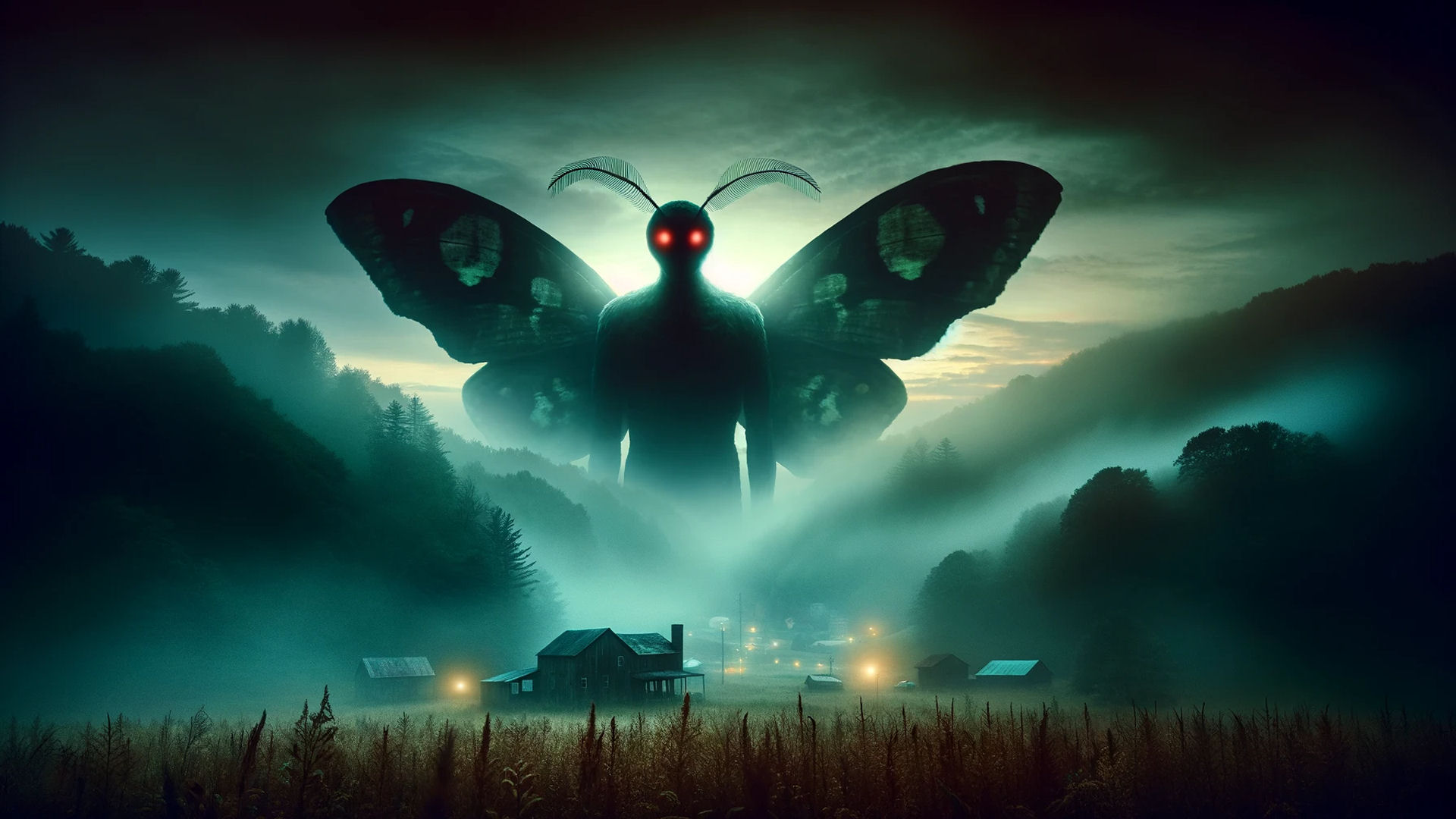
The conversation takes a turn when Lauren Coleman, a friend of John Keel, calls in. She discusses her new book, “Mothman and Other Curious Encounters,” and invites listeners to view a representation of the Mothman on her website. She describes the Mothman as a seven-foot-tall creature with huge red eyes, rekindling Art’s unease about red eyes, a personal fear of his.
Art expresses his curiosity about the Mothman, noting how it has remained a relatively obscure phenomenon until recently. He wonders if the Mothman might become as popular as other cryptids like the Chupacabra, reflecting on the growing interest in cryptic zoology and paranormal phenomena.
Coleman, a friend and admirer of John Keel, the man credited with popularizing the Mothman, shares insights into Keel’s work and beliefs. Coleman explains Keel’s concept of “window areas,” where various paranormal phenomena, including Mothman sightings, are thought to occur.
Coleman and Bell discuss the Mothman’s portrayal, with some considering it a demonic entity, while others view similar winged creatures as angels. The conversation touches on the physical interactions of Mothman with humans, noting that while it hasn’t physically harmed anyone, there is a linkage to the collapse of the Silver Bridge. Coleman clarifies that Mothman has never physically assaulted humans or caused direct harm.
The discussion then turns to the various names and interpretations of Mothman-like creatures across different regions. Coleman mentions that in Illinois, similar entities are referred to as “thunderbirds.” The name “Mothman” itself, as explained by Coleman, was coined by a newspaper editor and differs from the names given by local witnesses, who referred to it as “big bird” or simply “bird.”
Art Bell expresses his intrigue and admits his lack of knowledge about the Mothman before this show. He reflects on how he has missed learning about the Mothman despite its references in past programs.
Art Bell introduces John Keel, described as arguably the world’s foremost researcher into the paranormal. Keel has traveled to over 40 countries and has been investigating the unknown for almost 50 years. His early encounters with the paranormal began at age 12 with an attic poltergeist and continued as he pursued a career in writing, radio, and paranormal research.
Keel has authored 30 books, with notable works including “Operation Trojan Horse,” “Our Haunted Planet,” and “The Mothman Prophecies,” the latter being the subject of a major motion picture. His investigations into the Mothman phenomena, which began about 35 years ago in West Virginia, have garnered considerable attention.
Keel describes the Mothman as a creature approximately seven to eight feet tall with bright red eyes and ten-foot wingspan, capable of vertical flight and known for chasing automobiles. He collected over a hundred reports from witnesses who were often left horrified and traumatized by their encounters. Keel also links the Mothman sightings to the collapse of the Silver Bridge, noting that many people on the bridge had either encountered the Mothman or had close relatives who did.
The Mothman sightings were primarily confined to the Ohio Valley, particularly around the small town of Point Pleasant, West Virginia, and also extended into Ohio. Keel discusses other unusual sightings in the area, including large bird-like creatures resembling ancient pterodactyls.
Keel shares an intriguing story about a winged cat named Thomas in Beckley, West Virginia, which drew his attention due to its unusual nature. The cat’s wings, described as lumps of gristle, eventually fell off, ending the local fascination with it.
Keel then recounts his accidental involvement in the Mothman investigations in Point Pleasant, West Virginia. While initially visiting the area to cover a story about the winged cat, he stumbled upon reports of a tall winged creature seen by four young people in an area known as the TNT area. This discovery led him to extend his stay in Point Pleasant, where he encountered numerous paranormal manifestations and UFO sightings.
These UFOs, described as very bright lights often seen above the river, resembled large beach balls and exhibited behavior suggesting intelligence. Keel describes instances where these lights would respond to flashlight signals, flashing back in a seemingly intelligent manner.
Keel also mentions his encounters with people who suffered burns and eye injuries, like conjunctivitis, after getting close to these lights. He speculates on the nature of these lights, suggesting they could be a form of energy, and reflects on the history of such phenomena.
John Keel discusses the widespread UFO wave that occurred globally between 1964 and 1968. He describes various physical ailments experienced by people after encountering UFOs, including burns and a condition similar to being microwaved, which even affected animals’ behavior. Keel reflects on humanity’s relatively insignificant role in the universe and the continual resurgence of UFO sightings across generations.
Keel, aged 72, recounts his experiences of observing UFOs, especially over Long Island, New York. He describes them as large, radiating objects resembling the tips of red-hot pokers, often emanating infrared light. He speculates on the interrelation of these phenomena with other paranormal sightings, such as Mothman and Bigfoot, and shares his personal unease with creatures described as having blood-red eyes.
The conversation then shifts to the release of the movie based on Keel’s book, “The Mothman Prophecies.” Keel talks about his busy schedule leading up to the movie release, with numerous interviews and media appearances. He expresses a preference for radio interviews, where his words remain unchanged, unlike newspaper interviews where misinterpretations can occur.
John Keel discusses the mysterious phone calls he received during his investigations, which often contained accurate predictions of future events. He recalls being warned about the assassination of Martin Luther King Jr. and an attempted assassination of the Pope. These calls, which Keel couldn’t attribute to government interference due to the lack of technology at the time, often had a mechanical voice quality, akin to what we’d associate with computers today.
Keel also describes the connection between these calls and his frequent visits to Point Pleasant, West Virginia. He was often informed about frantic developments in Point Pleasant just after returning to New York. One such prediction was about a tragic accident on the Ohio River, which Keel feared might involve a chemical plant explosion. He felt conflicted about sharing these predictions, fearing the consequences if they didn’t come true or if he was implicated in the events.
Furthermore, Keel talks about the heavy presence of FBI and CIA agents in Point Pleasant at the time, noting their distinct appearance which made them stand out in the small town. He also mentions a local resident’s observation of two unfamiliar men in unusual attire inspecting the Silver Bridge just days before its collapse. This observation led to speculation about potential sabotage, especially considering the traffic lights on the bridge were stuck on red during the rush hour, resulting in heavy traffic congestion when the bridge collapsed.
Keel reflects on the possible motives behind these events, pondering the implications of deliberately causing the bridge’s collapse.
John Keel discusses the prophecies and mysterious phone calls he received, which accurately predicted events like Martin Luther King Jr.’s assassination. He describes the mechanical voices on these calls, which seemed beyond the technology of that era. Keel also mentions his correspondence with Dr. J. Allen Hynek, where he predicted a significant event on the Ohio River, which Dr. Hynek initially dismissed.
Keel shares that during his time in Point Pleasant, people started having strange dreams and premonitions of a disaster, including a dream about Christmas packages floating on the river. He talks about the Mothman possibly trying to warn people of impending danger and reflects on whether Mothman caused the events or was merely a messenger.
Art Bell then relates a recent incident where a photograph was taken near the 9/11 disaster site, showing a bird resembling a giant pterodactyl. This leads to a discussion about prehistoric-looking birds and reports of pterodactyl sightings in Texas in 1975, investigated by Jerry Clark.
The conversation shifts to animal mutilations, with Keel mentioning a class-action lawsuit against the government by farmers in western states, who claimed the government was responsible for these mutilations. A book was published detailing the trial, suggesting that the animals showed signs of radiation exposure.
Keel ponders the possibility that the Mothman might have been trying to warn people about the impending disaster in Point Pleasant, as indicated by the strange dreams and premonitions experienced by locals, including a newspaper reporter’s dream about Christmas packages floating on the river.
Art Bell brings up a photograph related to the 9/11 disaster, showing what appears to be a giant pterodactyl-like bird. This leads to a discussion about the possibility of prehistoric creatures still existing, with Keel mentioning a sighting of what was thought to be a pterodactyl in Texas in 1975.
The conversation then turns to the topic of animal mutilations. Keel discusses a class-action lawsuit against the government by farmers, claiming the government was responsible for these mutilations. A book published about the trial suggested that radiation was found around the mutilated animals, indicating a potential government involvement.
Art Bell, addressing his audience, directs them to his website to view the photograph he mentioned earlier, comparing it to descriptions of the Mothman. He invites listeners to speculate on the type of bird depicted in the photo, considering its size and appearance in relation to the buildings in the background.
John Keel discusses his theory about “windows” – temporary openings to different places or dimensions where paranormal phenomena cluster. He gives examples of such areas with historical significance, like Moundsville, West Virginia, known for Indian mounds shaped like animals. Keel suggests these mounds might have origins predating the Native Americans.
Keel also mentions various mysterious events along the Ohio Valley, including a bright light in 1896 in Sistersville that lacked a logical explanation and couldn’t be attributed to a meteor. These events lead him to believe in the existence of other dimensions or realms that occasionally intersect with our own.
Art Bell and Keel then discuss recent sightings of Mothman-like creatures, including a giant bird sighting in Pennsylvania and South Dakota. They speculate that these creatures might be connected to psychic phenomena and note the absence of physical evidence, like nests or traces, which could suggest their existence in another dimension.
The conversation shifts to the broader implications of these phenomena. Keel mentions the scientific exploration of other dimensions and dark matter, suggesting that much of the universe comprises unseen matter. This idea aligns with theories that what was once considered science fiction or myth may have a basis in reality.
John Keel discusses the recurrent nature of paranormal events, often clustered around certain areas and sometimes seeming hereditary. He reflects on the difficulty of researching historical records, which were often vague and sometimes hoaxes.
Keel also touches on the “Men in Black” phenomenon, describing encounters with mysterious figures that seemed otherworldly and had an uncanny interest in children, a theme that has appeared in similar cases in England. This phenomenon contributed to the growing sense of paranoia during his investigations.
Art Bell and Keel discuss the upcoming “Men in Black” movie and the peculiarities of Keel’s experiences, such as unexplainable phone calls and a woman falsely claiming to be his secretary. Keel expresses satisfaction with the movie adaptation of his book “The Mothman Prophecies,” noting that it captures the mood and atmosphere of his experiences, despite the usual liberties taken by Hollywood.
Towards the end of the segment, they speculate on the potential impact of the movie on public awareness and reports of Mothman sightings. Keel suggests that such phenomena can be contagious, with reports often leading to an increase in similar sightings in the same area.
John Keel discusses the possibility that his presence might have influenced the paranormal phenomena he encountered. He reflects on the unsettling thought of being a catalyst for these events.
Art Bell then transitions to discussing the upcoming “Men in Black” movie, expressing concerns about what Keel worries about with the film’s release. However, they don’t delve into these worries as the conversation shifts to a young caller making a light-hearted prediction about getting a higher allowance.
The discussion returns to the peculiarities of Keel’s experiences, such as phantom photographers and men in black, which contributed to the growing paranoia during his investigations. Keel mentions the forthcoming “Men in Black” movie and his approval of it, noting that it captures the essence of his book, “The Mothman Prophecies,” although with some Hollywood liberties.
Keel also touches upon his theory of paranormal manifestations clustering around certain areas across generations and discusses the movie’s portrayal of his character, represented in part by actor Alan Bates.
The conversation shifts to Keel’s earlier career, where he covered various human interest and paranormal stories. He talks about his experiences with unusual phenomena, like lights in graveyards, and the current interest in electronic voice phenomena (EVP), where people record voices of the deceased.
Keel then shares an intriguing phenomenon from Europe, where people have reportedly seen images of deceased individuals on television screens arranged with mirrors. This phenomenon has not received much publicity in the United States but was a sensation in Europe.
Keel discusses his long-standing interest in paranormal phenomena in graveyards, particularly the unexplained toppling of heavy tombstones. He notes that these occurrences are not isolated to one location but happen nationwide and even internationally.
Keel and Art Bell then shift to discussing crop circles, acknowledging their complexity and global presence. Keel suggests that if these patterns could be mapped out globally, it might reveal a more significant pattern or cause, possibly even involving satellites.
The conversation turns to the challenge of distinguishing genuine paranormal phenomena from hoaxes. Keel shares his experiences in identifying hoaxes during his investigations, noting that while many cases turn out to be pranks, there are still numerous unexplained mysteries.
They also discuss mysterious holes appearing in the ground worldwide, with no plausible explanation for their sudden emergence. Art Bell mentions an upcoming show about a seemingly bottomless hole, similar to one previously discovered near Ellensburg, Washington, known as “Mel’s Hole.” Keel confirms he has heard of such phenomena, highlighting the reluctance of scientists to study these unexplained holes due to their preference for explainable phenomena.
John Keel discusses his investigations into various paranormal phenomena, including the mysterious toppling of tombstones in graveyards and the appearance of crop circles and deep, unexplained holes in the ground. He notes the challenges he faced in getting scientific involvement in these investigations due to the skepticism and fear of reputation damage among scientists.
Keel and Art Bell also discuss the potential impact of the movie “The Mothman Prophecies” on public interest and tourism in Point Pleasant, West Virginia. Keel expresses concern that the town might be overwhelmed by tourists drawn by the movie’s release. He suggests that the local community could benefit economically by preparing for the influx of visitors.
As the show approaches its final hour, Art Bell invites Keel to stay and answer questions from the audience, recognizing the value of Keel’s insights into the paranormal. Despite being tired from his extensive media engagements for the movie promotion, Keel agrees to stay and interact with the listeners.
Keel discusses how his life and thinking have been profoundly affected by his experiences with the paranormal, especially after the tragedy of the Silver Bridge collapse. He likens his shock to the aftermath of the World Trade Center attacks, explaining that it took him a long time to process and eventually write about the events in West Virginia.
Art Bell and Keel then delve into the concept of “windows” – areas or moments where paranormal phenomena seem to occur more frequently. They agree that these occurrences seem to be happening more often and with greater intensity.
The conversation shifts to a caller from Monroe, Wisconsin, who shares a childhood experience of seeing what appeared to be a man with wings near his family’s farm. This sighting coincided with the disappearance of a pig from his uncle’s farm, leading to speculation about a biological or otherworldly creature. Keel acknowledges that there have been other sightings of winged humanoids, which remain unexplained.
The caller also mentions his mother’s interest in paranormal phenomena, indicating a broader curiosity and engagement with such mysteries.
A caller from Wisconsin relates a childhood memory of seeing a man with wings, reminiscent of the Mothman. Another listener, a scientist from Seattle, comments on the need for a scientific model to make sense of these phenomena. Both Keel and Bell acknowledge the significance of these observations, even if they currently lack a scientific explanation.
Keel addresses the caller’s story about the pig incident, expressing interest in the unusual nature of the event. Another caller from Victoria, BC, discusses witnessing the Leonid meteor shower, comparing it to a 19th-century sky lighting incident in Virginia. Keel clarifies the differences between meteors and the unexplained sky lighting event, emphasizing the unique characteristics of the latter.
A caller from Norfolk, Virginia, shares a story of encountering two red eyes in the woods while under the influence of marijuana. Keel and Bell discuss the common theme of red eyes in paranormal sightings and the potential implications.
The conversation shifts to the concept of prophecy and time. Keel ponders whether the future exists in some form, making predictions possible. Bell shares his experience with a premonition, adding to the discussion about the nature of time and its relationship to paranormal phenomena.
John Keel discusses his experiences and theories about various paranormal phenomena, including mysterious messages he received in motels and his investigations into government activities. He talks about the existence of numerous underground facilities across the United States, which were built for civil defense purposes during the Cold War era. Keel shares his observations of these facilities, including their extensive size and the provisions stored within them, such as whiskey.
The conversation then turns to the implications of these underground facilities in the event of a nuclear war, with Art Bell humorously noting that politicians might be the only survivors. Keel and Bell contemplate the eerie prospect of a world where the only survivors of a nuclear holocaust are politicians.
As the show progresses, Bell welcomes listeners to call in and ask questions to Keel. The segment ends with a promotion for the “Mothman Prophecies” movie, starring Richard Gere, which is being released nationwide on that day.
A listener recalls waking up to see a huge, dark figure in his room, which grabbed him, causing him to scream. This incident had a lasting impact on him, and he connects it with other unusual events, like the death of his sister. Keel notes that such experiences, often termed ‘bedroom invaders’, are more common than one might think.
Another caller from North Louisiana describes discovering a dead area in a forest, with strange birds that screamed at night. He also recounts an eerie experience of witnessing a bonfire, luminous balls shooting up into the sky, and people standing silently by their cars in the woods. This experience suggests a ritual or some sort of gathering, adding to the mystery.
Art Bell and John Keel discuss the likelihood that the government is aware of these strange occurrences and may be investigating them, though they may not understand these phenomena any more than the general public. Keel affirms that this has been the case for a long time.
As the show nears its end, the discussion reflects on the vast array of unexplained events and the government’s potential role in investigating these mysteries.
Keel discusses his experiences while working in the government, exploring the topic of UFOs and other unexplained phenomena. He reveals his skepticism about the existence of large-scale government conspiracies related to these mysteries. Keel also shares an anecdote about receiving nonsensical messages while staying in motels, suggesting someone knew his whereabouts in advance.
The conversation then shifts to listener calls. One caller from New Orleans discusses a peculiar building he plans to investigate, prompted by Keel’s earlier mention of it. Another listener suggests a symbolic connection between the two red traffic lights on the collapsed Silver Bridge and the red eyes often reported in Mothman sightings.
A caller shares a dream experience about traveling through time, leading to a discussion about the nature of time and its perception. Keel recommends a book titled “An Experiment in Time,” which discusses dream control and time travel.
The next caller recounts haunting experiences in his house, including hearing voices and footsteps, and his girlfriend experiencing physical attacks from an unseen entity.
A caller describes an encounter with a black figure with red eyes in his house. This entity was seen ascending the stairs and then disappearing. The caller also mentions taking photographs in the house that captured unusual images. Art Bell encourages the caller to email him these photos for further examination.
Keel discusses his experience working in the government and his inability to find substantial evidence of significant conspiracies related to UFOs and paranormal activities. He shares anecdotes about receiving strange messages and his observations of the government’s construction of underground facilities during the Cold War for civil defense purposes.
The show ends with Art Bell thanking John Keel for his participation and discussing the upcoming release of “The Mothman Prophecies” movie. Bell invites his audience to subscribe to the “After Dark” newsletter for more insights into the topics covered on his show.