
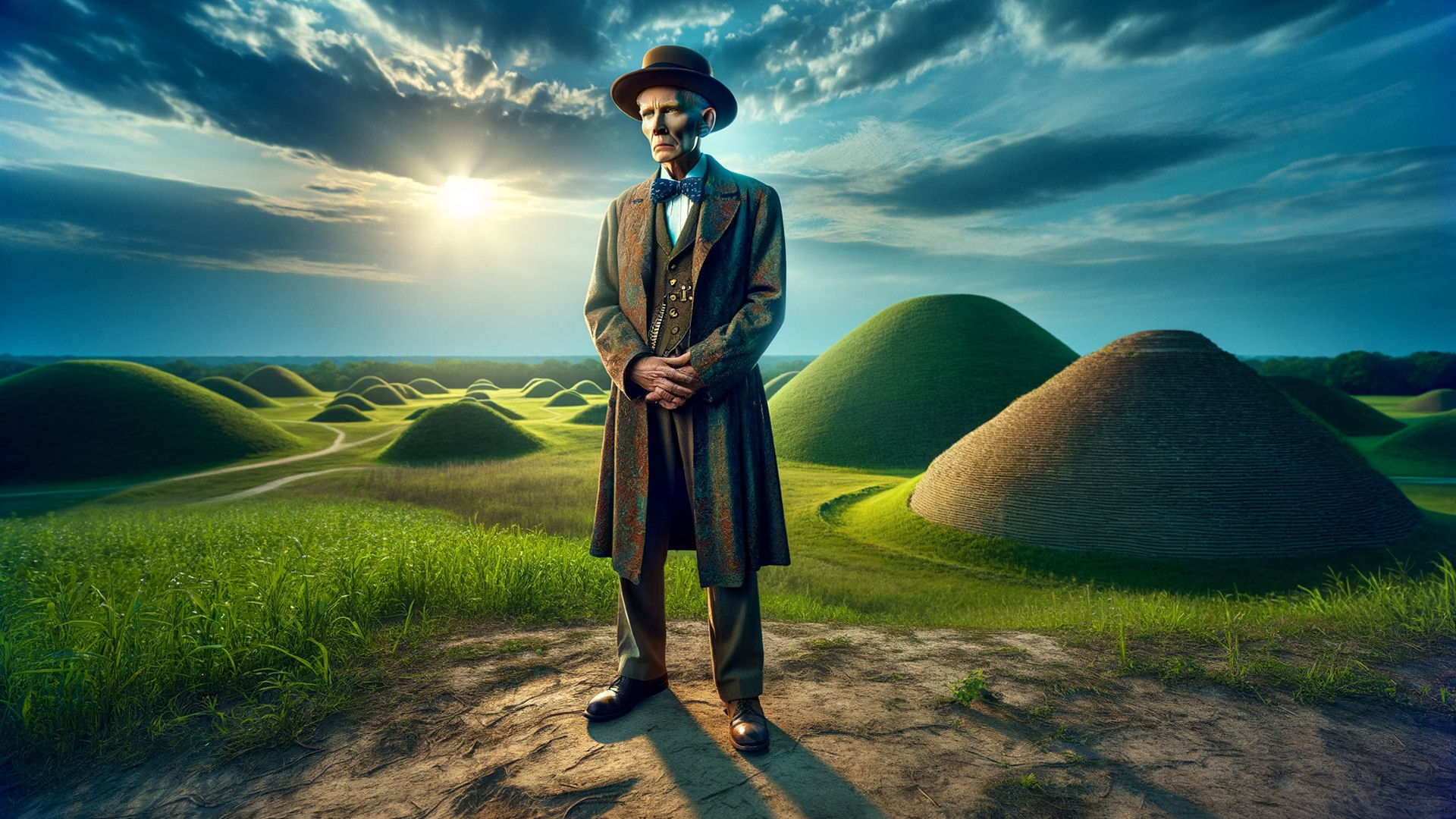
In this segment of the “Coast To Coast AM” show, hosted by Art Bell, a deep dive into the world of archaeology reveals a generational clash. Younger archaeologists, frustrated with the rigidity of their older counterparts, express a controversial view that significant changes in archaeological thinking might only occur after the older generation, referred to as the ‘Clovis mafia’, has passed away. This tension underscores the reluctance of established academics to adapt to new ideas, with one prominent Harvard archaeologist highlighted as a case in point. Despite being presented with new evidence, this archaeologist, who had misunderstood Edgar Evans Cayce’s works for those of Edgar Cayce, refused to alter the information in his widely-used textbook.
The conversation then shifts to Edgar Cayce’s theories on ancient America. According to Cayce, the history of ancient America began around 50,000 BC with migrations from the lost continents of Mu (Lemuria) and Atlantis. These migrations supposedly brought advanced and peaceful civilizations to America long before Columbus. Casey’s accounts detail various incursions into the Americas from regions like the South Pacific Islands and describe the spiritual and cultural dynamics of these ancient people. Additionally, the segment touches on the population of ancient America before Columbus, suggesting numbers far greater than commonly believed, which contradicts the notion of an empty continent.
Next, the show delves into the metaphysical aspects of Cayce’s theories, discussing the battle between two spiritual groups: the Sons of Belial and the Children of the Law of One. This battle, representing the conflict between good and evil, is said to have ancient roots and continuing relevance.
Art explores further the spiritual and cultural dynamics of ancient America as described by Edgar Cayce. The show discusses the dichotomy between two ancient groups: the Sons of Belial, who represent materialism and self-indulgence, and the Children of the Law of One, who believe in a singular God and advocate for peace and unity. This narrative suggests a historical and ongoing battle between good and evil, reflecting the spiritual struggles of humanity.
The discussion then shifts to archaeological evidence supporting Cayce’s theories. Recent DNA analysis and archaeological excavations, especially below the Clovis layer (which represents the 9,000-year-old level in archaeology), reveal migration patterns and ancient civilizations that align with Cayce’s descriptions. These findings challenge the conventional archaeological belief that nothing significant existed below the Clovis layer. The segment emphasizes the need for new terminology to describe these pre-Clovis civilizations, highlighting the limitations of current archaeological naming conventions.
The episode briefly diverts from its main topic to cover contemporary news, including an update on the case of kidnapped Wall Street Journal reporter Daniel Pearl, a Pentagon apology for civilian deaths in a raid near Kandahar, and compensation provided to Afghan families. It also mentions a prisoner exchange in Afghanistan and comments on the high security costs of the Super Bowl.
The show returns to the subject of ancient civilizations, focusing on the role of genetics in understanding the history of ancient America. Dr. Greg Little explains the importance of mitochondrial DNA analysis in tracing human ancestry. This type of DNA, passed exclusively through the maternal line, allows for the tracing of female lineage and has revolutionized genetic research. The discussion reveals that mitochondrial DNA can determine when an individual’s ancestors migrated from their original location, offering insights into ancient human migration patterns.
This genetic analysis supports Cayce’s theories about the migration and settlement patterns of ancient civilizations in America.
Dr. Little explains that mitochondrial DNA analysis has contradicted many traditional archaeological theories, particularly regarding the origins and migration patterns of ancient peoples.
One key revelation from mitochondrial DNA analysis is that it has debunked the long-held belief that all Native Americans migrated from Siberia across the Bering Strait around 10,000 to 9,000 BC. This theory was initially supported by the presence of four major types of mitochondrial DNA (labelled A, B, C, D) found both in Native Americans and Siberians. However, the discovery of a different mitochondrial DNA type, haplogroup X, in America challenged this theory. Haplogroup X, not found in Siberia at the time but prevalent in Israel and among the ancient Basques, suggested a more complex pattern of migration and settlement.
This discovery led to a reassessment of the origins and migrations of populations in Europe and America. For instance, a study on ancient Basque remains revealed a significant presence of haplogroup X, contrasting with the lack of haplogroup V, which archaeologists had expected to find. This finding contradicted the theory that a group identified as haplogroup B populated Europe from southwestern Europe around 5,000 years ago.
Dr. Little connects these genetic findings to the predictions of Edgar Cayce, who claimed that haplogroup X could be traced back to Atlantean migrations. According to Cayce, this group would be found in specific regions such as the Gobi Desert, Israel, Egypt, and among the ancient Iroquois, suggesting a link to the lost civilization of Atlantis. The dates associated with haplogroup X, which typically trace back to around 10,000 BC, align with Cayce’s timelines.
The discussion shifts to the topic of ancient mounds in America, suggesting that they are more than just burial sites or heaps of dirt. These mounds are seen as symbols with greater significance, although the segment ends before elaborating further on their meaning or purpose.
In this segment of “Coast To Coast AM,” Art Bell and Dr. Greg Little delve deeper into the significance of ancient American mounds. They discuss how these mounds, numbering around 200,000 in the early 1800s but fewer today, served as more than mere burial sites. Dr. Little describes them as spiritual structures, connecting the upper world to the lower world, and refers to them as “spiritual magic machines.”
The conversation then shifts to the remarkable earthworks found in America, which Dr. Little claims surpass the complexity and size of ancient structures found elsewhere in the world. These earthworks, like those in Ohio, are made of piled earth forming circles, octagons, and long parallel walls, and were likely used for rituals. One particularly notable earthwork in Newark, Ohio, aligns perfectly with the moon’s movements over an 18.6-year cycle, drawing parallels to the pyramids of Giza and their alignment with Orion’s belt.
Dr. Little ties these structures back to Edgar Cayce’s theories, suggesting a connection to Atlantis. He mentions the “Hall of Records,” a concept first introduced by Cayce, which is believed to contain the history of Atlantis and its spiritual battles. This Hall of Records is thought to exist beneath the Sphinx in Egypt, as well as in a site in Guatemala called Piedras Negras, which Brigham Young University has been investigating.
The segment concludes with a discussion on the technology and magic of ancient civilizations, particularly the use of crystals. Cayce’s stories describe a highly advanced culture that harnessed the energy of crystals, a concept still intriguing and somewhat mysterious today. Dr. Little demonstrates the potential power of crystals by describing an experiment where rubbing large quartz crystals together in a dark room can produce visible light, illustrating the untapped energy within these natural elements.
Dr. Little explains the piezoelectric effect, where pressure on crystals causes them to release energy in the form of tiny balls of light, akin to plasma. This phenomenon was known to ancient shamans who would create these effects to impress or perform rituals, demonstrating a sophisticated understanding of natural energies.
Dr. Little also touches on the use of crystals in modern technology, such as in radio transmitters where they were used to determine specific frequencies. This leads to a discussion about the belief systems of ancient peoples, particularly their use of crystals to communicate with the spirit world and gods.
Additionally, there’s a mention of an archaeological site in Portsmouth, Ohio, which features a circle and a square with long extensions. Dr. Little suggests that this site could have been perceived as a portal or entrance to heaven in ancient times.
Art Bell shares his own experience with the piezoelectric effect of crystals. He describes striking two large chunks of raw crystal together in a dark room, which produced significant sparks and an unusual kind of light. This experiment led to a fascinating discussion about the nature of these sparks, which Dr. Greg Little clarifies are not sparks in the traditional sense but electrons pinging off from microscopic fractures in the crystals, creating plasma-like balls of light.
Dr. Little also suggests an experiment with crystals underwater in a bathtub, which can illuminate the entire bathroom when done in complete darkness. He explains this phenomenon could be due to the refraction of light in water, amplifying the effects observed with crystals.
The conversation then touches on the potential powers of crystals. Dr. Little remains skeptical about some of the more fantastical claims, such as moving heavy objects, but acknowledges that there is still much to learn about crystals and their interaction with electromagnetic fields. He discusses the belief held by ancient civilizations that crystals could open portals to other realms, allowing for the movement of beings or forces between the spiritual and physical worlds.
The discussion with Dr. Greg Little continues to delve into the mysteries of ancient civilizations, particularly focusing on the pyramids of Egypt and the possible existence of a ‘Hall of Records’ as proposed by Edgar Cayce.
Dr. Little discusses the alignment of the pyramids with specific stars and their role in housing information from the Atlanteans. He references Graham Hancock, who is scheduled to appear on the show later in the week, agreeing with Hancock’s view that the pyramids point to a significant time around 10,500 BC, which coincides with Cayce’s timeframe for Atlantean migrations to Egypt, Yucatan, and Iroquois lands.
He expresses skepticism about the pyramids being a power source, despite his extensive exploration of the Great Pyramid. Dr. Little believes that the pyramids may serve as a permanent repository of information and that the Hall of Records, if found, could reveal how ancient powers were used. He speculates that the Hall of Records might contain information about the use of crystals in Atlantis for both constructive and destructive purposes, reflecting the philosophical and political battle between the Sons of Belial and the Children of One.
The conversation then shifts to the potential for history to repeat itself and whether civilizations can learn from the past. Dr. Little acknowledges that civilizations have borrowed technologies and philosophies from their predecessors but doubts that fundamental moral understandings of right and wrong have evolved significantly.
Dr. Little shares his experience of taking a group to visit ancient mounds in Ohio, emphasizing the lack of widespread awareness about these significant archaeological sites. He describes the mounds’ intricate structures and expresses frustration over the general public’s unawareness of these ancient marvels, highlighting one instance where a local bus driver was completely unaware of the existence of these significant sites.
Dr. Little discusses the enormity and complexity of these earthworks, comparing them to well-known structures like Stonehenge and the Great Pyramids. He highlights Poverty Point in Louisiana, dating back to 2500 BC, with its extensive embankments and an eagle effigy mound. These earthworks, according to Dr. Little, rival or even surpass the scale of some of the most famous ancient structures in the world.
The discussion then shifts to the spiritual beliefs of the Native Americans and their concepts of heaven and hell. Dr. Little suggests that some of the earthworks may have been used as portals to these spiritual realms. He bases these assertions on the study of modern Native American beliefs and historical accounts from the first European settlers.
Dr. Little also touches on the controversy surrounding the age of humanity, addressing the views of some Christian fundamentalists who believe in a relatively young human history. He asserts his belief in a much older human civilization and emphasizes the importance of understanding spiritual matters in all decisions.
Dr. Little proposes that the electromagnetic energy spectrum represents what he calls the “reality spectrum,” with the physical world occupying only a small part of it. He hypothesizes that the two extremes of this spectrum correspond to heaven and hell, with the higher frequencies representing heaven and the lower frequencies, where energy comes to a standstill, representing hell. This idea is linked to the concept of black holes, where energy and matter are thought to cease moving.
He also references Carl Jung and John Keel, suggesting that UFOs and other paranormal phenomena might originate from different parts of the electromagnetic spectrum. This theory is further supported by ancient texts like the Hebrew Book of Enoch, which describe otherworldly creatures and experiences that align with his concept of the electromagnetic spectrum.
Dr. Little touches upon the notion that energy cannot be created or destroyed but only changes form, leading to a discussion on the nature of existence and consciousness after death. He mentions the work of Stephen Hawking, which suggests that energy entering a black hole might not be destroyed but transformed, offering a less bleak perspective on what happens after death.
In this segment of “Coast To Coast AM,” Dr. Greg Little delves into profound metaphysical discussions, exploring the nature of heaven, hell, and the soul’s journey.
- Concept of Heaven and Hell: Dr. Little continues his explanation of the electromagnetic energy spectrum as it relates to spiritual realms. He likens a black hole to hell, where energy comes to a complete standstill, and views heaven as a place of cosmic creation, akin to a stellar nursery where energy is constantly produced. This perspective aligns with scientific theories but is imbued with spiritual significance.
- Soul’s Existence and Reincarnation: The discussion turns to the nature of the soul, its imprisonment in the physical body, and the cycle of reincarnation. Dr. Little suggests that souls are trapped in physical matter and continue to reincarnate until they can escape this cycle.
- Struggle Between Good and Evil: The conversation touches on the value of the soul and its role in the struggle between good and evil forces. Dr. Little shares insights from his experience working in prisons, where he has witnessed manifestations of evil, supporting the idea that malevolent forces exist and seek to propagate misery.
- Fundamentalist Beliefs and Universal Truths: Art Bell notes the parallels between Dr. Little’s beliefs and those of religious fundamentalists, though Dr. Little maintains that fundamentalists are misguided in some of their specific doctrines. He observes that many religions share similar core beliefs about the soul and the afterlife.
- Humanity’s Inability to Resolve Fundamental Problems: Towards the end of the segment, Dr. Little expresses skepticism about humanity’s ability to resolve its fundamental problems and break the cycle of history repeating itself. He doubts that there is a solution to the deep-rooted issues that plague human civilization, such as the ongoing conflicts in the Middle East.
- Freedom of Choice and Predetermined Outcomes: Dr. Greg Little discusses the paradox of freedom of choice within the context of a seemingly predetermined future. He shares insights from his experiences in prison systems, highlighting how individual actions can impact larger outcomes.
- Career Background and Experiences in Prisons: Dr. Little talks about his background in psychopharmacology and his transition to working in prisons. He shares his experience with drug and alcohol treatment programs and the development of a treatment program called “Moral Recreation Therapy.”
- Nature of Evil and Psychological Disorders: The discussion shifts to the nature of evil, with references to notorious figures like Charles Manson and Adolf Hitler. Dr. Little discusses the concept of antisocial personality disorder and the spectrum of psychopathy.
- Existence of Demons and Negative Energy Forms: Surprisingly, Dr. Little reveals his belief in the existence of demons, describing them as negative energy forms within the electromagnetic spectrum. He relates this to the beliefs of Carl Jung and John Keel, suggesting that these entities can influence human behavior.
- UFOs and Dan Aykroyd’s Interest: The program briefly mentions actor Dan Aykroyd’s deep interest in UFOs and a related article in the “After Dark” newsletter. This inclusion illustrates the show’s wide range of topics, from scientific theories to celebrity interests in paranormal phenomena.
- Philosophical Musings: The discussion delves into the concept of predetermined destiny versus free will. Dr. Greg Little explores the idea that while individuals have freedom of choice, certain outcomes may be inevitable due to the broader context of human history and the nature of reality.
- Experience in Prisons and Psychopharmacology: Dr. Little shares more about his background, detailing his work in prisons and his early career in psychopharmacology. He discusses his journey from atheism to a belief in spiritual and metaphysical concepts.
- Concepts of Evil and Demonic Entities: The conversation shifts to the nature of evil, with Dr. Little sharing his views on demonic entities as negative energy forms in the electromagnetic spectrum. He discusses his belief that these entities are designed to mislead people and make them choose unwisely.
- Current News Updates: The program interjects with various news updates, including international events, such as the situation with kidnapped American reporter Daniel Pearl and security issues in Afghanistan. These updates provide listeners with a blend of current affairs alongside the show’s typical content.
- Health and Wellness Advertisements: The segment also includes advertisements for health-related products and services, such as vitamin supplements and online marketplaces like eBay.
- Promotion of Telescopes: Art Bell highlights a sponsor, Heartland Optical, offering telescopes for those interested in astronomy. He describes the quality and specifications of the telescopes, encouraging listeners with an interest in exploring the night sky to consider purchasing one.