
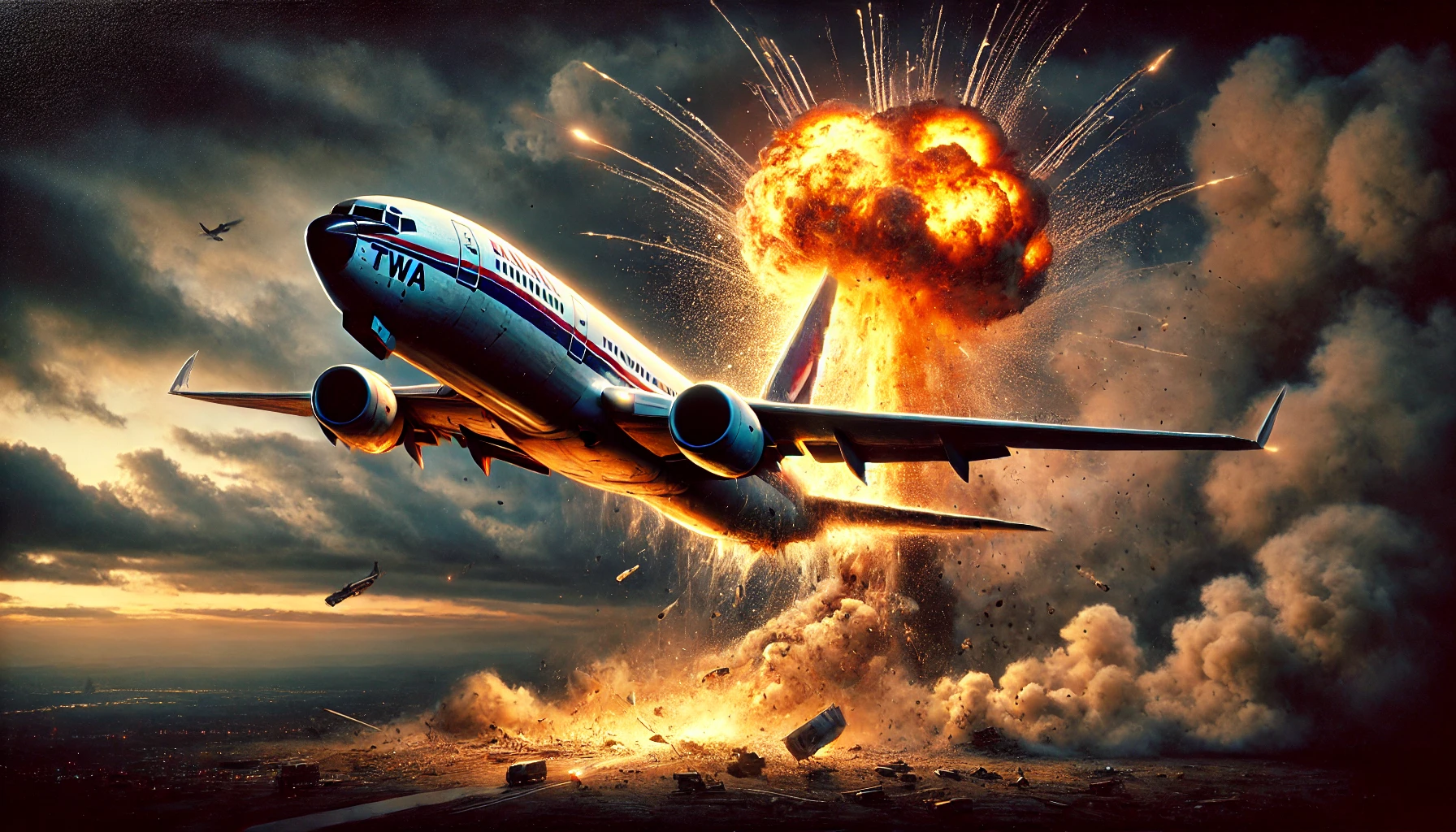
Art begins the show discussing an unusual video capturing a strange creature, possibly a “digo medusa,” which doesn’t resemble anything from Earth. The video has gained significant attention online and is available on his website. He also mentions a major scandal involving the Ashley Madison website, where hackers exposed sensitive information of users worldwide, leading to potential legal and personal chaos. Art then shifts the focus to the main topic of the night: the controversial downing of TWA Flight 800 in 1996. He raises the question of whether the U.S. government could have mistakenly shot down a civilian plane and subsequently covered it up. Art introduces Bill Birnes, a New York Times bestselling author and expert on UFOs and government cover-ups, and Jim Sanders, an experienced investigator and author who has extensively researched the TWA Flight 800 incident.
Art and his guests discuss the official explanation of the TWA Flight 800 disaster, which attributes it to a spark in the center fuel tank, dismissing the testimonies of witnesses who claimed to have seen a missile strike the plane. The media, particularly in New York, largely accepted the government’s narrative, but skepticism remains, especially given the evidence presented, such as a video showing what appears to be a missile heading toward the aircraft. The video, recorded on a clear evening, was reportedly seized by the FBI and kept under wraps for 19 years before being released due to persistent efforts through the Freedom of Information Act. The hosts recount the events of July 17, 1996, when the flight took off from JFK Airport, heading for Paris, and how witnesses observed the plane being struck by what they believed was a missile. Despite eyewitness accounts, including detailed observations from a woman who saw the missile hit the plane, the FBI and CIA have dismissed these testimonies, and the official narrative remains unchanged.
Art and his guests delve deeper into the events surrounding TWA Flight 800, discussing how the flight leveled off at 13,000 feet due to air traffic control instructions. Despite requests for information, the CIA refused to provide paperwork related to witness testimony, claiming it would be too burdensome. The conversation shifts to the military operations occurring near the flight path on the night of the disaster. Flight 800 was delayed due to a connecting flight, causing it to pass through a military exercise area known as Whiskey 105, where a significant U.S. Navy exercise involving advanced systems was underway. The guests discuss the involvement of various naval assets, including destroyers, cruisers, and the Seawolf submarine, which was undergoing testing at the time. They speculate that the military’s Cooperative Engagement Capability (CEC) program, a high-stakes initiative crucial for the Navy’s 21st-century readiness, may have played a role in the disaster. Despite the Navy’s denial of having submarines in the area, it is revealed that the Seawolf, not yet commissioned, was indeed present and equipped with unique weapon systems. The exercise was critical, as Congress threatened to defund the program if it wasn’t proven successful by September 1st, 1996. Interestingly, after the incident, Congress spent no additional money on the Seawolf, suggesting that some senior officials might have been aware of what truly happened that night.
The discussion continues with the revelation that a drone was photographed over land near West Hampton on the night of the TWA Flight 800 disaster, possibly linked to military exercises. The Seawolf submarine and the Cooperative Engagement Capability (CEC) program were involved in tracking and engaging targets, with the system designed to function autonomously, without human intervention. The guests suggest that a missile may have been automatically fired by the CEC system at what was perceived as a target—likely a drone—only for Flight 800 to inadvertently cross its path due to an unexpected delay. The missile, homing in on the plane, struck it, leading to the catastrophic event.
They reiterate that the video evidence clearly shows a missile going up, not down, and speculate on the origin of the missile, considering whether it could have been fired by another country. However, the guests assert that the missile in question was not a small, shoulder-fired type but a much larger one, likely a “backstop missile” meant to intercept another missile that had locked onto the wrong target. They reveal that a Notice to Airmen (NOTAM) was indeed sent out regarding the military exercise, but for reasons unknown, the controllers at JFK did not alert the TWA flight about the active military zone.
The guests also discuss the official explanation that the center wing fuel tank exploded due to faulty wiring, a theory they strongly dispute. They recount an experience with an FAA engineer who confirmed that tests conducted on similar 747s never resulted in a center wing tank explosion, casting further doubt on the official narrative. The discussion then takes a surprising turn as one guest reveals that they were indicted for investigating the cover-up of the TWA Flight 800 incident, raising questions about government interference in uncovering the truth.
Despite being a credentialed journalist, Sanders faced significant government pushback due to his previous works that criticized the Department of Defense, which led to his targeting. The government seized his mail and other materials, later claiming that he was the center of a criminal investigation rather than a journalistic one. They attempted to prevent him from writing his book by treating his wife as a hostage and disregarding his journalistic credentials.
The conversation also touches on the manipulation of the judicial process, where the jury was carefully selected to exclude anyone who might believe the government was capable of a cover-up. Despite these obstacles, Sanders persisted, ultimately uncovering and obtaining a crucial video showing a missile heading towards TWA Flight 800, which the FBI had hidden for years. The guests affirm that this video is solid proof that the mechanical failure story is false and emphasize that there is no evidence to suggest the video was fabricated or altered.
The discussion intensifies as the guests reveal that many eyewitness testimonies regarding the TWA Flight 800 disaster were either ignored or altered by the FBI and CIA. One key witness, Mike Wire, who initially reported seeing a missile, later had his statement manipulated, according to the guests. Despite his insistence that he never changed his story, the official records were modified to discredit his account. Other witnesses experienced similar treatment, with their statements being altered or dismissed to fit the official narrative.
The conversation also touches on physical evidence, including residue found on the wreckage, which was initially claimed to be adhesive by the government. However, after extensive investigation, it was identified as residue from a thermite warhead, a technology unique to the U.S. Navy at the time. The guests argue that this residue, consistent with a missile, further supports the theory that the plane was shot down by a missile. Despite this, the government maintained that the residue was merely glue, dismissing the implications of the thermite evidence.
Jim Sanders, who was investigating the case, faced significant pressure from the FBI to reveal his sources, especially after he obtained the red residue from the seatbacks of the plane. The government even threatened his wife, who was connected to the source, to force him to comply. Despite the intense pressure, Sanders refused to reveal his source, which led to further legal and personal repercussions.
Art and his guests, Bill Birnes and Jim Sanders, continue discussing the TWA Flight 800 incident. They address listener questions, including one about the origins of the video showing the missile. The video was recorded by an amateur cameraman whose identity is still being pursued. Jim Sanders managed to obtain the video from the FBI by making a mandatory request for the specific file, which led to its declassification.
Another listener asks about Sanders’ indictment. He explains that he was charged with a felony for conspiracy and aiding and abetting, even though he never asked for the residue from the plane but merely received it from Terry Stacey, a 747 pilot involved in the investigation. Despite being advised by First Amendment lawyers that his actions were legal, Sanders was not allowed to present a First Amendment defense in court. The judge dismissed his journalistic defense, labeling him as a “souvenir hunter” rather than a journalist, which significantly undermined his case.
Sanders also reveals that the jury pool was manipulated to exclude anyone who believed the government could engage in a cover-up, ensuring a biased trial. The mainstream media largely ignored the trial, with one NBC reporter focusing only on why Sanders didn’t return the residue rather than the broader implications of his findings.
The discussion reveals that this broadcast is the first time the missile video has been shown publicly. Sanders emphasizes that they are carefully organizing their evidence to maximize its impact, rather than releasing it haphazardly.
They describe how the video shows a contrail that appears to pixelate due to the low-light conditions and the cameraman’s adjustments. Despite the pixelation, the video clearly depicts a missile, which the guests describe as a “gotcha video.” They speculate that the government struggled to explain the red residue found on the wreckage, initially labeling it as glue but later dismissing it as unimportant.
The guests explain that the video was privately analyzed by a retired Air Force intelligence colonel and Bill Scott from Aviation Week, both of whom confirmed that it looks like a missile contrail. The video, declassified by the government, contains all the necessary codes to confirm its authenticity, and the guests believe that once it gains more public attention, it will be hard for the government to deny its implications.
Sanders also discusses his appeal against his conviction, revealing that Judge Sonia Sotomayor, before her time on the Supreme Court, was involved in the case. Despite a strong appeal, the transcript was altered, and the case was ultimately dismissed by the Supreme Court.
They talk about how the press was undermined during the investigation and how the legal system manipulated the case, with transcripts being altered to obscure the truth. They reveal that two National Guard pilots witnessed the missiles converging on the plane and had to back their helicopter away from the falling wreckage.
The conversation turns to Pierre Salinger, a former White House press secretary, who claimed to have satellite imagery proving the plane was shot down by a U.S. missile. The FBI intervened and pressured the movie producer who was working on a film about the incident, leading to the project’s cancellation. Salinger later confided that his best evidence came from Mossad, Israel’s intelligence agency, which investigated the crash because there were Israeli citizens on the flight. Mossad concluded that the U.S. Navy was responsible for the shoot-down.
The guests also discuss how the FBI used Sanders’ wife as leverage, threatening to arrest her unless he revealed his source. Despite the pressure, Sanders did not give in, maintaining his stance against the government’s efforts to suppress the truth.
Art and his guests continue discussing the challenges they face in exposing the truth about the TWA Flight 800 disaster. Jim Sanders describes how he and his wife were essentially fugitives, with the FBI tracking their movements and making it difficult for them to stay in one place. Liz, Jim’s wife, was protected by TWA staff who helped her avoid capture by the FBI at airports.
Art expresses skepticism about the likelihood of the public rallying behind the cause unless it gains widespread media attention. The guests speculate on the potential impact if major media outlets like The New York Times or The Washington Post were to investigate and report on the issue. They also consider the possibility of the incident becoming a political issue, particularly in relation to Hillary Clinton and the 2016 presidential campaign, given that Bill Clinton was president during the time of the cover-up.
The conversation suggests that Fox News might be the most likely network to pursue the story, given its less direct involvement during the original incident and its large audience. The segment ends with Art preparing to open the phone lines for listeners to call in with their questions or comments.
Art opens the phone lines for callers to ask questions. The first caller, Scott, raises a question about whether technological advancements between 1996 and 2001 could explain the events of 9/11, suggesting that the government could have covered it up just as they did with TWA Flight 800. The guests clarify that while they believe in the cover-up of TWA Flight 800, they do not think 9/11 was a cover-up. They assert that the U.S. government has become more adept at covering up incidents since World War II, but they acknowledge that the media has not kept pace with these advancements, often serving as tools for the government.
One caller shares that they were a Marine radar technician in 1996 and questions why the entire fleet of 747s wasn’t grounded if the cause of the crash was a spark in the central wing tank, as the FAA claimed. The guests agree that this would have been the standard procedure, suggesting that the reason the fleet wasn’t grounded is that no one truly believed the official explanation.
Another caller from Colorado mentions a rumor that another TWA plane, supposedly carrying high-ranking Jewish officials, was supposed to take off before Flight 800 but pulled aside, leading to Flight 800 taking the hit. The guests dismiss this as an unfounded rumor.
A caller from Washington asks why the video evidence is only being released now. The guests explain that it took 18 years to wrestle the video from the FBI, and they only obtained it in April of this year. They decided to wait until the timing was right to ensure that the release would have the maximum impact.
A caller brings up a claim that the senior software designer of the Aegis missile system was on Flight 800. The guests are not aware of this but note that such a detail would be significant if true.
One caller raises a question about the federal government’s attempt to explain the TWA Flight 800 disaster by claiming that what witnesses saw was fuel streaming out of the aircraft after the explosion, rather than a missile. The guests reiterate that the video evidence contradicts this explanation, showing what appears to be a missile.
Another caller challenges the idea of implicating the Clintons, questioning the relevance of bringing up an “email server scam.” The guests respond by explaining the context of the time when the incident occurred, during Bill Clinton’s presidency, a period marked by multiple crises. They suggest that the weapon involved in the TWA Flight 800 incident was so highly classified that not even the president could disclose its existence, or that the political implications were so severe that the administration chose to cover it up.
The conversation then turns to a caller who argues that if the government had simply admitted to a mistake, the public would have eventually accepted it. The guests agree but note that the cover-up has made the situation much worse.
Another caller asks about the pixelation and digital breakup seen in the video, questioning its authenticity. The guests explain that the video is a section from a longer 15-minute recording that initially showed the moon and the sunset before capturing the missile’s contrail. The video lab cut the earlier parts of the recording to focus on the critical moments.
The conversation continues with a caller from Bakersfield discussing the origin of the video and the pixelation issues observed in it. The caller mentions that when the FBI seized the video, it was on a CD-ROM, and copies were made from that original. The guests explain that they don’t know whether the copy they received was from the original or one of the subsequent copies, but they took the video to a studio for analysis and had stills lifted from it for further investigation.
Another caller questions the pixelation, suggesting that it might indicate a second video source. However, a different expert in video production argues that the pixelation is not indicative of a second source but rather a result of the original video quality. The hosts acknowledge the differing opinions but emphasize that they are not video experts.
Another caller asks about the missing two minutes in the video, where the missile is seen but the impact is not captured. The guests clarify that the cameraman was sweeping back and forth and did not focus on the contrail until after it had climbed. While the strike itself is not captured, stills from the video show the missile’s progress and the plane coming down.
The segment ends with a caller from Switzerland recalling how Pierre Salinger’s claims about the incident were dismissed by the U.S. government without providing evidence. The guests confirm this, explaining how the government marginalized Salinger by labeling his information as “internet chatter,” even though it was based on internal communications within the government.
The conversation shifts to a broader discussion about the public’s perception of conspiracy theories and the government’s role in allowing such discussions. A caller from Romania asks whether the government’s tolerance for conspiracy discussions makes people less likely to take them seriously. The guests agree, noting that societal frameworks often dictate how people perceive these theories, leading to their marginalization. They suggest that the media’s reluctance to cover these stories seriously plays a significant role in this dynamic.
The guests then discuss how the government has learned to handle dissent and conspiracy theories over time, particularly through discrediting opponents. They cite a government study from 2004-2005 that explored strategies for managing new internet-based news services, emphasizing the importance of maintaining credibility.
Another caller from Portland asks about the potential repercussions if the truth about TWA Flight 800 were to come out, particularly regarding national security. The guests speculate that it could lead to political turmoil on a scale not seen since the Nixon era, given the severity of the incident and the potential cover-up.
A caller from Hawaii briefly diverts the conversation to another topic, CERN, but is redirected back to the discussion on Flight 800. Another caller shares a personal story about witnessing the shoot-down of Flight 800 and reporting it to the FBI, only to be ignored—a common experience, according to the guests. They confirm that many critical witness reports were either altered or dismissed by authorities.
The discussion continues with a caller from Phoenix, Arizona, who raises a question about the sequence and quality of the video showing the TWA Flight 800 incident. The caller notes that the video seems to start with blue skies and end with darker, hazier conditions, which seems out of sequence. The guests explain that the video, which is nearly 20 minutes long, includes a lot of poor-quality footage where the cameraman pans back and forth between the moon and the sunset. To make the video more digestible, especially for news organizations, the studio in Las Vegas created a condensed version that summarizes the key moments. This condensed version is what most people have seen, leading to some confusion about the sequence of events.
The guests emphasize that the original video, whether it was the first copy or one of the later copies made by the FBI, is still in their possession, and they are prepared to share it with any media organization that wishes to analyze it further. They note that the video was shot using old consumer-grade technology, which accounts for some of the quality issues.
The conversation continues with a caller from Sacramento raising questions about the submarine involved in the TWA Flight 800 incident and the role of James Kallstrom, who was involved in the investigation as an FBI official. The caller suggests that Kallstrom should be indicted for conspiracy and questions why no one from the submarine crew has come forward with information. The guests explain that shortly after the incident, the Clinton administration effectively eliminated whistleblower protections for military personnel, which may have prevented crew members from speaking out. They acknowledge that if a cover-up of this magnitude occurred, it would involve a large number of people, making it a significant secret to keep.
After a brief break for a “Dark Matter News” segment covering various unrelated topics, including a subterranean amusement park in Transylvania and a psychological study on the effects of prolonged eye contact, the show returns to Art Bell discussing the implications of the revelations about TWA Flight 800. Art reflects on how the guests, Bill Birnes and Jim Sanders, have brought significant information to light regarding the incident, emphasizing the magnitude of their findings.
The discussion resumes with the hosts addressing the question of how such a significant secret as the TWA Flight 800 incident could be kept hidden for so long. The guests explain that President Bill Clinton signed Executive Order 12958 on March 11, 1997, which effectively removed whistleblower protections for a select group of military personnel involved in the Cooperative Engagement Capability (CEC) program. This order made it impossible for Navy officers who knew what had happened to legally come forward without risking their careers and freedom. Despite attempts by a group of Navy officers to find a legal way to blow the whistle, they were ultimately unable to do so and remained silent.
The guests also discuss their ongoing efforts to prepare for the battle ahead, including the release of a book next year that will shed more light on the incident. Bill Birnes mentions that they plan to share the material with Donald Trump, who has shown interest in their work, hoping that he will bring attention to the issue.
A caller asks why Boeing, the manufacturer of the 747, did not protest the official explanation of the crash to protect its brand. The guests explain that Boeing, as a prime defense contractor with deep ties to the government, chose not to jeopardize its relationship with the Department of Defense over this incident. They also note that TWA, the airline involved, went out of business as a direct result of the crash, despite having evidence of a cover-up. TWA was too weak to challenge the government effectively and was ultimately forced out of business.
The discussion continues with the guests addressing questions about the debris field from the TWA Flight 800 crash. They reveal that the official National Transportation Safety Board (NTSB) records of where the debris was found on the ocean floor were altered to fit the narrative of a mechanical failure rather than an external explosion. Specifically, the number three engine, which should not have been knocked off the wing if the center wing tank had exploded, was among the altered records.
A caller from Massachusetts asks if any wreckage was found at the crash site and whether it could have been analyzed to determine if a missile or a spark caused the crash. The guests explain that Seal Team Six was in the area and controlled access to the site for the first 72 hours, preventing other divers from entering. They also mention that missile parts were recovered but were quickly taken away, and those who saw them were threatened with imprisonment if they leaked any information. Additionally, during the reconstruction of the plane, the FBI removed parts that indicated an external event and manipulated the wreckage to support the official narrative of a mechanical failure.
Another caller asks if the guests fear for their lives given the scale of the cover-up. The guests respond that, given their age and the experiences they’ve already been through, they are no longer afraid. They recount previous instances where they faced threats and government interference, including being followed and having an episode of “UFO Hunters” shut down by the NSA.
The segment concludes with a pilot calling in to express his disbelief in the official explanation that the center fuel tank exploded, noting that if it were a real issue, all Boeing aircraft with similar setups would have faced the same problem, which clearly didn’t happen.
As the discussion wraps up, the guests address one final question from a pilot who recalls hearing that during the TWA Flight 800 investigation, someone loudly declared that the cause of the crash was a center fuel tank explosion and insisted that this would be the official explanation. The guests confirm that this did happen and attribute it to Dr. Margaret Berkey, an underling who was more vocal than others. This assertion by the NTSB became the official narrative, despite other evidence suggesting an external cause for the crash.
The show concludes with the guests reiterating that the proof of their claims is available on their website and that they will be releasing a book that further details the shoot-down of Flight 800. They thank Art Bell for having them on the show, and the program ends with a wish for listeners to have a good night, no matter their time zone.