
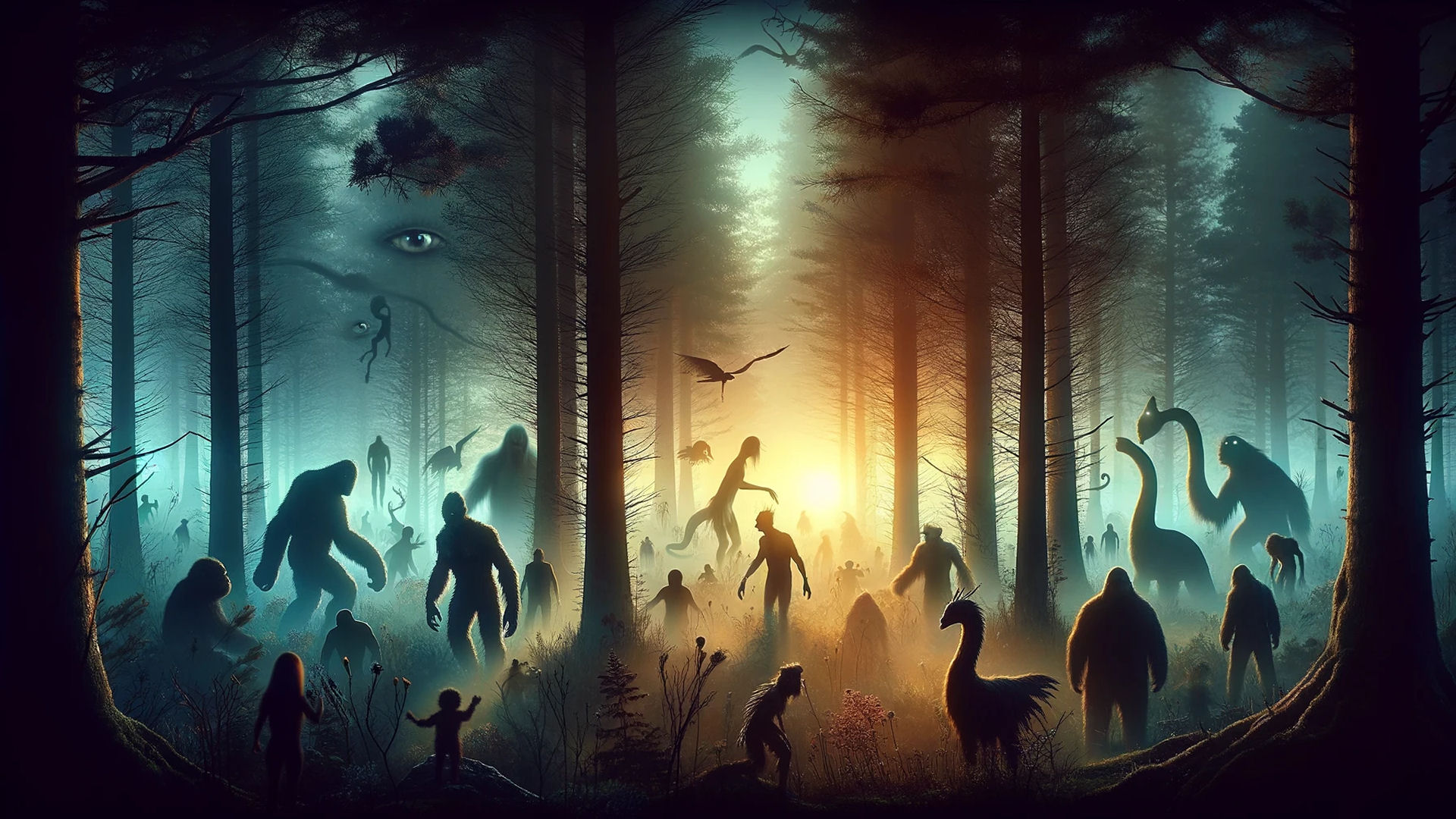
Art Bell delved into the fascinating world of cryptids with guest Loren Coleman, one of the world’s leading cryptozoologists. The discussion was primed to explore unusual animal behaviors, with stories emerging from India about animals aggressively turning against people. This conversation set the stage for a deeper inquiry into cryptids like Bigfoot, Yeti, and other mythical creatures that straddle the line between legend and plausible reality. Art humorously recalled a film where domestic and wild animals inexplicably attack humans, hinting at a mysterious global phenomenon affecting animal behavior.
The show also touched upon serious topics like the situation in Iraq and the unexpected response from ABC’s Nightline to a flood of faxes from Art’s listeners, showcasing the passionate engagement of his audience. Coleman’s distinguished career, spanning decades of academic and field research on cryptids across continents, was highlighted. His contributions to cryptozoology, including books, articles, and appearances on various media platforms, underscore his status as an authority in the field. Particularly noteworthy was his induction into the Roger Patterson Memorial Bigfoot Museum, reflecting his significant impact on the study of mysterious creatures.
The segment concluded with a discussion on the alarming reports of marine mammals, such as dolphins and whales, exhibiting unusual behavior by beaching themselves or fleeing the ocean, possibly in reaction to human activities. This raised concerns over the Navy’s plans to conduct high-volume sonar tests despite environmental objections, sparking a debate on the intersection of animal behavior, human intervention, and the mysteries that remain unsolved in the natural world.
Loren Coleman and Art Bell delve deeper into the interplay between animals and their changing environments, attributing unusual animal behavior to various factors, including human encroachment into wilderness areas. Coleman points out that as humans venture further into these territories, encounters with wildlife, like mountain lions stalking hunters, become more frequent. This perspective shifts the blame away from animals themselves and towards the impact of human activities, such as deforestation and urban expansion into natural habitats.
The conversation transitions to discussing the phenomena of animals turning on humans and other peculiar behaviors, suggesting these incidents may correlate with environmental changes or even astronomical events like solar eclipses. Coleman emphasizes the importance of considering long-term patterns in animal behavior rather than interpreting these events as novel or apocalyptic signs.
The focus then shifts to Bigfoot, a topic of particular interest to both Coleman and Bell. Coleman firmly believes in the existence of unidentified primates in the Pacific Northwest, distinguishing genuine evidence from hoaxes with scientific scrutiny. He discusses the credibility of eyewitness accounts and the forensic analysis of footprints, which can reveal the authentic presence of these cryptids. Despite numerous reports and alleged encounters, including individuals claiming to have shot Bigfoot, physical evidence remains elusive. Coleman recounts stories of individuals too frightened by the legal and ethical implications of their actions to come forward, highlighting the complex human emotions and societal pressures that intertwine with the search for cryptids.
Loren Coleman and Art Bell explored the complexities surrounding evidence of Bigfoot’s existence, including the notorious Minnesota Iceman case. Coleman elucidated how initial genuine discoveries often become obscured by hoaxes, emphasizing that while skeptics often cite the lack of physical bodies as a primary argument against the existence of cryptids like Bigfoot, this isn’t entirely accurate. He highlighted historical challenges in discovering large primates, such as mountain gorillas, which remained elusive for decades despite concerted efforts to find them, drawing parallels to the ongoing search for Bigfoot.
Loren’s insights extended to the evidence supporting Bigfoot’s existence, including footprints and hair samples that defy explanation as known animals. He underscored the scientific process of validating such evidence, distinguishing genuine artifacts from hoaxes. Discussion also covered the behavioral patterns of Bigfoot, suggesting that these creatures are primarily nocturnal and might construct nests, similar to behaviors observed in gorillas. Coleman shared anecdotes from his research and the experiences of others who have encountered evidence of Bigfoot, including nests and unique vocalizations.
The conversation then shifted towards skepticism surrounding Bigfoot evidence, particularly the Patterson-Gimlin film, often cited as the most compelling visual proof of Bigfoot’s existence. Despite controversies and claims of fabrication, Coleman defended the authenticity of the film, attributing such skepticism to a broader pattern of disbelief and dismissal that often greets purported evidence of cryptids. He recounted an instance where a Hollywood makeup artist was rumored to have created a costume for the Patterson film, only to reveal that allowing such rumors to persist served his interests in Hollywood.
Loren Coleman shared further insights into Bigfoot, focusing on the creature’s nature and the debate surrounding its existence. Coleman and Art Bell discussed the two major schools of thought regarding Bigfoot’s classification: one positing it as a descendant of Gigantopithecus, a giant ape known only from sparse fossil records in Asia, and another suggesting it could be related to Paranthropus, a genus closer to humans. This debate underlines the complexity of Bigfoot’s potential place in the natural world, suggesting it exhibits a blend of primate and human-like characteristics, including intelligence and bipedalism.
The conversation also touched upon the ethical implications of proving Bigfoot’s existence, with some advocating for the killing of one specimen to provide undeniable evidence, while others, including Coleman, prefer non-lethal methods such as photography and DNA sampling. This highlights a broader discussion within cryptozoology and wildlife research on the balance between discovery and conservation.
Coleman emphasized the importance of respecting these creatures, advocating for tranquilizing and studying them in a humane manner, if necessary, to avoid harming them. He also spoke about the challenges faced by those who report sightings, including ridicule and skepticism, which likely leads to a significant underreporting of encounters.
Loren Coleman expanded the conversation to include other cryptids, notably the Chupacabra, which has intrigued both researchers and the public across various cultures, particularly within Hispanic and Latino communities. Starting as a mysterious phenomenon in Puerto Rico, reports of the Chupacabra have spread through South America, Mexico, and even into the southwestern United States. Descriptions of the creature and its actions, particularly its alleged attacks on livestock and sometimes humans, leaving them drained of blood, have fueled widespread interest and speculation.
Coleman touched on the historical context of creature reports that resemble the Chupacabra, noting that such accounts have been part of folklore and eyewitness narratives for decades. Despite skepticism and ridicule from some quarters, Coleman underscored the importance of taking these reports seriously, given the volume of eyewitness accounts and physical evidence, like unusual footprints and animal victims showing peculiar injuries.
The discussion also veered into the evidence for the existence of the Chupacabra, including photographs of victims and alleged footprints. Coleman revealed having a plaster cast of a footprint believed to be from a Chupacabra, obtained from a fellow investigator in Miami. This evidence suggests a creature that, while often depicted as reptilian or alien-like in popular media, might actually share characteristics with primates, including bipedality and hair, hinting at a connection to other cryptids like Bigfoot.
Loren Coleman delved into a variety of cryptids beyond Bigfoot, including the intriguing phenomenon of phantom kangaroos reported in the United States, particularly a notable flap in Chicago during the 1970s. These sightings, characterized by credible witnesses reporting kangaroo-like creatures hopping across their yards and leaving three-toed footprints, parallel early Chupacabra reports. Coleman posits that these so-called kangaroos might be more primate-related, challenging conventional perceptions and suggesting a deeper complexity in cryptid sightings.
The discussion transitioned to the origins and nature of these cryptids. Coleman pondered whether these creatures have coexisted with humans for an extended period, successfully evading detection, or whether they are newer species emerging through evolution or other processes. Another intriguing possibility raised was the idea of cryptids originating from other dimensions or being extraterrestrial in nature, suggesting a blend of science fiction and cryptozoological speculation.
Coleman also touched on various regional cryptids across North America, from the Wendigo in Eastern Canada and the Skunk Ape in the Southern United States to the Mothman of West Virginia and mysterious black panthers in the East, indicating a rich tapestry of cryptid folklore across the continent. This diversity of sightings and reports underscores the widespread human fascination with the unknown and the myriad ways in which these mysterious creatures are woven into local lore and culture.
Loren Coleman addressed the phenomenon of the Chupacabra and its supposed method of extracting blood from its victims, highlighting the uniqueness of such behavior among known animals. The conversation shifted towards the examination of animal mutilations attributed to the Chupacabra, emphasizing the importance of differentiating between these incidents and those caused by natural predators or other explainable factors. Coleman suggested that while there is a reality to the Chupacabra, the aggregation of all mysterious animal deaths under its name is part of the early stages of any cryptid phenomenon wave, where distinguishing between genuine and misidentified reports is crucial.
The dialogue then moved to another cryptid, the Skunk Ape, known for its pungent odor and sightings in the Florida Everglades. Descriptions of the Skunk Ape vary, with some reports suggesting a Bigfoot-like creature and others likening it more to chimpanzee-like beings, indicating the diversity within cryptid sightings and the challenges in categorizing these reports.
Coleman and Art Bell also explored the concept of “missing links” in the context of Bigfoot and other cryptids, discussing the evolutionary significance of these creatures and the potential for new species to emerge due to environmental pressures. Coleman cautioned against the simplistic use of the term “missing link,” advocating for a more nuanced understanding of evolutionary processes and the complexity of classifying new or undiscovered species.
Loren Coleman discussed the possibility of communication among non-human species, suggesting that we might not fully understand signals like the skin patterns of giant squids or the clicks of dolphins. Coleman also touched on the concept of very brainy, bipedal reptiles potentially coexisting with humans, a notion proposed by scientist Dale Russell, which imagines an alternative evolutionary path where reptilian creatures evolved with high intelligence.
The conversation then shifted to the topic of famous lake monsters, like the Loch Ness Monster and Lake Champlain’s Champ. Coleman discussed the characteristics common to many reported lake monsters around the world, including the possibility that these creatures could be giant otters or prehistoric whales that have survived into modern times. He mentioned a forthcoming NOVA program expected to shock audiences by suggesting the existence of the Loch Ness Monster, based on new evidence.
Coleman also covered reports of creatures in the United States, particularly focusing on Lake Champlain’s monster, Champ, which shares similarities with the Loch Ness Monster. These creatures are often reported to resemble plesiosaurs, sparking interest and speculation about their origins and existence.
Addressing the question of whether cryptids like Bigfoot or lake monsters have ever been reported to consume or attack humans, Coleman provided an example from the Northwest Territories called the “Headless Valley,” where prospectors disappeared or were found decapitated, fueling rumors of giant Bigfoot-type creatures being responsible. However, he clarified that there’s no evidence of these creatures consuming humans.
One caller, Fran from Springfield, Massachusetts, shared a detailed account of a military exercise in California where their battalion encountered unidentified creatures, leading to the cancellation of the exercise and a heightened security response. This incident sparked questions about the government’s awareness and potential suppression of evidence regarding cryptids like Bigfoot.
Another caller, John from Scottsdale, raised points about human-animal conflicts and the theory proposed by Lloyd Pye, suggesting that humanoids are the natural inhabitants of Earth, while humans might be genetically engineered beings. This theory implies that many of the cryptids discussed could represent Earth’s original lineage, making humans the outliers in natural evolution.
Coleman provided insights into these discussions, emphasizing the complexity of defining intelligence and communication in non-human species. He expressed skepticism towards the idea that humans are unnatural compared to other beings, framing humans as part of the animal kingdom with a capacity to significantly alter our environment.
One caller described a Bigfoot sighting at a nuclear power plant, highlighting the creature’s ability to camouflage and the eerie feeling it left behind. Another caller, with experience handling wild rhesus monkeys for research, pointed out the potential strength of a creature like Bigfoot and the challenges it would pose in capturing and containing it without harm. This led to a discussion on the ethics and practicalities of tranquilizing and studying such a creature, emphasizing the importance of preparation and respect for the animal’s well-being.
Coleman also discussed the role of funding and scientific support in researching cryptids, suggesting that a dedicated team stationed in a habitat known for sightings could yield significant findings. He mentioned ongoing efforts in places like Sumatra to study elusive creatures by integrating researchers into the environment, a method he believes could be effective in finding Bigfoot.
One caller recounted a chilling incident at a nuclear power plant where both he and a colleague encountered something that resembled a pile of pine straw, which unexpectedly stood up and moved into the woods, accompanied by a terrible smell and a powerful bellowing sound. This story contributed to the ongoing discussion about the elusive nature of Bigfoot and its exceptional ability to remain undetected in its natural environment.
Another discussion revolved around the logistics and ethics of capturing such creatures for study. A caller with experience handling wild rhesus monkeys highlighted the immense strength these animals possess relative to humans, suggesting that if a Bigfoot were to be captured, it would require a significantly strong containment method to ensure safety for both the creature and the humans involved.
The conversation also touched on the historical and cultural perspectives of Native American tribes regarding Bigfoot, suggesting a rich tapestry of beliefs and understandings about these beings. Some view them as flesh-and-blood creatures, while others see them as part of the ghost world, highlighting the diversity of interpretations across different cultures.
A particularly compelling story came from a caller who, along with a biologist companion, experienced a terrifying encounter with a creature in Georgia. The creature emitted a primal scream and charged towards them, breaking tree limbs in its path. This encounter underscores the primal fear such experiences can evoke, often preventing witnesses from investigating further or collecting evidence.
Coleman reflected on these stories, emphasizing the challenges in studying cryptids due to the fear and immediate need for safety that witnesses often feel during encounters. He suggested that despite the difficulties, there remains a significant opportunity for scientific inquiry and understanding, provided there is sufficient courage and funding to pursue these elusive creatures systematically.
A caller inquired about the impact of the Mt. St. Helens eruption on the Bigfoot population. Coleman acknowledged that while some Bigfoot might have been affected, the population density of Bigfoot in the area was likely low, similar to that of bears, suggesting a limited impact on their numbers.
Another caller questioned the extent of government attention to cryptid research. Coleman reiterated the challenges in determining government involvement or interest, pointing out that unless a significant discovery is made on public lands or near sensitive sites, there is little active government engagement in cryptid research.
The conversation also touched on philosophical and scientific critiques of evolutionary theory, with callers referencing works like “Darwin’s Black Box” by Michael Behe, which argues that evolution has not been sufficiently proven at the molecular level. This led to a broader discussion on the unique traits of humans compared to other primates, despite genetic similarities.
Coleman and callers explored the potential for sign language and other forms of communication to reveal intelligence and sentience in great apes. The discussion highlighted instances where apes have shown the ability to create art or use sign language to communicate, raising ethical and philosophical questions about the treatment and classification of these animals.
One caller recounted a peculiar sighting of an animal with tusks in Taiwan, suggesting the diversity of wildlife and the potential for discovering previously unknown species. Another caller discussed regional names and behaviors of mountain lions, illustrating how cryptid lore can sometimes be rooted in encounters with known wildlife exhibiting unusual behavior.
A significant part of the discussion revolved around the idea of Bigfoot or Sasquatch being a descendant of Neanderthals, which Coleman addressed by highlighting the distinct differences between reported Bigfoot behaviors and the archaeological evidence of Neanderthal life. This conversation underscored the complexity of cryptid research, which often intersects with anthropology, paleontology, and zoology.
Questions about the potential for government experiments leading to the existence of creatures like the Chupacabra prompted Coleman to emphasize the long history of cryptid sightings predating modern genetic experimentation. While acknowledging the possibility of secret projects, he maintained a focus on the historical and eyewitness evidence supporting the existence of cryptids as naturally occurring beings rather than lab-created entities.
One topic addressed was the fascinating sound recordings of what could be Bigfoot from Washington state, with Coleman expressing a cautious interest, emphasizing the importance of context and verification for such evidence. He also touched on sightings of large black birds, which he suggests could be turkey vultures or black vultures, common in the East Coast but often mistaken for something more exotic due to their size.
The conversation took a more speculative turn with a caller’s story about being kidnapped as a child and later encountering beings she believed to be Bigfoot while picking berries. She described these beings as vegetarians, having long brown hair, and emitting a strong odor. Despite her traumatic background, she recounted interactions that suggested to her these creatures possessed a form of communication and social structure, though her experiences are highly unusual and difficult to verify.
One caller recounted an unusual childhood experience of interacting with what she believed were Bigfoot creatures, emphasizing her conviction that these encounters were not the product of a child’s imagination. Coleman acknowledged the significance of such accounts, especially noting that children often report cryptid sightings, suggesting a potential non-threatening perception of children by these creatures.
Another caller introduced the topic of giant anacondas, leading to a discussion about reports of oversized snakes in South America, with Coleman confirming the existence of historical accounts suggesting abnormally large anacondas. This conversation underscores the global nature of cryptid stories, encompassing not just terrestrial but also aquatic and semi-aquatic creatures.
Subsequent calls covered a range of topics, including the physical strength differences between Neanderthals and modern humans, with Coleman explaining the anatomical reasons behind Neanderthals’ superior strength. The discussion also ventured into the aquatic ape hypothesis as a potential explanation for human evolution.
One caller from Minnesota described an encounter with a mysterious animal, prompting a conversation about the variety of wildlife that can often be mistaken for cryptids due to their unusual appearances or behaviors. Coleman addressed these encounters with a scientific perspective, suggesting possible known animals that could explain the sightings.
Loren Coleman and the host delve into discussions about the potential for unknown creatures inhabiting deep, unexplored holes and underwater tunnels, reflecting on how life adapts to the harshest environments, suggesting a natural propensity for life to thrive under various conditions. This conversation highlights the immense biodiversity of our planet and the possibility of undiscovered species living in extreme habitats.
The dialogue continues with a caller inquiring about ancient reports of giant skeletons found in burial grounds across the United States, hinting at historical evidence that could potentially support the existence of beings like Bigfoot. Coleman expresses interest in these stories, emphasizing the value of tracing and examining such reports as part of the broader investigation into cryptids and their historical context.
The program also touches on Coleman’s published works and how listeners can connect with him for further inquiries, showcasing his significant contribution to the field of cryptozoology and his openness to engaging with the public on these fascinating topics.