
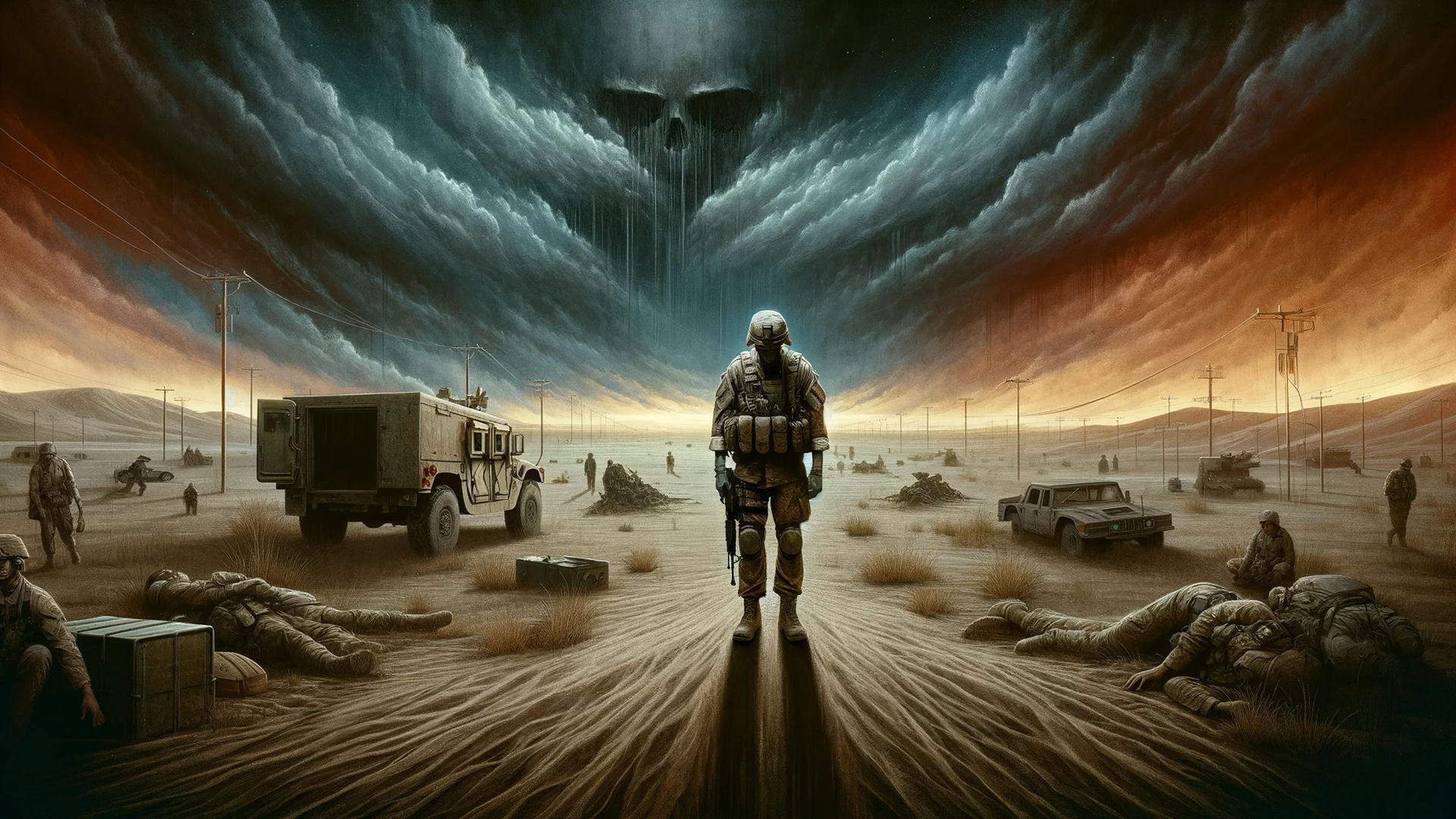
Art introduces the topic by highlighting the government’s inconsistent stance on the Gulf War syndrome, oscillating between acknowledging it as a legitimate issue and dismissing it as stress-induced. Joyce Riley, a nurse and former captain who treated Gulf War veterans, joins the show to discuss this controversial topic. She expresses strong disagreement with the federal government’s recent statement that the illness is stress-related and not caused by a specific factor.
Joyce shares her personal experience with Gulf War illness, revealing a time when she was in such intense pain that she considered suicide. She discusses the complex issue of doctor-assisted suicide, especially from a nurse’s perspective, and her mixed feelings about it. Despite understanding the desire of terminally ill patients to end their suffering, Joyce personally believes in the sanctity of life and struggles with the idea of actively ending someone’s life, even in cases of severe pain.
The conversation then shifts to the government’s role in personal health decisions, with both Art and Joyce agreeing that such decisions should not be dictated by the state. They acknowledge the existence of pain so severe that it leads individuals to contemplate ending their lives. Joyce concludes by emphasizing the need to recognize the severity of Gulf War Syndrome and criticizes the government’s denial of treatment for military personnel suffering from it.
Joyce expresses her frustration with the government’s handling of the issue, emphasizing the urgency as lives are at stake. She is confused by the government’s inconsistent messages, sometimes acknowledging a disease called Mycoplasma Incognitus, while other times attributing the symptoms to stress.
Joyce accuses the government of disinformation, a tactic used to discredit information by releasing contradictory statements. She believes this is a clear case of government propaganda, intentionally denying the illness of Gulf War veterans. Joyce cites a statement from a 1994 Senate hearing led by Senator Riegle, highlighting the widespread impact of the syndrome not only on U.S. veterans but also on those from Canada, Britain, and Australia. The hearing emphasized that the illness was not a mental problem for the veterans, but rather a physical one, with even their families showing symptoms.
She criticizes the government and military for their denial and lack of action, mentioning various studies that have been inconclusive or focused on less relevant aspects like low-level exposure to chemicals. Joyce talks about a conversation with a Green Beret who is experiencing physical symptoms but is dismissed as having a mental problem. She stresses the seriousness of the situation, pointing out that the government avoids discussing the communicable nature of the disease, which she sees as a critical issue.
The segment also touches on the psychological aspects of illness, with Art mentioning studies on the placebo effect. Joyce acknowledges this but insists that the veterans she speaks with are genuinely ill, suffering significant declines in their quality of life and income. She argues that these veterans are not fabricating their symptoms for financial gain, as they have much more to lose than gain by being sick.
Joyce highlights the alarming increase in tumor rates among active duty military personnel, citing a confidential study from the Veterans Administration showing a 600% increase in brain cancer cases from 1991 to 1994. This rate is significantly higher than the norm, indicating a serious health crisis among military members.
Joyce also discusses the high incidence of birth defects in children of Gulf War veterans. A statistic from the Nation magazine indicates that 67% of sick Gulf War veterans report birth defects or deformities in their children, a figure drastically higher than in the general population. This alarming statistic, however, did not receive adequate attention in official surveys or reports.
The conversation then turns to the psychological impact on veterans. Joyce shares stories of veterans who feel betrayed and disillusioned by the government’s response to their health issues. They report being dismissed or misdiagnosed, with some even being told their physical symptoms are psychological or related to their sexual orientation. This treatment is particularly demoralizing for those who have served their country with distinction.
Art Bell raises a question about the role of military doctors in this situation, wondering how they could be part of a potential cover-up. He suggests that while a cover-up at the top levels of the military and political system is plausible, the involvement of military doctors is more complex and puzzling.
In this segment they delve into the role of military doctors in the Gulf War Syndrome issue. Art, having been a medic in the Air Force, expresses skepticism about military doctors being part of a cover-up, given their generally non-military demeanor and approach in hospitals. Joyce responds by sharing her interactions with military physicians and nurses, many of whom initially believed there was no Gulf War illness and considered the veterans as malingerers.
Joyce reveals that many military medical professionals were under an unofficial gag order, not allowed to speak about the communicable nature of the disease. She notes that while some military doctors are beginning to acknowledge the illness, they are often unable to openly discuss it or provide appropriate treatment due to restrictions. Joyce also mentions that VA (Veterans Affairs) doctors are more aware of the situation, with a significant number of Gulf War veterans now out of active duty and seeking treatment through the VA.
She shares a specific example of Dr. Leasure from Hershey, Pennsylvania, who has gone on record stating that Gulf War illness is a communicable disease. However, Joyce notes that physicians who speak out about this within the military or VA system face reprimands and threats of firing, as happened with Dr. Bob Franken in Los Angeles.
Art asks Joyce if she fears repercussions for her outspokenness on this issue. Joyce admits she might not be able to continue her work unscathed, as she is challenging powerful entities like the Pentagon and the CIA. Despite potential risks, she feels compelled to speak the truth for the sake of her patients and those suffering from the illness.
Joyce also touches on the severity of the situation, emphasizing that the real question is not just about the veterans being sick, but whether they will survive. She mentions that it’s difficult to obtain accurate figures on the number of deaths related to Gulf War illness, but estimates suggest that at least 15,000 military personnel may have died. Joyce describes cases of young, otherwise healthy veterans dying from rare conditions like “exploding heart syndrome,” highlighting the critical and life-threatening nature of the illness.
Joyce Riley discusses the unusual and severe health issues affecting Gulf War veterans. She describes cases of “exploding heart syndrome,” where the heart muscle becomes enlarged due to infection by Mycoplasma incognita, leading to fatal outcomes in young, otherwise healthy soldiers. Joyce mentions receiving reports of such cases from Fort Sam and other sources, emphasizing the abnormal nature of these deaths in young men.
Joyce shares emotional letters from Gulf War veterans and their families, illustrating the devastating impact of the illness. These letters express the pain and frustration of dealing with severe health issues, including the birth of deformed children, chronic pain, and financial ruin. The veterans emphasize their desire not for compensation, but for truth and a return to health. They express a sense of betrayal by their own government, with one veteran writing about the war that started again three years later, not with a foreign nation but with their own government.
The discussion then shifts to Mycoplasma incognita, a microorganism that typically causes mild infections like pneumonia but has been found to be altered in a way that makes it more dangerous. Joyce references Dr. Nicholson’s research, which suggests that the DNA of Mycoplasma incognita was altered to include part of the HIV envelope gene, making it more virulent. Dr. Nicholson’s interest in this pathogen began when his daughter, a Gulf War veteran, returned home and transmitted the illness to her family.
Art Bell questions whether Mycoplasma incognita was engineered for biological warfare. Joyce believes it was experimented with by the Department of Defense, though she cannot confirm if it was developed by them. She explains that Mycoplasma incognita is a good transfer mechanism for other pathogens and is typically treatable with antibiotics like erythromycin or doxycycline. However, the altered version associated with Gulf War Syndrome is more complex and dangerous.
Joyce Riley continues discussing the complexities of Mycoplasma incognita and its connection to the Gulf War Syndrome. She explains that this microorganism, when combined with part of the HIV envelope gene, results in a disease that mimics many symptoms of AIDS, such as night sweats, lymph node swelling, rash, headache, and nausea. However, when veterans exhibiting these symptoms are tested for AIDS, the results come back negative, leaving their condition undiagnosed.
Joyce mentions that there are specific tests for Mycoplasma incognita, but they are not widely available or used. These tests can be conducted at the Immuno Sciences Lab in Los Angeles or by Dr. Garth Nicholson, who has been independently testing Gulf War veterans for this condition. Despite the significance of these findings, the information has not been widely disseminated or acknowledged by the government or the medical community.
Art Bell raises the question of whether the AIDS envelope gene’s presence in Mycoplasma incognita could have been a contaminant in the anthrax vaccinations given to Gulf War soldiers. Joyce considers this a possibility, emphasizing that regardless of whether the contamination was accidental or intentional, the fact remains that a significant number of veterans are testing positive for this altered microorganism.
Joyce also addresses the challenges faced by veterans in getting tested and treated for Mycoplasma incognita. She notes that the VA is not testing for it and is reluctant to provide the necessary antibiotic treatment, such as doxycycline. Many doctors are hesitant to get involved due to fear of government repercussions. Joyce makes a plea for doctors willing to assist these veterans to come forward and help address this critical health issue.
Riley discusses the challenges faced by Gulf War veterans in seeking treatment for their illness. She reveals that some doctors are reluctant to treat these veterans due to the communicable nature of the disease, fearing infection in their own practices. This situation has led to Gulf War veterans being treated like lepers, further exacerbating their struggles.
Joyce emphasizes the urgency of treating the illness, regardless of its origin. She agrees with Art Bell that it’s reasonable to call for doctors willing to treat Gulf War veterans with the appropriate antibiotics. However, she notes the difficulty in finding such doctors, as many are afraid of government repercussions.
The conversation then shifts to the actions taken by some Gulf War veterans in response to the lack of support from the Pentagon. Joyce mentions that a group called the Operation Desert Shield/Desert Storm Association, led by Sylvester in Odessa, Texas, has filed a complaint with the United Nations Human Rights Commission. This action was taken because the Gulf War was a UN operation, and the veterans feel that their only avenue for redress is through the UN.
The complaint alleges that the U.S. Department of Defense and the Department of Veterans Affairs have violated various international codes and standards by exposing military personnel to dangerous substances, often secretly, and failing to provide necessary information and medical follow-up. The veterans believe these actions constitute crimes against humanity and potential war crimes.
Art expresses concern about the implications of U.S. citizens seeking help from the UN, a body that the U.S. government often views skeptically. Joyce agrees, acknowledging the gravity of the situation where U.S. military personnel must turn to a foreign power for assistance. She notes that this action is not something she personally agrees with or would have promoted, but understands that the veterans felt it was their only option.
Joyce Riley discusses the dire situation of Gulf War veterans and the potential legal implications for the U.S. government. She expresses her frustration with the government’s denial of the existence of a Gulf War illness, while veterans continue to suffer and die. Joyce suggests that admitting the illness would require the government to acknowledge unethical and possibly illegal activities.
Art raises the question of why the government doesn’t blame the illness on Iraq, especially if it’s treatable. Joyce explains that a lot of the illness is past the point of no return and cannot be treated, which includes not only the effects of Mycoplasma incognita but also organophosphate poisoning from chemical weapons. She emphasizes the severity of the situation and the potential liability for the U.S. government, suggesting that the issue could escalate to war crimes due to intentional neglect and criminal intent.
Joyce also mentions the destruction of medical records, which adds another layer of criminality to the situation. She notes that approximately 60% of medical records have been either lost or sanitized, further complicating the veterans’ ability to seek treatment and justice.
Regarding the dispersal of Mycoplasma incognita, Joyce admits she is not an expert but suggests it could have been a contaminant in the drugs given to soldiers or possibly transferred in Scud missiles. She shares firsthand accounts from reputable sources who claim that chemical weapons were used during the Gulf War, including by the U.S. She argues that the denial of treatment to U.S. troops only exacerbates the situation.
Joyce also discusses the issue of chemical alarms that went off during the war, indicating the presence of chemical weapons. She questions the reliability of these alarms, noting that Senator Riegle addressed the issue in committee hearings, deeming it ridiculous to think that the alarms malfunctioned to such an extent.
Joyce also discusses the U.S. government’s provision of agents for nuclear, biological, and chemical capabilities to Saddam Hussein up until 1990, questioning the rationale behind such actions. She mentions the discovery of various chemical agents, including mustard gas and sarin, after the war, challenging the notion that these agents were not used or were left unused on the battlefield.
The conversation shifts to U.S. Code Chapter 50, which allows the government to experiment on the American civilian population with 30 days’ notice to local authorities. Joyce expresses her concern about ongoing experiments in the U.S. and criticizes the media for initially ignoring her findings and labeling her as a “wacko.”
Joyce emphasizes her love for the country and her commitment to uncovering the truth about Gulf War Syndrome. She stresses the importance of listening to those who study and understand these issues, highlighting the need for a new perspective on individuals labeled as “right-wing wackos” or “patriots” who are trying to save the country.
Riley continues to discuss her dedication to uncovering the truth about Gulf War Syndrome and her commitment to helping affected veterans. She expresses her deep patriotism and belief in the values of the United States, emphasizing her willingness to risk everything to ensure the safety and well-being of Americans. Joyce is determined to challenge any actions that compromise the health of the population, such as the creation or maintenance of diseases.
Joyce also talks about the growing awareness and unity among different groups affected by similar health issues, including Vietnam veterans, chronic fatigue sufferers, and Gulf War veterans. These groups are collectively saying “enough is enough” and demanding action and accountability.
Art and Joyce then discuss the U.S. government’s history of experimenting on its own citizens. Joyce mentions various experiments involving viruses and bacteria, some of which were conducted at airports to study disease transmission. She highlights the violation of human rights inherent in these experiments and references the CIA’s MKUltra program, which conducted experiments on unwitting subjects.
The conversation shifts to the potential reasons behind these experiments, such as studying disease effects on populations or testing biological agents for deforestation and water contamination. Joyce cites specific examples like the outbreak of chronic fatigue in Einstein Village, Nevada, suggesting a link to mycoplasma.
Art reads a fax about Saddam Hussein’s claim of victory in the Gulf War, considering the ongoing health issues in the U.S. military. Joyce responds with a chilling anecdote about Iraqis holding a sign saying “Bush, your troops are dead,” and questions whether Hussein’s claim of winning the war could be seen as accurate in light of the health crisis among U.S. veterans.
The segment concludes with a discussion about the disposal of chemical and biological weapons. Art Bell reads a statement criticizing the U.S. government’s claim that open-air bombing of sealed munitions could be safe, contrasting it with the controlled incineration methods used in the U.S. chemical and biological weapons disposal program. The statement calls for the truth to be widely known so that affected individuals can receive the treatment they need.
Joyce Riley continues discussing the Gulf War Syndrome and the U.S. government’s response. She criticizes the government for selling chemical and biological agents to Iraq and then deciding to bomb these same agents, highlighting the danger this posed to U.S. troops and the environment. Joyce points out the intelligence insult in the government’s claim that no one got sick during the war, despite evidence to the contrary, including a message from the Joint Chiefs of Staff indicating that 40% of U.S. troops experienced health problems during the war.
Joyce also discusses the inadequacy of the U.S. military’s chemical detection systems, which required a dangerously high level of sarin gas to trigger alarms. She criticizes the Assistant Secretary of Defense for claiming there was no evidence of chemical or biological agents, despite the lack of biological monitoring systems and the possibility that these agents were designed to incapacitate rather than kill.
Art speculates that Saddam Hussein likely used biological agents during the war, given his desperate situation. Joyce agrees, emphasizing the need to treat Gulf War veterans for both biological and chemical agent poisoning. She criticizes the post-war denial of Gulf War illness and the government’s reluctance to investigate whether troops saw chemical or biological agents.
The conversation then shifts to a caller, a former Marine who served in the Gulf War. He describes his experience with chemical detection tape turning pink during the ground offensive into Kuwait, indicating exposure to chemical agents. He also recounts how many soldiers started getting sick, and later conversations with other veterans revealed similar experiences with illness and exposure to Iraqi bunkers containing artillery shells.
A former Marine calls in, sharing his experience during the Gulf War. He recalls wearing chemical suits and noticing that the chemical detection tape on his suit turned pink, indicating exposure to chemical agents. He also mentions hearing about Iraqi soldiers affected by their own chemical weapons due to changing wind directions. This caller’s account adds to the evidence suggesting that chemical weapons were indeed used during the war.
Joyce then discusses her efforts to spread awareness about Gulf War Syndrome. She mentions providing a tape with information about the disease and supporting documentation, which she offers for free to Gulf War veterans. Joyce has recently met with German journalists from “60 Minutes” to discuss the issue, highlighting international interest in the matter.
The conversation shifts to multiple chemical sensitivity (MCS), particularly among Gulf War veterans who were in areas with chemical explosions. Joyce describes severe cases of MCS, including a young man who lives in a room papered with aluminum foil due to extreme sensitivity to chemicals.
A nurse from Missouri calls in, sharing observations from her work in an emergency room and speculating about the origins of the mycoplasma bacteria with the AIDS envelope gene. She suggests that Saddam Hussein might have developed this as a form of biological warfare, leading to long-term health effects. Joyce agrees with this possibility, noting that many mycoplasma scientists were trained in the U.S., including at Fort Detrick, Maryland.
Another caller from Los Angeles questions whether soldiers are used as “guinea pigs” for experiments. Joyce confirms this, citing a government document stating that hundreds of thousands of military personnel have been experimented upon without their knowledge.
The segment concludes with Art asking Joyce what people can do to help or learn more. Joyce emphasizes the importance of spreading awareness and encourages people to obtain her tape for more information.
In this segment Joyce Riley discusses the need for action to support Gulf War veterans. She mentions Dan Cassady from Minnesota, who has organized a group to aid these veterans, including fundraising and spreading awareness through videos. Joyce shares distressing stories of families abandoning sick veterans due to disbelief in the Gulf War illness. She emphasizes the importance of rallying support for these veterans, both financially and in raising awareness across America.
Art reflects on the discussion, acknowledging the complexity of the Gulf War Syndrome and the sad reality of U.S. troops having to seek help from the United Nations, effectively testifying against their own government. He expresses his concern about the situation and the need for further understanding and action.
The conversation then shifts to Art discussing the Supreme Court’s consideration of physician-assisted suicide. A fax from a listener brings up the topic, leading to a discussion about the ethical and legal implications of assisted suicide. Art shares his libertarian view that decisions about one’s life, including the end of it, are personal and should not be the government’s business.
The segment concludes with Art mentioning various global phenomena, including UFO sightings, religious apparitions, and environmental issues like fish mutations in the Mississippi River. He ponders the reasons behind these occurrences, questioning whether they are related to the approaching millennium or if there is a deeper significance to these events.
A caller questions why the U.S. military chose to blow up warehouses full of chemicals in Iraq, suggesting that a more controlled destruction method would have been safer. Art agrees, noting the contrast with how such munitions are carefully destroyed in the U.S.
The conversation then shifts to a discussion about fax communications and the inefficiency of cover sheets. Art humorously suggests that the person who invented cover sheets should be reprimanded, emphasizing the importance of concise communication.
A caller from Hawaii shares her opinion that Bill Clinton is a “Nazi fascist,” blaming him for the destruction and harm caused during the Gulf War. Art corrects her, pointing out that the Gulf War occurred during George Bush’s administration, not Clinton’s. He also discusses the privileges given to immigrants over American citizens, a topic that has been a point of contention through many administrations.
Art then reflects on the unthinkable actions of the U.S. government, such as experimenting on children and pregnant women, and the difficulty people have in accepting such realities about their government. He comments on the similarities between the Bush and Clinton administrations, suggesting that there is little real difference at the top levels of government.
A caller from Indiana brings up the use of depleted uranium in munitions and armor during the Gulf War. Art clarifies that while depleted uranium in a mist or dust form might be dangerous, it does not equate to nuclear shells, which would imply a nuclear explosion.
A caller questions the U.S. military’s decision to blow up warehouses full of chemicals in Iraq, suggesting that a more controlled approach to dismantling the buildings would have been safer. Art Bell agrees, noting the contrast with the careful destruction of munitions in the U.S.
Another caller discusses the federal government’s reaction to California and Arizona’s votes on medicinal marijuana use. The caller criticizes the government’s disregard for the states’ decisions, highlighting the tension between state and federal laws. Art comments on the government’s hardline stance on marijuana, contrasting it with the need for a more thoughtful national approach to drug policy.
The conversation then shifts to a caller who attempts to discuss metaphysical and spiritual topics, including a perceived “equilibrium balance” in the universe. Art , finding the caller’s comments confusing and unrelated to the previous discussion, steers the conversation back to the differences in policy between the George Bush and Bill Clinton administrations. He asserts that, at the top level, the policy differences between the two administrations are minimal.
Art also mentions a conversation with Joyce Riley about information being developed by an attorney, not Joyce herself, regarding the first lady. He plans to have the attorney present the material on the show, rather than Joyce.
A caller expresses concern about the perceived softening of each successive generation, particularly in their ability to handle adversity. Art agrees, suggesting that people have become progressively softer since World War II and questioning whether current generations would be willing to make significant sacrifices if needed.
Another caller from Des Moines, Iowa, discusses the demographic composition of the U.S. military, noting that it predominantly consists of individuals from poorer backgrounds. He expresses frustration with the treatment of veterans and the lack of support they receive upon returning home. The caller also raises concerns about the potential for armed conflict within the U.S. and the role veterans might play in such a scenario.
The conversation then shifts to a discussion about “Sue,” a well-preserved dinosaur fossil. A caller speculates that the FBI’s confiscation of the fossil might be due to it containing information that could challenge existing theories about dinosaurs. He suggests that remnants of dinosaur populations might have survived until the Middle Ages, inspiring legends of knights and dragons.
Art responds to the caller’s theory, mentioning Michael Crichton’s fictional work about dinosaurs surviving in modern times. The caller asserts that the scientific community often resists new findings that contradict established theories, likening science to a religion with its own high priests.
The segment concludes with a caller from Redding, California, discussing bioelectric therapy and its reported health benefits. The caller shares anecdotes about individuals who have experienced improvements in their health conditions after using bioelectric devices.
A caller from Canyon Country observes that each generation seems to be getting softer, less resilient, and less able to handle adversity. Art Bell agrees, suggesting that people have become progressively softer since World War II and expressing concern about the current generation’s ability to handle significant challenges.
A caller from Spokane, Washington, shares her positive experience with doxycycline, a medication she was prescribed for her health issues. She credits the medication with alleviating her symptoms, including rashes and headaches, and expresses her support for Joyce Riley’s cause.
Art Bell then addresses a peculiar incident involving a listener sending him a cursed doll. He explains that he disposed of the doll in the trash, covered in salt, as per his wife’s suggestion, to contain any negative energy. He advises listeners not to send him items that are supposedly cursed.
A caller from Wisconsin inquires about recent sightings of the Chupacabra, a mythical creature. Art Bell shares a bizarre story about a man in Wisconsin who claimed to have hit a Chupacabra with his car. The caller from Wisconsin also mentions recent Chupacabra attacks in Puerto Rico, including an incident involving three camels.
Another caller from Fresno, California, discusses symbols of fascism in the U.S. Congress and the government’s stance on marijuana and alcohol. He suggests that the government prefers substances like alcohol, which dull the mind, over those that induce euphoria.
A caller expresses frustration with the government’s stance on marijuana, arguing that it’s lumped together with more dangerous drugs like crack cocaine and heroin. The caller believes this approach is misguided and indicative of a fascist government.
Art then ponders the future of marijuana laws in California and Arizona, questioning whether these states will back down due to federal pressure or if the federal government will enforce its own laws. He criticizes the federal government’s arrogance in dismissing the voters’ decision as being “asleep at the switch.”
The conversation shifts to a caller from Des Moines, Iowa, who discusses the CIA’s alleged involvement in selling cocaine in Los Angeles and Arizona. The caller is curious why there hasn’t been more news coverage on this issue. Art Bell suggests that the lack of follow-up coverage might indicate a lack of evidence.
Another caller from Auburn praises Art Bell’s book and the Baozun automation radio. The discussion then turns to the U.S. government’s treatment of veterans, with the caller expressing disbelief and disappointment that the government could turn its back on its military personnel. The caller is particularly disturbed by Colin Powell’s statement that the Pentagon wouldn’t lie to the American people, given the evidence to the contrary.
A caller from Kodiak, Alaska expresses appreciation for the show’s open-mindedness and its role in promoting the American way of thinking. Art Bell thanks the caller for the compliment and emphasizes the importance of open lines for any topic.
A caller inquires about the Freemen, a group involved in a standoff with the government, noting the lack of recent news coverage. Art Bell agrees that the story seems to have been swept under the carpet, a common occurrence with such incidents.
The conversation then shifts to a caller discussing a news segment about a comet coming close to Earth. The caller is excited about the astronomical event and praises Art Bell’s show.
Another caller from Council Bluffs, Iowa, brings up the topic of ghosts, leading to a discussion about an upcoming show featuring Dr. Karpf, who investigated a case that inspired the movie “The Entity.” Art Bell and the caller talk about the nature of ghosts, pondering whether they are echoes of traumatic events, projections of the mind, or something else entirely.
A caller shares her philosophy on love and its role in society. She believes that more love in the world would reduce the need for laws and rules. Art Bell responds by pointing out that sometimes unconditional love can create the need for rules, using the example of a spoiled child who receives everything they want.
A caller reflects on the Gulf War Syndrome and the role of prominent figures like Colin Powell and George Bush. The caller expresses disillusionment with Bush, whom he once admired, and suggests that there’s more to the Gulf War illness than meets the eye.
Another caller inquires about “Art’s Parts,” a set of mysterious metal pieces allegedly associated with UFOs. Art Bell explains that experiments are being conducted to determine if these parts exhibit a weight or mass reduction when subjected to high voltage. He mentions that preliminary results suggest a possible mass reduction, but the tests are complex and require careful interpretation.
A caller from Chicago shares a theory that George Bush, as a former head of the CIA, was involved in secret testing on the public and knew about the risks posed to troops during the Gulf War. Art Bell challenges this view, arguing that if Bush was involved in a cover-up, then subsequent presidents like Bill Clinton would also have to be complicit. The caller believes that Clinton would not have had the same level of access to information as Bush.
The conversation then turns to the involvement of other presidents, such as Ronald Reagan and Jimmy Carter, in secret government activities. The caller speculates that Reagan might have been more aware of these activities than Clinton, but is unsure about Carter’s involvement.
A caller from Nashville discusses the transformation from an agricultural to an information-based society and its impact on social patterns, religions, and government. The caller suggests that society needs to consciously decide its future social forms, referencing the communes and alternative lifestyles of the 1960s as initial experiments in this direction.
Art Bell shares his thoughts on why communes did not work, attributing it to the unnatural unit of a commune and the inevitable formation of cliques and political groups within. He extends this idea to larger groups, suggesting that the larger the committee, the less likely it is to accomplish anything.
Another caller presents a theory on ghosts, suggesting that they are bleed-throughs from other dimensions coexisting with ours. Art Bell agrees that time is a human construct and that there could be interactions between different dimensions, including the past and future.
The conversation then shifts to a discussion about the media’s influence on perceptions of the world. A caller questions whether the perception of the world going “to hell in a handbasket” is media-induced. Art Bell acknowledges the role of media but also points out that real-world experiences, like a day trip through Los Angeles, can also shape one’s view of the world.
A caller discusses the social deterioration and economic issues in society, particularly focusing on the irresponsible use of credit cards and bankruptcy. Art Bell agrees and suggests that such behavior reflects a broader societal problem.
Another caller discusses the idea of decriminalizing marijuana, comparing it to alcohol regulations. The caller suggests that the government could profit from marijuana through taxes and regulations, similar to alcohol and tobacco.
A caller then presents a conspiratorial view that the government is involved in drug trafficking and fostering a false war on drugs, particularly targeting the black population. Art Bell challenges this view, pointing out that it is individuals who choose to use drugs, not the government.
The conversation shifts to a discussion about communes, with a caller from Indiana suggesting that the failure of communes is due to an imbalance of givers and takers and a lack of commitment and continuity. Art Bell agrees, adding that even the best-intentioned groups can form cliques and face internal conflicts.
The topic then turns to the right to commit suicide, particularly in cases of severe disability or terminal illness. Art Bell expresses his libertarian view that the decision to end one’s life, with or without physician assistance, should be a personal choice and not the government’s business. He criticizes those who advocate for smaller government but are willing to impose regulations on moral issues.
The segment concludes with a caller discussing a webpage about biological warfare and sharing the information with their congressman, who was reportedly unaware of the issue.
A caller shares information about open-air biological warfare tests conducted by the U.S. government between 1949 and 1969. The caller mentions receiving documents from a congressional library about these tests and expresses concern about the lack of follow-up on the long-term effects on the civilian population.
Another caller from Colorado thanks Art Bell for years of enjoyable programming and discusses how some other talk show hosts view Art Bell’s approach as unconventional or “nuts.” Art Bell responds by saying he is unfazed by criticism and views it as a badge of honor, emphasizing the importance of open line talk radio for its authenticity and unscripted nature.
The conversation then shifts to a caller discussing a magazine called “Extra” and “Covert Action Quarterly,” which document how corporate media suppresses evidence that could embarrass the CIA and the military-industrial complex. The caller specifically mentions the CIA crack cocaine-Contra link and how leading media outlets, with ties to the CIA, have tried to discredit this story.
The caller suggests that figures like Oliver North and John Poindexter were implicated in a drug-running ring. Art Bell expresses skepticism about these claims, particularly at the highest levels of government. He acknowledges that individual pilots might have transported drugs, but he does not believe it was a policy of the U.S. government.