
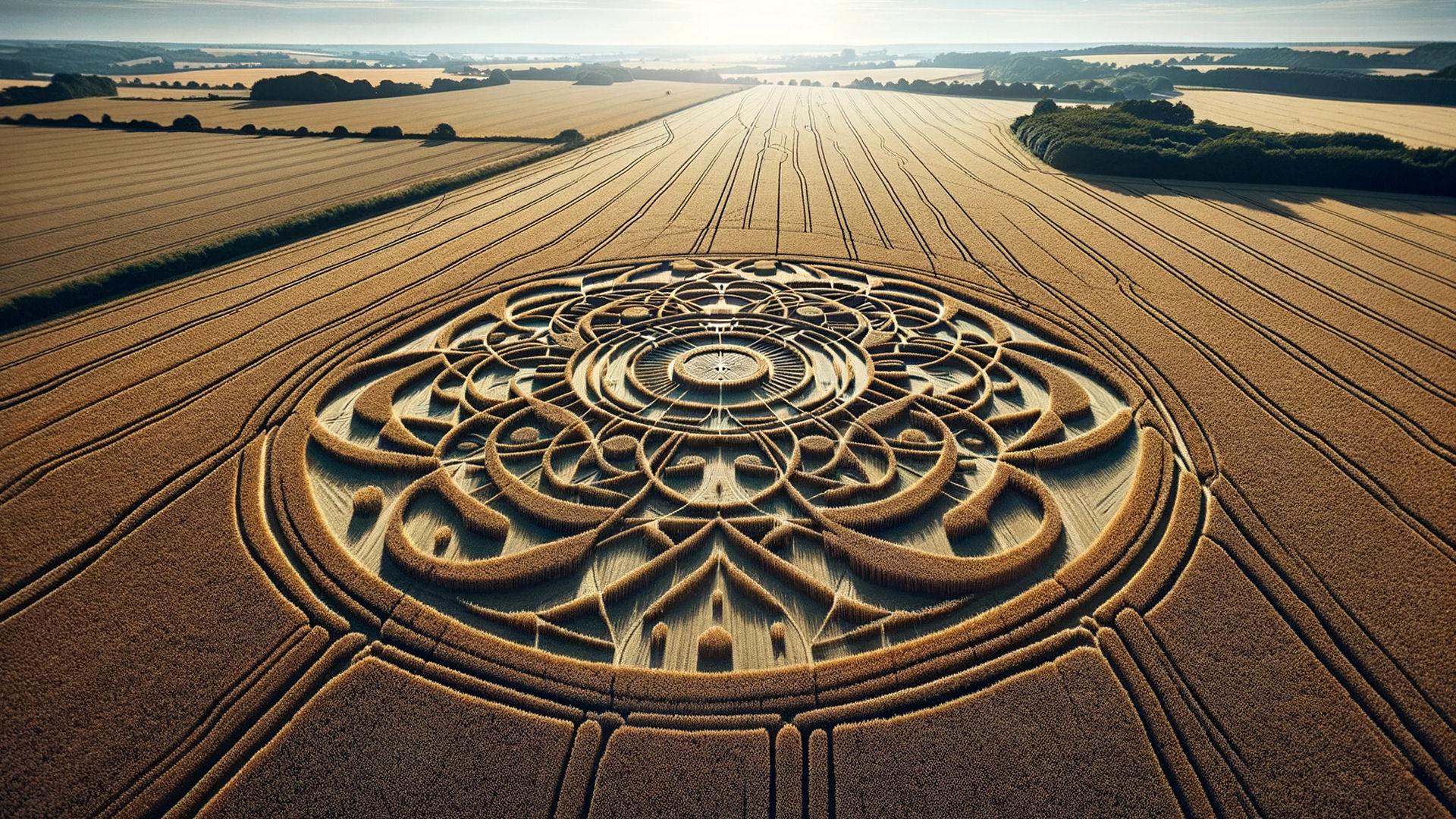
The program begins with an acknowledgment of the Bigelow Foundation’s support. Art introduces the night’s topics, which include a discussion on crop circles and other unexplained phenomena. Linda Howe is the first guest, sharing her experiences and findings from investigating crop circles in England alongside colleagues, including a detailed examination of affected plants.
Linda’s report highlights fundamental changes at the chemical and physical level in the plants from these crop circles. These findings align with the global phenomenon of crop formations, animal mutilations, and other anomalies occurring simultaneously in various countries. The show also touches on the subject of UFO sightings and extraterrestrial interactions, citing a study from Carleton University in Ottawa. This study, published in the Journal of Abnormal Psychology, finds that witnesses of UFOs are mentally sound and intelligent, challenging the stereotype of such witnesses.
The discussion then shifts to personal accounts of UFO encounters, emphasizing the normalcy of these individuals in society. This segment concludes with a focus on how media outlets, influenced by the Canadian study, have started reporting on UFO encounters more credibly, sharing stories of people who feel haunted or affected by these unexplained phenomena.
Art Bell delves deeper into the realm of unexplained phenomena with a focus on UFOs and alien encounters. The segment begins with a story from a Gannett News Service about two women in Catlett, Virginia, who report seeing a spaceship materialize out of thin air. These sightings contribute to the pattern of the UFO-human abduction syndrome, which has been reported for at least 30 years.
The discussion shifts to the traumatic experiences of abductees, likening their ordeals to a cat’s visit to the vet: frightening but potentially for a greater purpose. This leads to speculation about the long-term reasons for these abductions, suggesting a connection to human survival. Linda Howe then emphasizes the significance of psychology in understanding these phenomena. Researchers and the media are taking these reports seriously, investigating and reporting on them as credible experiences.
The conversation moves to the political arena, speculating about potential upcoming public statements regarding UFOs by governments. A particular focus is on Bobby Ray Inman, Secretary of Defense designate, who may have insider knowledge about government interactions with alien life forms. The segment hints at the existence of a secretive government group, MJ-12, which possibly holds extensive knowledge about extraterrestrial affairs since the Truman administration.
Linda concludes by stressing the urgency of accepting the reality of extraterrestrial life. With only six years until the year 2000, she argues that the overwhelming eyewitness accounts, military, and intelligence sources indicate ongoing interactions with extraterrestrial beings since the 1940s. She suggests that the government’s gradual revelation of these interactions over the past 50 years might be a strategy to prepare the public for the acceptance of our place in a universe where we are not alone.
Linda expresses her belief that the policy of silence maintained by the government and other countries has persisted because the story of extraterrestrial contact is too difficult for the general public to comprehend. She suggests that governments have been waiting for a generational shift to occur since the 1940s, making it easier to eventually disclose the truth.
Linda argues that the public has a right to know about extraterrestrial interactions, which could significantly impact our future. She raises a hypothetical scenario for the listeners: if they were in the government’s position, with complete knowledge of non-human, sophisticated intelligence interacting with our planet, would it make sense to inform the entire planet now, or continue the policy of silence?
Art reflects on the difficulty of revealing the truth after years of maintaining a lie. Linda shares an anecdote about a government official associated with MJ-12, a term she uses generically to describe insiders with knowledge of extraterrestrial contact. She mentions that those associated with MJ-12 face the challenge of navigating a story that is almost impossible to tell, dealing with knowledge completely outside of our planet’s everyday experience.
The segment also touches upon the dilemma faced by these insiders: revealing part of the story could lead to an unravelling of a much larger narrative, potentially disrupting the social and economic status quo. Linda suggests that the government’s silence might not be as insidious as portrayed, possibly being an act of benevolence to avoid panic and chaos.
The conversation then shifts to the topic of crop circles, with Linda bringing up the involvement of the English military in creating hoaxes to discredit the phenomenon. Art Bell introduces the upcoming discussion with Chad Deetken about the complexity and scientific aspects of crop circles, hinting at the idea that hoaxes do not fully explain the phenomenon.
Art continues the discussion on crop circles, focusing on their potential origins and the involvement of the English military in creating hoaxes. Linda Howe shares insights from her 1991 research, where advanced technology like infrared cameras and staff scopes were used to monitor crop circles. During this research, odd items like a Bible and candles were found in a circle, leading to speculation that the English military might have been involved in placing these items to shift the narrative towards a more mystical or occult explanation for the circles, away from the possibility of extraterrestrial involvement.
Linda and Art question why crop circles would be considered a national security issue by any government and why there isn’t a more concerted global effort to understand this phenomenon. Linda’s report serves as a segue to the next guest, Chad Deetken, who has been investigating crop circles since 1990 in Canada and England. Chad’s expertise lies in detecting and photographing physical anomalies in crop circles that cannot be easily explained.
Chad shares his journey into researching crop circles, sparked by an “Unsolved Mysteries” episode. He was intrigued by the unexplainable nature of these phenomena, which seemed to open a door to another dimension. Chad discusses the history of crop circles, noting their prominence in the late 1970s and early 1980s, particularly around south-central England near Stonehenge. He explains that the phenomenon was initially confined to Great Britain and started with simple circles, which gradually increased in number and complexity over the years. Researchers like Colin Andrews and Pat Delgado were among the first to investigate these formations.
Art Bell and guest Chad Deetken delve into the complexities of crop circles, discussing their evolution over time and the controversy surrounding their authenticity. Chad explains that crop circles became more complex through the 1980s, leading to a definitive evolutionary process in their formation. He addresses the skepticism around crop circles, particularly focusing on those who claim to have faked them, like Robert Irving.
Chad emphasizes his approach to crop circles as a physical investigation, examining how the stems are bent and looking for any signs of human involvement. He is convinced that the majority of crop circles are not hoaxes due to the intricate and unexplainable physical characteristics they exhibit. He mentions specific cases where individuals like Doug and Dave publicly attempted to create crop circles but failed to replicate the complexity and beauty of the authentic ones. These attempts resulted in formations that were visibly imperfect and lacked the seamless lay of crops seen in genuine formations.
Chad describes the intricate layering and interweaving of crops in authentic circles, which are seemingly impossible to replicate by human hand. The stalks in these formations are often very brittle, yet they are bent without breaking, which further complicates the mystery. He also notes the presence of thousands of individual stalks standing upright amidst flattened crops, indicating a selective process that is difficult to attribute to human or meteorological causes.
Chad emphasizes the difficulty in replicating the intricate patterns and formations found in authentic crop circles, even by those who claim to have created them as hoaxes. He specifically mentions individuals like Robert Irving and the duo Doug and Dave, who have claimed responsibility for creating crop circles but failed to demonstrate the ability to recreate the complex formations.
Chad explains that over 3000 crop circle formations have been reported in England alone since the early 1980s, questioning the feasibility of a small group of individuals creating such a vast number of complex formations. He also highlights the global presence of crop circles, with reports coming from countries like Canada, the United States, Holland, Eastern Europe, Russia, Germany, Japan, and Australia, predominantly in industrial nations.
The discussion touches upon the possibility of alien intelligence being behind these formations. Chad considers the choice of crops as a canvas for these formations to be intentional, ensuring visibility and discovery. He also notes the lack of substantive evidence for crop circles in non-crop environments like trees or ice fields.
Regarding the interpretation of these formations, Chad mentions that while there have been signs resembling astrological symbols and ancient languages, there is no definitive message that can be discerned. The formations tend to vary greatly, with only a few recurring patterns like simple circles or circles with rings.
Art raises questions about the potential for a discernible message or repetitive nature in the formations, suggesting an intelligent design rather than random occurrences. Chad agrees, affirming the presence of an intelligence behind these formations, though the exact nature and intent remain elusive.
Deetken discusses his experience examining crop circles and the challenges in distinguishing authentic formations from hoaxes. He explains that while he has encountered crop circles where authenticity is uncertain, he has not personally come across one he could definitively declare as fake. Chad also addresses the misconception that farmers create crop circles for profit, emphasizing that the loss incurred from crop damage and the effort to manage visitors make it unprofitable for most farmers.
Deetken then delves into the scientific aspects of crop circle research, particularly focusing on the work of Dr. Levengood, a biophysicist. Dr. Levengood’s research reveals significant findings in the cell wall structure of plants from crop circles. He discovered that the microfibril tissue in these plants, responsible for nutrient transfer, shows an increased ion transfer rate compared to unaffected plants. This change, Deetken suggests, could be caused by microwave activity, as similar effects have been observed when plants are subjected to microwave radiation.
Art questions whether varying the microwave frequency used could result in different effects on the crops. Chad acknowledges this as a possibility, although he is unsure if Dr. Levengood has conducted such experiments. The discussion also touches on the high energy levels required to create such changes in the crops and the implications of this energy on nearby wildlife. They conclude that whether the energy is from an advanced technology or alien origin, its intensity would likely have devastating effects on animals in the vicinity, yet such effects have not been observed in crop circle cases.
Chad Deetken discusses unusual animal occurrences in crop circles and explores the potential causes of crop circle formations. He recounts two specific instances in Saskatchewan, Canada, where dead porcupines were found in crop circles, exhibiting strange characteristics like complete dehydration and alignment with the swirl of the circle. These cases remain unexplained, with one speculated to be a result of the porcupine curling up in response to danger and being caught in the energy forming the circle.
Deetken also addresses the theory of Star Wars technology or microwave energy being used to create crop circles. He points out that if such high-intensity energy were used, it would likely cause harm to animals and people in the vicinity, yet there have been no reports of such harm. This raises questions about the nature of the energy source responsible for crop circles.
Art and Chad then discuss efforts to observe crop circles being formed. Despite numerous watches and cameras set up, no one has successfully captured a crop circle’s formation. However, witnesses who claim to have seen crop circles form describe a sudden, unexplained flattening of crops accompanied by a whistling or howling sound, despite no visible wind.
Chad confirms that meteorological conditions have been thoroughly investigated, especially in England, where natural phenomena could potentially cause similar effects. However, the precision and cleanliness of the crop circles do not resemble any known wind damage, suggesting a different, unexplained origin.
Chad shares that while there have been reports of people witnessing crop circles being formed, no one has been close enough to capture definitive evidence. Witnesses describe an eerie stillness followed by a rapid, unexplained flattening of the crops, accompanied by a whistling or howling sound.
Chad also discusses the relationship between UFOs and crop circles. While he believes there is a loose connection, he notes several sightings of strange lights and structured UFOs near crop circles. These observations include small, shiny, silvery objects moving over wheat fields and other anomalous lights in the sky. However, Chad admits he has not personally witnessed these phenomena.
The conversation then turns to the frustrating experiences of researchers trying to document the formation of crop circles. Despite using sophisticated equipment and conducting night watches, researchers, including Chad, have often found that crop circles appear when they are not being directly observed. He recounts an incident where a large formation appeared behind a team from ABC’s “20/20” program while they were conducting a night watch.
Chad highlights the challenges faced by researchers in this field, mentioning an international effort funded by the Bigelow Foundation, which involved scientists and sophisticated equipment. Despite these efforts, the intelligence behind the crop circles remains elusive, avoiding detection and leaving researchers with more questions than answers.
Chad Deetken discusses the findings and challenges of Project Argus, an initiative funded by the Bigelow Foundation aimed at understanding the energy behind crop circle formations. Despite using various electronic instruments to detect radiation in crops and soil, the project did not yield definitive results. However, it helped refine the research methodology by eliminating unnecessary tests.
Art suggests using microwave energy sensors in future research, considering the hypothesis that microwave radiation might be responsible for the crop circles. Chad confirms that such approaches were already implemented in the project. Dr. Levengood, whom Chad regularly contacts, has conducted experiments on the amount of energy required to produce effects similar to those observed in crop circles. He found that a 20 to 30-second blast of microwave energy from a household microwave oven could create similar effects, but replicating this from a distant source like a satellite would require an immense amount of energy.
Chad also shares his personal experiments with germination tests. Seeds from crop circles germinated faster and at a higher rate than control samples. Even when grown in less favorable conditions, plants from crop circle seeds showed unusual growth patterns. This suggests that the energy affecting the crops may alter the genetic makeup of the seeds.
As the year comes to a close, Art asks Chad for predictions regarding crop circles in the upcoming year. Chad anticipates that the crop circles will become even more complex, providing more information and potentially getting closer to understanding their purpose and origin. He suggests that the increasing complexity and information might be a way to garner more attention and possibly reveal a message or purpose in the future.
Deetken discusses the relationship between crop circles and sunspot activity. Dr. Levengood, a scientist working on the phenomenon, suggests a correlation between the sunspot cycle and the frequency of crop circles. He believes that the peak in crop circle numbers around 1990 coincided with high sunspot activity, indicating a potential link between the two. However, Chad raises doubts about this theory, pointing out the difficulty in explaining how sunspot activity could guide energy to create intricate crop circle patterns.
Chad also shares personal experiences and observations from his crop circle investigations. He notes that different formations seem to exhibit characteristics that suggest the involvement of different entities or ‘artists,’ with varying levels of sophistication and energy application. Furthermore, he discusses the physical and electronic anomalies experienced within crop circles, such as headaches and equipment malfunctions.
For instance, Chad describes an incident where his tape recorder ran at half speed while recording inside a crop circle, despite being fully functional before and after. Additionally, a German film crew experienced a rapid depletion of their fully charged battery pack within minutes of entering a crop circle. These occurrences suggest strong electromagnetic activity, which Chad believes could be measured and might provide insights into the nature of the energy creating the crop circles.
Chad notes that the rapid battery drain phenomenon, a common occurrence in crop circles, seems to affect only rechargeable batteries. This, along with other unexplained electronic malfunctions, suggests the presence of a strong electromagnetic field within the crop circles. For example, one listener’s electronic camera malfunctioned over a specific crop formation but worked fine elsewhere.
Chad also touches on the Star Wars technology theory, which posits that advanced microwave or laser technology could be responsible for crop circles. However, he is skeptical of this theory, given that crop circles were reported before such technology was likely available. Additionally, the risk and visibility of conducting such experiments in populated areas like England seem improbable.
A caller inquires about the similarity between the quiet, eerie atmosphere reported around crop circles and the conditions described by people claiming to have been abducted by aliens. This parallel raises further questions about the potential connection between crop circles and extraterrestrial phenomena.
Deetken discusses the connection between crop circles and UFO phenomena. He suggests that the UFO connection is probably the strongest link they have, despite the absence of absolute evidence. Chad describes a mysterious case in Germany where metal plates with the imprint of a crop circle pattern were found, adding to the enigma of the phenomenon.
Listeners call in with questions and stories, one of which involves a crop circle in England that had a matching pattern imprinted on a coin. While Chad hasn’t heard of that specific case, he relates it to the German instance, noting the unusual nature of these findings.
Chad also advises farmers who discover crop circles on their property to restrict access until researchers can examine them. He emphasizes the importance of preserving the crop circles in their original state for accurate study. However, he acknowledges the challenge of reaching and investigating crop circles promptly, especially in vast areas like Canada. He shares an experience of meticulously examining a crop circle in Canada, emphasizing the lack of any physical disturbance or footprints, which indicated to him that no human was involved in its creation.
Listeners call in with various theories and questions. One caller suggests that the simplest crop circles might represent an alien alphabet, with the complexity of the formations increasing as if forming sentences over time. This caller inquires about the chronological order of crop circles’ appearances and any deciphered messages. While there have been attempts to translate formations that resemble writing, the results are inconclusive and often peculiar.
Another caller compares some crop circle patterns to electronic schematics and relates the phenomena to Wilhelm Reich’s experiments with orgone energy. This leads to a discussion about the possibility of crop circles being schematic representations of unknown technologies.
Chad Deetken, addressing these theories and suggestions, reiterates the challenges and frustrations in crop circle research. He encourages listeners to share any relevant information, as the collective effort is crucial in trying to understand the phenomenon.
Chad expresses frustration over the lack of a clear message in the formations, despite extensive research. Deetken notes that if the crop circles are indeed a form of communication from an advanced intelligence, it’s perplexing why they wouldn’t use a language or symbols easily understandable to humans.
Listeners call in with various theories and questions. One caller suggests the possibility that crop circles are created from another dimension, projecting like a slide onto the Earth’s surface. This idea aligns with the ongoing research into the potential multidimensional nature of the phenomenon. Deetken mentions that computer modeling is being used to analyze crop circles in three dimensions, looking for patterns or meanings that might not be apparent in a two-dimensional view.
Another area of exploration Deetken discusses is the mathematical relationships found within the crop circles, specifically relating to the diatonic musical scale. Gerald Hawkins has conducted studies in this area, suggesting a possible mathematical language within the crop circles.
Listeners also inquire about how to report crop circle sightings. Deetken provides his contact information for anyone who wants to report a crop circle or share information. He also addresses a caller’s question about strange ground formations seen near Stonehenge in the late 1970s, suggesting they might have been ancient excavation sites rather than crop circles.
Chad acknowledges the perplexing nature of the phenomenon, noting that despite various studies, including those on microorganisms and insects in the soil, no conclusive evidence has been found to explain how the crop circles are formed. The lack of impact on these organisms further deepens the mystery, as any significant radiation or energy used to create the crop circles would likely affect them.
Chad mentions the unusual case of the two porcupines found in crop circles, which were virtually cremated, adding to the complexity of the phenomenon. He expresses the challenging nature of piecing together the various aspects of the crop circles, which often seem like disconnected parts of a puzzle.
Looking forward, Chad plans to return to England for further research, intending to use more scientific testing and observation techniques. His dedication to the investigation is unwavering, driven by the compelling and infectious nature of the crop circle mystery.
The show concludes with Art Bell thanking Chad for his insightful contributions and inviting him back for future updates on the crop circle investigations.